Top 10 Franchise Hygiene Violations Total 188 Cases
Approximately 2.5 Times Increase Compared to 76 Cases in 2020
The annual per capita coffee consumption in South Korea reaches 405 cups. According to statistics, this means that an average person drinks more than one cup of coffee per day. As coffee becomes an essential beverage in daily life, data has emerged showing an increase in violations of the Food Sanitation Act by coffee franchises.
On the 18th, Park Hee-seung, a member of the Democratic Party of Korea, disclosed the results of an analysis of the 'Food Sanitation Act Violations by Coffee Franchises' data submitted by the Ministry of Food and Drug Safety. The analysis revealed that last year, the top 10 coffee franchises committed 188 violations of the Food Sanitation Act. This is about 2.5 times higher than the 76 violations recorded in 2020. The data was retrieved from the Food Administration Integrated System based on inspections and guidance conducted by local city, county, and district offices targeting the top 10 companies.
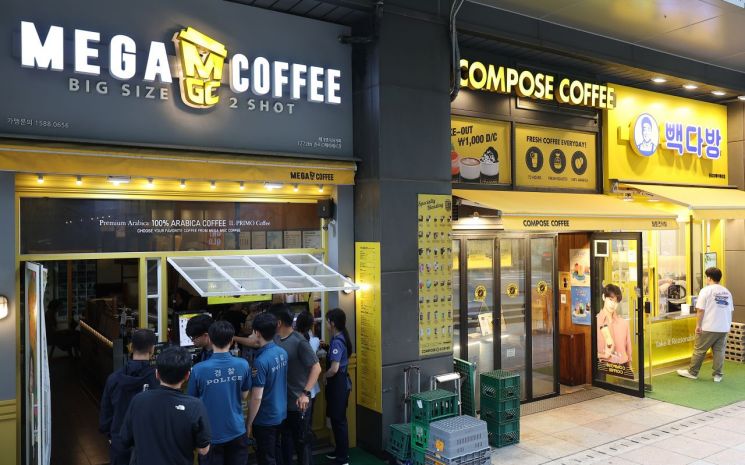
Looking at the average violation rate relative to the number of stores by brand over the past six years (2019 to the end of June 2024), Compose Coffee and The Venti led with 1.3%, Mega Coffee followed with 1.2%, Hasamdong Coffee with 1.1%, and Twosome Place and Hollys Coffee each with 1.0%. Starbucks (0.2%), Ediya Coffee, and Pascucci (0.3%) had relatively low rates, under 1%.
By number of violations, Mega Coffee (138 cases) and Compose Coffee (135 cases) exceeded 100 cases, followed by Twosome Place (84 cases), The Venti (69 cases), and Paik’s Coffee (62 cases). Brands strong in the low-priced coffee market such as Compose Coffee, Mega Coffee, The Venti, and Paik’s Coffee appeared prominently in both violation rates and total violations.
Analyzing the types of violations during the same period, out of a total of 634 violations, failure to complete hygiene education was the most frequent with 287 cases (45.3%). Other violations included breaches of standards and specifications with 151 cases (23.8%), failure to report business changes with 50 cases (7.9%), violations of hygienic handling standards with 49 cases (7.7%), and failure to conduct health examinations with 36 cases (5.7%).
Representative Park said, "Ice or cold beverages are mostly non-heated foods, and in summer, if contaminated by bacteria or viruses, they can cause enteritis or food poisoning. Since coffee is a popular preference food and a highly consumed product in summer, thorough hygiene management and supervision are necessary."
Meanwhile, the coffee market recently shows a polarization between low-priced and high-priced coffee. In particular, low-priced coffee brands are aggressively increasing their number of stores by leveraging affordable prices. Mega Coffee, a representative low-priced coffee brand, opened its 3,000th store in South Korea this year, and Compose Coffee will open its 2,500th store.
© The Asia Business Daily(www.asiae.co.kr). All rights reserved.
![Clutching a Stolen Dior Bag, Saying "I Hate Being Poor but Real"... The Grotesque Con of a "Human Knockoff" [Slate]](https://cwcontent.asiae.co.kr/asiaresize/183/2026021902243444107_1771435474.jpg)
















