Kim Geon-hee and Chae Sang-byeong Special Prosecutor Act Passed Multiple Times in the National Assembly
Choo Kyung-ho "Will Follow the Path of Being Discarded After Re-voting"
The so-called Dual Special Prosecutor Laws (Kim Geon-hee Special Prosecutor Law and Chae Sang-byeong Special Prosecutor Law) and the Local Currency Act (Partial Amendment to the Act on the Promotion of Use of Local Love Gift Certificates) were passed in the National Assembly plenary session led by the opposition parties. The opposition appeared to pressure the government and ruling party by passing bills that President Yoon Seok-yeol had repeatedly exercised his right of reconsideration (veto) on. The People Power Party protested by boycotting the plenary session, claiming that the bills were submitted without bipartisan agreement.
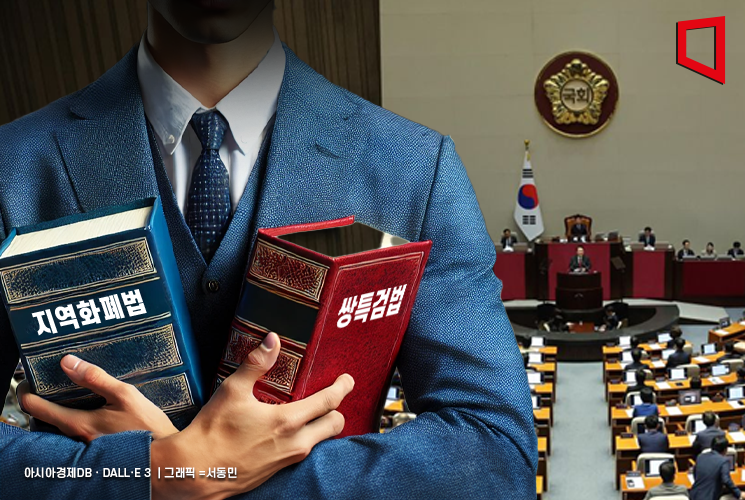
On the 19th, the National Assembly held a plenary session and passed the Kim Geon-hee Special Prosecutor Law, the Chae Sang-byeong Special Prosecutor Law, and the Local Currency Act. The Kim Geon-hee Special Prosecutor Law was approved with 167 votes in favor out of 167 members present, the Chae Sang-byeong Special Prosecutor Law with 170 votes in favor out of 170 members present, and the Local Currency Act with 166 votes in favor and 3 against out of 169 members present.
The Kim Geon-hee Special Prosecutor Law and the Chae Sang-byeong Special Prosecutor Law were brought to the National Assembly plenary session multiple times, undergoing votes and revotes. The Kim Geon-hee Special Prosecutor Law was passed in the plenary session led by the opposition in December last year but was returned to the Assembly after President Yoon exercised his veto. A revote was held in February this year, but it was rejected as it did not receive the approval of two-thirds of the members present. The Chae Sang-byeong Special Prosecutor Law is now on its third attempt. The first Chae Sang-byeong Special Prosecutor Law passed in the 21st National Assembly in May this year was also vetoed by President Yoon. After being rejected in the revote, the opposition reintroduced the Chae Sang-byeong Special Prosecutor Law as the first bill of the 22nd National Assembly. However, President Yoon exercised his veto again, and after a revote in July this year, it was rejected and finally discarded.
This time, the Kim Geon-hee Special Prosecutor Law added allegations of stock price manipulation of Deutsche Motors, suspicions of receiving luxury bags, lobbying to save former Marine Corps 1st Division Commander Lim Seong-geun, and allegations of Kim Geon-hee's interference in the 22nd general election candidate nomination to the existing special prosecutor law. The Chae Sang-byeong Special Prosecutor Law changed the method of forming the special prosecutor. Previously, the opposition recommended the special prosecutor, but this time, the Chief Justice of the Supreme Court recommends four special prosecutors, and the Democratic Party and non-negotiating parties each recommend one to the president, a so-called 'third-party recommendation method.' This is interpreted as the opposition accepting the third-party recommendation method mentioned by People Power Party leader Han Dong-hoon during the party convention process. However, the opposition also included a veto right in the Chae Sang-byeong Special Prosecutor Law, allowing them to request a re-nomination if the special prosecutor recommended by the Chief Justice is deemed inappropriate.
The Democratic Party held a plenary session on the 12th to pass the Dual Special Prosecutor Laws and the Local Currency Act to capture public sentiment ahead of Chuseok. However, Speaker Woo Won-shik postponed the handling of contentious bills until after the Chuseok holiday, stating that resolving the medical crisis should take priority. The Democratic Party protested that Speaker Woo arbitrarily blocked bills that had passed the National Assembly Legislation and Judiciary Committee. On the 11th, Jeong Cheong-rae, chairman of the Legislation and Judiciary Committee, criticized in a press conference, saying, "This is the first time I have seen a speaker not submit a bill that has been urgently completed through the agenda coordination committee while working in the National Assembly," calling it "very embarrassing and even shocking." However, the Democratic Party leadership accepted Speaker Woo's proposal, and the plenary session was held that day.
Dual Special Prosecutor Laws and Local Currency Act Face Turmoil from Standing Committees... President Yoon Seok-yeol Expected to Exercise Veto
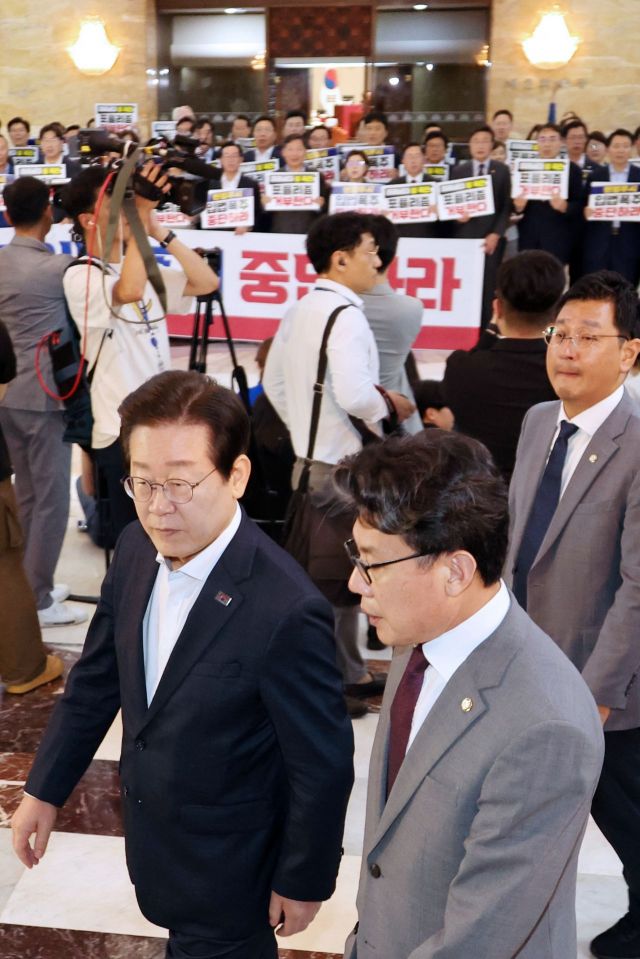 On the afternoon of the 19th, while the members of the People Power Party condemned the opposition party's attempt to forcibly pass the 'Special Investigation Act on First Lady Kim Keon-hee,' Lee Jae-myung, the leader of the Democratic Party of Korea, along with other members, are entering the National Assembly plenary session hall. [Image source=Yonhap News]
The People Power Party did not attend the plenary session and abstained from voting on the Dual Special Prosecutor Laws and the Local Currency Act. On that day, after a party meeting, People Power Party floor leader Choo Kyung-ho said at a rally, "The major opposition party is once again focusing solely on political strife as soon as the Chuseok holiday ends," adding, "Today's plenary session, held unilaterally ignoring the plenary session schedule agreed upon by both parties for the 26th, is nothing more than a Democratic Party party meeting."
Conflict between the ruling and opposition parties was anticipated from the standing committees.
On the 5th of this month, the opposition passed the Local Currency Act in the National Assembly's Public Administration and Security Committee and forwarded it to the Legislation and Judiciary Committee. The Local Currency Act mandates national financial support for local love gift certificates, and the Democratic Party considers it an essential bill for livelihood recovery, designating it as a party-promoted bill. On the other hand, the People Power Party criticized the opposition's unilateral handling of the bill, likening it to a 'cash handout law.' People Power Party lawmaker Cho Eun-hee said of the Local Currency Act, "It is the worst of the worst laws that mandate cash handouts," and added, "It should not be unilaterally processed just because it is called the Lee Jae-myung directive law."
The Dual Special Prosecutor Laws also faced turmoil in the Legislation and Judiciary Committee before being forwarded to the plenary session. On the 11th of this month, when the Dual Special Prosecutor Laws were submitted to the full meeting of the Legislation and Judiciary Committee, the People Power Party proposed forming an agenda coordination committee. However, without much consultation, the agenda coordination committee was completed, and the voting procedure began. People Power Party lawmakers protested the opposition's unilateral handling of the bills by leaving the Legislation and Judiciary Committee meeting room just before the vote.
President Yoon Seok-yeol is expected to exercise his veto on all three bills. President Yoon has maintained a policy of vetoing bills passed without bipartisan agreement. The People Power Party is also expected to soon recommend that President Yoon exercise his veto. Floor leader Choo said, "Ultimately, contentious bills unilaterally processed without bipartisan agreement will follow the precedent of the president exercising the right of reconsideration (veto) and being discarded after a revote."
© The Asia Business Daily(www.asiae.co.kr). All rights reserved.
![Clutching a Stolen Dior Bag, Saying "I Hate Being Poor but Real"... The Grotesque Con of a "Human Knockoff" [Slate]](https://cwcontent.asiae.co.kr/asiaresize/183/2026021902243444107_1771435474.jpg)
















