60% of All Pollution Reports Are Household Waste
Enforcement Difficult and Punishments Are Lenient
"Environmental Threat Requires Comprehensive System Reform"
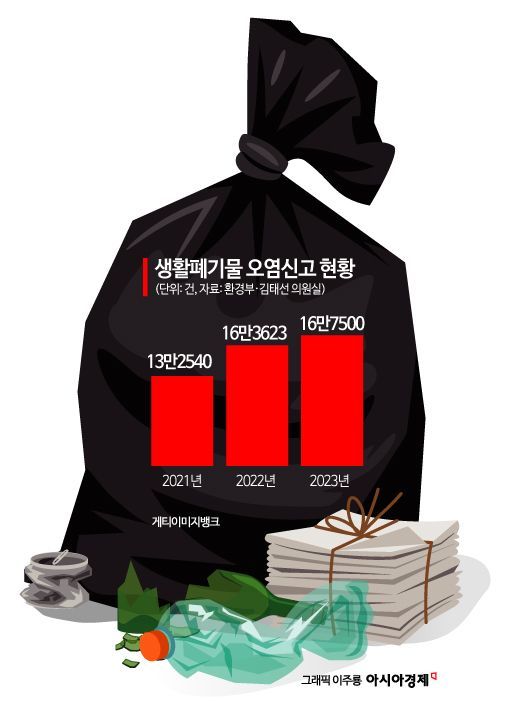
Reports of household waste pollution nearly reached 170,000 cases last year. This averages about 459 cases per day and has increased for three consecutive years. There are concerns that household waste pollution acts are not decreasing because enforcement is difficult and even when caught, penalties are lenient.
According to data submitted by the Ministry of Environment to the office of Kim Tae-seon, a member of the National Assembly's Environment and Labor Committee from the Democratic Party of Korea, reports related to household waste pollution totaled 167,500 cases last year. This accounts for 60.1% of the total 278,545 reports. It is more than 17 times higher than reports of industrial waste pollution from businesses (9,424 cases) and overwhelmingly higher than reports of air pollution (35,528 cases) or water pollution (8,454 cases).
Reports of household waste pollution have been steadily increasing. In 2021, there were 132,540 reports, which rose to 163,623 in 2022, and further increased to 167,500 last year. In the first quarter of this year alone, 30,578 reports were received. Considering that pollution reports typically surge during summer and winter vacation periods, it is highly likely that this year’s reports will match or exceed last year’s numbers.
The sharp increase in household waste pollution reports is due to a corresponding rise in the amount of waste generated. According to Statistics Korea, as of 2022, each citizen produced 446 kg of household waste annually. This is the highest amount in 20 years since 1994. Although it decreased to 352 kg in 1998, it has steadily increased since then, with annual waste generation exceeding 400 kg since 2019.
The Ministry of Environment explained that while it is difficult to pinpoint the exact reasons, frequent reporting appears to be a major cause. A ministry official stated, “Reports cover everything from improper use of the volume-based waste fee system to cigarette butt littering and illegal dumping of garbage,” adding, “These issues are easily noticeable in daily life and cause significant inconvenience to residents, which leads to a high number of reports.”
Another reason is the difficulty in enforcing regulations against household waste pollution. Local governments with many one-room or multi-family housing units or popular tourist destinations struggle with illegal dumping. Although surveillance cameras have been installed for enforcement, many cases go unpunished because the identity of offenders cannot be confirmed. It is practically impossible for the few personnel assigned to each local government to search through garbage for personal information or stake out habitual dumping sites.
Even when offenders are caught, most only pay light fines. According to the Waste Management Act, illegal dumping of household waste results in fines ranging from 50,000 to 1,000,000 KRW. Even if multiple violations are found in a single dumping incident, only one fine is imposed, and repeated reports of dozens of incidents do not lead to aggravated penalties. Because enforcement is difficult and penalties are lenient, reports of household waste pollution continue unabated.
Assemblyman Kim emphasized, “The increase in household waste and illegal dumping not only deteriorates living environments through odors but also disrupts resource recycling systems and fundamentally threatens the environment through greenhouse gas emissions and water pollution,” adding, “Comprehensive institutional reforms are necessary.”
© The Asia Business Daily(www.asiae.co.kr). All rights reserved.
![Clutching a Stolen Dior Bag, Saying "I Hate Being Poor but Real"... The Grotesque Con of a "Human Knockoff" [Slate]](https://cwcontent.asiae.co.kr/asiaresize/183/2026021902243444107_1771435474.jpg)
















