Non-Capital Regions Show Higher Rates: Chungnam 12.9%, Gyeongbuk 7.8%, Jeonbuk 7.7%
Bok Giwang: "Expand Rental Housing Size and Increase Government Support to Meet Demand"
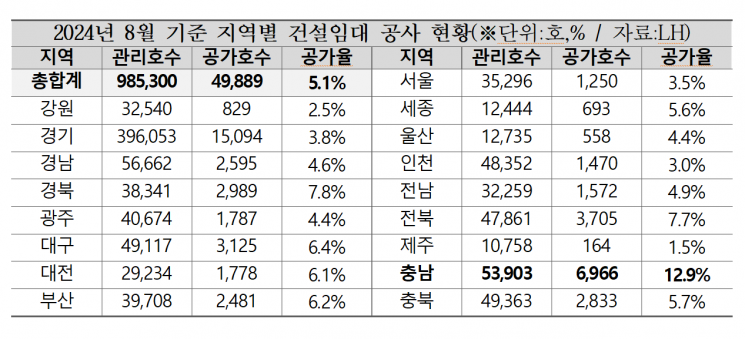 Construction Rental Work Status by Region as of August 2024 (※Unit: Units, % / Source: LH). Provided by Office of Assemblyman Bok Giwang.
The vacancy rate of public rental housing managed by Korea Land and Housing Corporation (LH) is the highest in the Chungnam region.
According to data titled "Number of Vacant LH Rental Housing Units and Vacancy Rate Status" submitted by Park Kiwang (Asan-gap), a member of the National Assembly from the Democratic Party of Korea, to LH, as of August this year, there were 985,300 LH-built rental housing units. Of these, 49,889 units were vacant, resulting in a vacancy rate of 5.1%.
By region, the vacancy rates for rental housing were as follows: Chungnam 12.9%, Gyeongbuk 7.8%, Jeonbuk 7.7%, Daegu 6.4%, Busan 6.2%, Daejeon 6.1%, Chungbuk 5.7%, and Sejong 5.6%. In contrast, the rates in the Seoul metropolitan area were lower: Seoul 3.5%, Gyeonggi 3.8%, and Incheon 3%, indicating that vacancy rates are higher in non-metropolitan areas.
The high vacancy rates in non-metropolitan areas are attributed to the fact that most rental housing units supplied are small, with a floor area of less than 33 square meters (approximately 10 pyeong).
In fact, of the 49,889 vacant LH-built rental housing units, 24,994 units (50.1%) have an exclusive area of less than 31 square meters (9.4 pyeong). In other words, half of the vacant LH rental housing units are small-sized homes of 10 pyeong or less.
The vacancy status by floor area is as follows: 31~41 square meters, 9,927 units (19.9%); 41~51 square meters, 8,803 units (17.6%); and more than 51 square meters, 6,165 units (12.4%). The smaller the unit, the higher the vacancy rate, and the larger the unit, the lower the vacancy rate.
In particular, for small units with an exclusive area of 31 square meters or less, which are suitable mainly for single-person households, the vacancy rate is lower in the metropolitan area where the proportion of single-person households is higher, and higher in non-metropolitan areas where the proportion of single-person households is lower.
LH is implementing measures to address the issue of vacant rental housing, such as relaxing tenant qualifications and rental conditions, designating and managing key management complexes, and improving residential environments.
However, given that the main cause of vacancies is the prevalence of small-sized units, there is a growing need for the government to increase financial support for rental housing and significantly reduce the construction of units smaller than 31 square meters.
Park Kiwang stated, "It is difficult for even two newlyweds to live in a 10-pyeong house," adding, "In the Asan region, there are frequent cases where newlyweds are selected for Happy Housing but give up moving in because the units are too small."
He further emphasized, "The biggest issue is that the actual floor area of public and rental housing is too small. For rental housing to be loved by the public, the unit size must be increased to meet the needs of actual users, and for this, the government support unit price and fund investment ratio must be expanded beyond current levels."
© The Asia Business Daily(www.asiae.co.kr). All rights reserved.
![Clutching a Stolen Dior Bag, Saying "I Hate Being Poor but Real"... The Grotesque Con of a "Human Knockoff" [Slate]](https://cwcontent.asiae.co.kr/asiaresize/183/2026021902243444107_1771435474.jpg)
















