The U.S. Federal Reserve (Fed) has abruptly initiated a monetary policy easing cycle by implementing a 'big cut' of 0.5 percentage points in the benchmark interest rate at once. It projected a year-end interest rate of 4.4% and also signaled an additional 0.5 percentage point cut within the year. Fed Chair Jerome Powell, who assessed the U.S. economy as resilient, drew a clear line to prevent this big cut decision from being interpreted as a signal of an imminent recession, while repeatedly emphasizing that further rate cuts will be made gradually. Wall Street is flooded with evaluations such as "hawkish big cut" and "one-time preemptive measure."
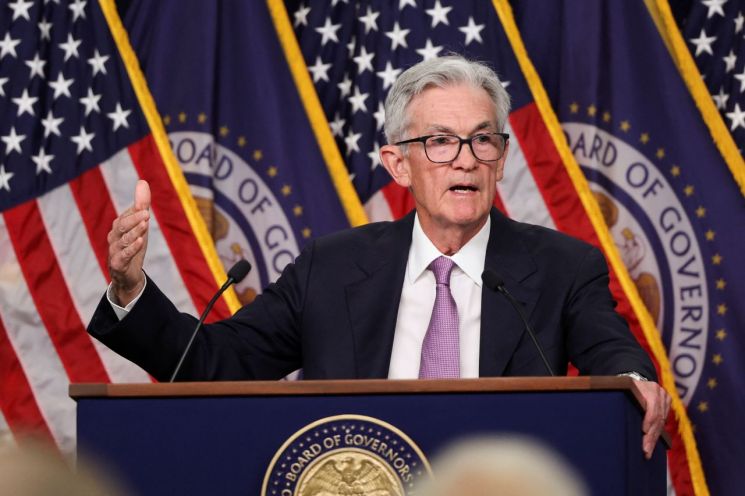
Fed Cuts Rate by 0.5%P... 11 out of 12 Members Support 'Big Cut'
On the 18th (local time), the Fed announced through the two-day September Federal Open Market Committee (FOMC) regular meeting that it decided to lower the benchmark interest rate by 0.5 percentage points from the previous 5.25?5.50% to 4.75?5.0%. This marks the end of the monetary tightening policy that began with rate hikes in March 2022 to combat inflation. The Fed's rate cut is the first in about four and a half years since the emergency rate cuts in March 2020 in response to the pandemic (global outbreak). As a result, the interest rate gap between the U.S. and South Korea (3.50% annually) has narrowed to a maximum of 1.50 percentage points.
In the monetary policy statement, the Fed judged that "the FOMC has gained greater confidence that inflation is consistently moving toward 2%" and that "risks to the employment and inflation goals are broadly balanced." It also added, "We are striving to pay attention to risks on both sides of our dual mandate (price stability and maximum employment)" and "We will carefully evaluate upcoming data, evolving forecasts, and the balance of risks." In this FOMC, 11 members voted for the big cut, except for Director Michelle Bowman, who favored a 0.25 percentage point cut.
Chair Powell emphasized at the subsequent press conference that "this decision reflects our increased confidence that the labor market can remain strong while inflation falls to 2% amid moderate economic growth." He cited economic indicators released after the July FOMC as the reason for the sudden big cut instead of the usual 0.25 percentage point cut. He explained, "We gathered all the data and deliberated on what to do," concluding that "this (big cut) decision is the right thing for the people we serve and the U.S. economy." This is a preemptive response considering that inflation, which was the background for maintaining high rates, has significantly eased and the labor market is cooling rapidly, including rising unemployment.
Through the dot plot released that day, the Fed lowered the median year-end rate forecast from 5.1% to 4.4%. This suggests that a total of 0.5 percentage points of additional rate cuts could be implemented at the remaining November and December FOMC meetings this year. The rate forecasts for next year and the year after were also revised downward. The year-end rate forecast for next year was lowered from 4.1% to 3.4%, and the 2026 year-end forecast was lowered from 3.1% to 2.9%. Additionally, through the updated economic projections (SEP), the Fed lowered the personal consumption expenditures (PCE) price index inflation forecast for this year from 2.6% in June to 2.3%, while presenting a real gross domestic product (GDP) growth forecast of 2.0% for this year. The year-end unemployment rate forecast was raised to 4.4%.
Recession Concerns Dismissed... Dot Plot Suggests 0.5%P Cut Within the Year
A significant portion of Chair Powell's press conference that day was devoted to ensuring that the big cut decision does not spread recession fears among market participants. He emphasized, "The U.S. economy is in good shape. It is maintaining solid growth while inflation is falling, and maintaining this state is what we are doing." He added, "The aggressive rate cut is not because there is a problem with the economy," and dismissed recession concerns by saying, "At this point, there is no evidence suggesting an increased likelihood of recession or economic slowdown." Diagnosing the labor market as still resilient, he also evaluated the recent rise in unemployment to 4.2% as historically healthy.
Chair Powell described the big cut decision as "timely" and said, "You can interpret it as an expression of our determination not to let monetary policy lag behind the economic flow." Regarding criticism that the Fed should have cut rates at the July FOMC, he responded, "I don't think we missed the opportunity," but added, "If we had received employment data earlier, we might have cut rates in July." When asked about the possibility of returning to zero interest rates in the future, he said, "I don't think we will return to that state," evaluating that "the neutral rate has risen significantly." He also emphasized that the rate cut decision, made about 50 days before the U.S. presidential election, was "not influenced by political motives."
However, Chair Powell did not clearly state how much further monetary policy would be adjusted at the next November FOMC meeting. He said, "We are not on a predetermined path. We will decide at each meeting," and "Policy recalibration will be carried out over time." He explained that depending on economic conditions, it could proceed faster or slower if necessary. He also emphasized, "The 0.5 percentage point cut should not be seen as a new pace of rate cuts."
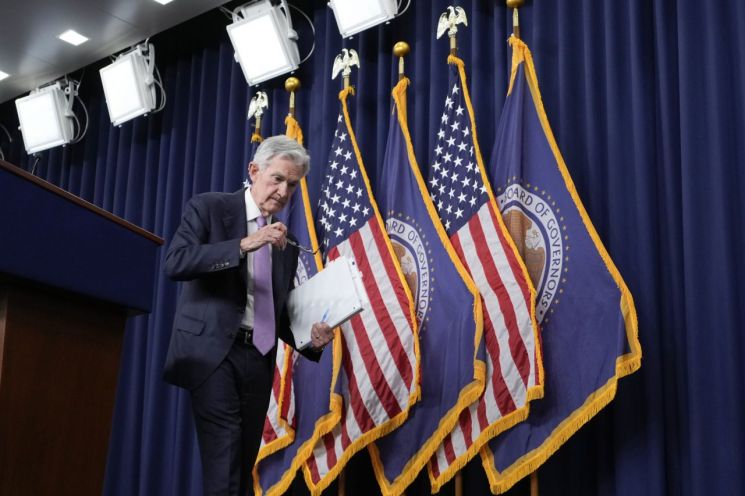
Evaluated as "Hawkish Big Cut, Preemptive Measure"... Unemployment Rate Forecast Also Noted
On Wall Street, there is an assessment that the Fed chose the latter between a 'dovish 0.25 percentage point cut' and a 'hawkish 0.5 percentage point cut.' Although the 0.5 percentage point cut itself is dovish, considering Chair Powell's remarks and the dot plot, it is difficult to view it as dovish.
Bank of America (BoA) pointed out, "They chose a hawkish 0.5 percentage point cut rather than a dovish 0.25 percentage point cut." Deutsche Bank said, "Chair Powell made every effort during the press conference not to send negative signals about the economy," and predicted, "The big cut may be a one-time event." Bloomberg Economics also evaluated, "The updated dot plot suggests a gradual rate cut path," meaning "the Fed views this big cut as a sufficient preemptive measure to stabilize the labor market." Chair Powell's emphasis during the press conference that no one should call the big cut a new pace of rate cuts is also interpreted as a hawkish message.
However, attention should also be paid to the fact that the Fed raised the year-end unemployment rate forecast to 4.4% through the SEP update that day. This suggests that the labor market could deteriorate further. Citi maintained its previous forecast that "the labor market will worsen further," and that at least one more big cut could follow.
Currently, questions continue to arise inside and outside the market about the Fed's sudden big cut. Nomura Capital conveyed the atmosphere, saying, "The market views the 0.5 percentage point cut as an aggressive move. There is curiosity about what the Fed has seen that the market has not, prompting such an aggressive cut." Immediately after the big cut decision announcement that day, the three major indices of the New York Stock Exchange, which had been rising, gave back their gains and eventually closed lower due to sharply heightened recession concerns, uncertainty over the pace of future cuts, and profit-taking selling pressure.
© The Asia Business Daily(www.asiae.co.kr). All rights reserved.


















