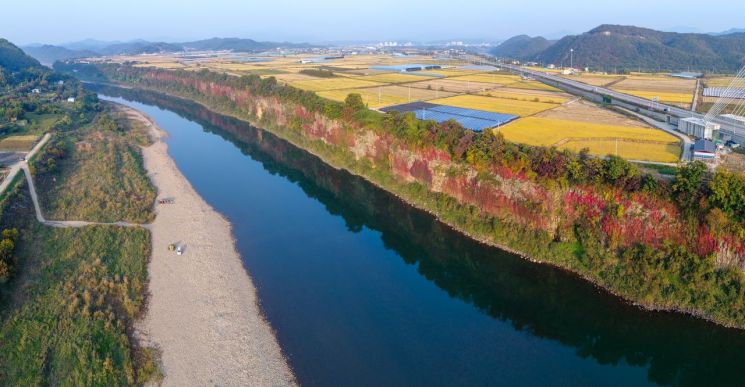
Hantangang Geopark has successfully been re-certified as a UNESCO Global Geopark.
Gyeonggi Province announced on the 19th that at the APGN (Asia-Pacific Geopark Network) symposium held in Cao Bang, Vietnam from September 8 to 15, 'Hantangang Geopark' received its re-certification as a 'UNESCO Global Geopark,' maintaining its official status until 2027.
Global Geoparks must undergo re-certification every four years through evaluation. This evaluation was the first re-certification assessment since Hantangang Geopark was initially certified as a Global Geopark in 2020.
Gyeonggi Province explained that it succeeded in re-certification by faithfully implementing the recommendations presented by UNESCO at the time of the initial certification in 2020, in cooperation with Pocheon City, Yeoncheon County, Gangwon Province, and Cheorwon County.
The five local governments, including Gyeonggi Province, jointly operate the Hantangang Global Geopark by allocating annual contributions for its operation and management. To comply with the recommendations, Gyeonggi Province conducted academic research to establish the international value of the geological sites within the Hantangang Global Geopark. As a result, seven papers on the geological sites such as the Eundaeri columnar joints and fold structures, and the Auraji pillow lava were published in prestigious journals including Remote Sensing and Minerals.
Along with the re-certification, UNESCO also presented new recommendations for the Hantangang Global Geopark, including strengthening cooperation among global geoparks, building facilities and infrastructure, enhancing visibility, reinforcing information, education and research, linking cultural heritage, and raising awareness through education.
Cha Seong-su, Director of the Climate Environment and Energy Bureau of Gyeonggi Province, stated, "This re-certification proves the 500,000-year geological and historical value of Hantangang Geopark," and added, "The five local governments will continue joint efforts, including regular working-level meetings, to succeed in re-certification again in four years."
UNESCO Global Geoparks are places managed with the concept of protecting geological sites and landscapes of global geological value, education, and sustainable development. Currently, South Korea has five designated sites: Hantangang, Jeju Island, Cheongsong, Mudeungsan area, and Jeonbuk West Coast area.
Meanwhile, Hantangang Geopark covers an area of 1,165.61 km², including 493.24 km² in the Pocheon City watershed, 273.65 km² in Yeoncheon County watershed, and 398.72 km² in Cheorwon County watershed, which is 400 times the size of Yeouido (2.9 km²).
Hantangang boasts a pristine ecosystem around the DMZ area and volcanic landforms that are rare to see inland, such as columnar joints and pillow lava formed by lava flows from Mount Ori in North Korea between 500,000 and 100,000 years ago. It has very high geological value and offers spectacular views that are rare worldwide. It contains 26 geological sites including Pocheon Art Valley, Bidulginang Waterfall, Jeongok-ri archaeological site in Jeongok-eup, Yeoncheon, and the Imjin River columnar joints.
© The Asia Business Daily(www.asiae.co.kr). All rights reserved.
![Clutching a Stolen Dior Bag, Saying "I Hate Being Poor but Real"... The Grotesque Con of a "Human Knockoff" [Slate]](https://cwcontent.asiae.co.kr/asiaresize/183/2026021902243444107_1771435474.jpg)
















