Powell FOMC Press Conference
"The U.S. economy is in a good situation."
Jerome Powell, Chair of the U.S. Federal Reserve (Fed), which has initiated a monetary policy pivot, focused much of his press conference on the afternoon of the 18th (local time) on ensuring that the recent big cut (a 0.5 percentage point reduction in the benchmark interest rate) decision does not inadvertently increase recession concerns.
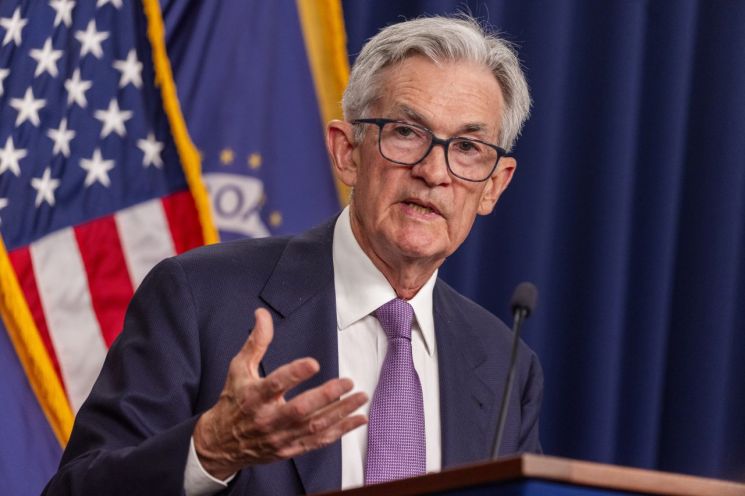
At the press conference held immediately after the September Federal Open Market Committee (FOMC) regular meeting, Chair Powell stated, "We know it is time to recalibrate policy more appropriately," adding, "This is the beginning of that process." The Fed lowered the federal funds rate by 0.5 percentage points from the previous 5.25?5.5% range to 4.75?5.0% at this FOMC. This effectively marks the end of the monetary tightening policy that began with rate hikes in March 2022 to combat inflation.
From the start of the press conference, Powell expressed confidence that inflation is approaching the 2% target. He explained the background of the policy shift by saying, "We have gained greater confidence that inflation is steadily moving toward 2%," and "Risks to employment and inflation targets are generally balanced." This stance was also confirmed in the monetary policy statement released prior to the conference.
As reasons for the bold big cut instead of the usual 0.25 percentage point reduction, Powell cited recently released data such as the July and August employment reports and inflation indicators. He said, "We gathered all the data released since the July meeting and considered what needed to be done," and concluded, "This (big cut) decision is the right thing for the people we serve and the U.S. economy." This proactive response reflects that inflation, which justified maintaining high interest rates, has significantly eased, and the labor market is cooling rapidly with rising unemployment. The August Consumer Price Index (CPI) increase was 2.5%, the lowest in three and a half years. The August nonfarm payroll increase also fell far short of market expectations.
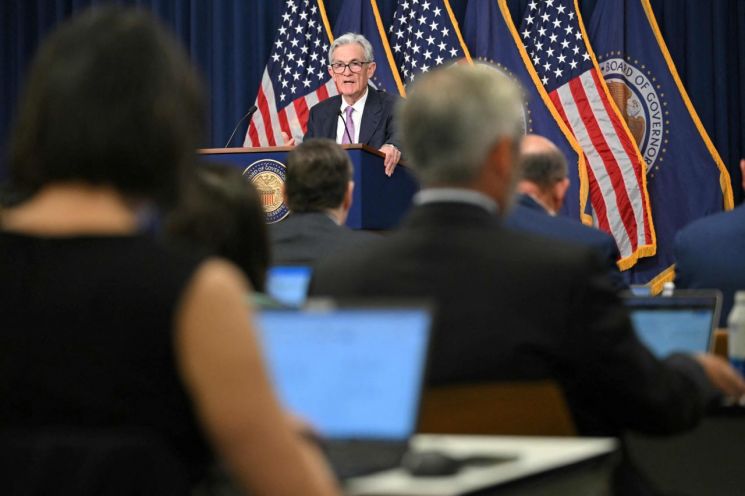
However, Powell made numerous remarks to draw a line so that the big cut would not be interpreted by market participants as a signal of an imminent recession. He said, "As I mentioned at Jackson Hole, the labor market has clearly cooled," but repeated, "The labor market is in good shape." Regarding the recent rise in unemployment to 4.2%, he assessed it as historically healthy. When asked about the economic projections (SEP) released that day, which raised the year-end unemployment forecast by 0.4 percentage points to 4.4%, he responded, "The labor market is actually strong. Today's policy decision is to maintain that condition."
Powell emphasized, "The same can be said for the entire U.S. economy. The U.S. economy is in good shape. It is maintaining growth at a solid pace while inflation is decreasing, and maintaining this condition is what we are doing." He drew a line against recession concerns raised by some, stating, "At this point, there is no evidence suggesting a higher likelihood of recession."
Furthermore, regarding criticism that the Fed should have cut rates at the July FOMC, he said, "I do not think we missed the opportunity," but added, "If we had received employment data earlier, we might have cut rates in July." When asked if the big cut decision was to catch up with delayed action, he replied, "I think it is timely," and said, "You can interpret it as an expression of our determination not to let monetary policy lag behind economic trends." It was confirmed that 11 of the 12 members voted for the big cut at this FOMC, except for Board member Michelle Bowman, who favored a 0.25 percentage point cut.
However, Powell did not clearly specify how much further monetary policy would be adjusted at the next meeting, the November FOMC. He said, "We are not on a predetermined path. We will decide at each meeting," and "Policy recalibration will proceed over time. Even the SEP does not indicate that the committee is in a hurry." He explained that adjustments could proceed faster or slower depending on actual economic conditions. He emphasized, "The 0.5 percentage point cut should not be seen as a new pace for rate cuts."
The Fed lowered the median year-end rate forecast from 5.1% to 4.4% in the dot plot released that day. This suggests that a total of 0.5 percentage points of rate cuts could be implemented in the remaining November and December FOMC meetings this year. The rate forecasts for next year and the year after were also revised downward. The year-end rate forecast for next year was lowered from 4.1% to 3.4%, and the 2026 year-end forecast was lowered from 3.1% to 2.9%.
Additionally, through the SEP update, the Fed projected this year's real Gross Domestic Product (GDP) growth rate at 2.0%, 0.1 percentage points lower than the 2.1% announced in June. The year-end unemployment rate was projected at 4.4%. The Fed's inflation indicator, the Personal Consumption Expenditures (PCE) price index forecast, was lowered from 2.6% in June to 2.3%.
Powell also stated that a return to the past era of ultra-low interest rates is unlikely. He said, "We will not return to the era when trillions of dollars of government bonds were issued at negative interest rates." Regarding the rate cut decision made just about 50 days before the U.S. presidential election, he emphasized, "There was no political motive involved." Former President Donald Trump, the Republican presidential candidate, had previously stated that the Fed should not cut rates before the election.
Meanwhile, immediately after the big cut decision, the New York stock market, which had been rising, closed lower across the board in a narrow range. This is analyzed as a result of recession concerns that surfaced immediately afterward, uncertainty over the pace of future rate cuts, and profit-taking selling. The Dow Jones Industrial Average, composed of blue-chip stocks, closed at 41,503.10, down 103.08 points (-0.25%) from the previous session. The large-cap S&P 500 index fell 16.32 points (-0.29%) to 5,618.26, and the tech-heavy Nasdaq index closed at 17,573.30, down 54.76 points (-0.31%).
© The Asia Business Daily(www.asiae.co.kr). All rights reserved.
![Clutching a Stolen Dior Bag, Saying "I Hate Being Poor but Real"... The Grotesque Con of a "Human Knockoff" [Slate]](https://cwcontent.asiae.co.kr/asiaresize/183/2026021902243444107_1771435474.jpg)












