From January to August this year, one out of every four domestic airline passenger planes experienced delays.
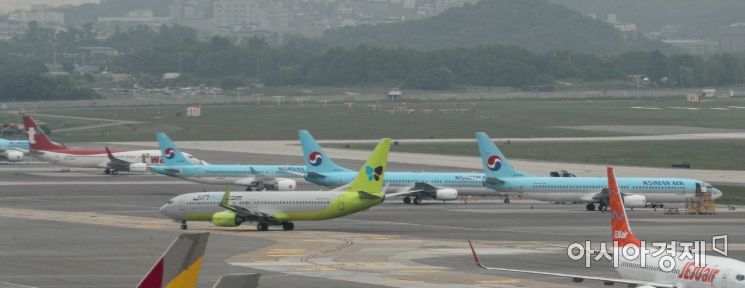
According to data submitted by Incheon International Airport Corporation and Korea Airports Corporation to Lee Yeon-hee, a member of the National Assembly's Land, Infrastructure and Transport Committee from the Democratic Party of Korea, the average delay rate for domestic airlines' domestic and international flights reached 24.8% up to last month this year.
The annual flight delay rate did not exceed 10% until 2022 but began to surpass 20% starting last year. This is due to the Ministry of Land, Infrastructure and Transport strengthening the criteria for what is considered a "delay." Since last year, both domestic and international flights are counted as delayed if they depart or arrive at the gate more than 15 minutes later than the scheduled operation time. Previously, delays were based on runway takeoff and landing times, with domestic flights considered delayed if exceeding 30 minutes and international flights if exceeding 60 minutes.
By airline, for domestic flights, Air Seoul and T'way Air recorded the highest delay rates at 34% each, making delays most frequent. They were followed by Jeju Air (28.4%), Jin Air (26.9%), Eastar Jet (22.6%), Korean Air (17.4%), Asiana Airlines (16.2%), Air Busan (10.3%), and Air Premia (9.3%).
For international flights, Eastar Jet had the highest delay rate at 37.4%. It was followed by Jin Air (34.8%), Air Premia (32.2%), T'way Air (32%), Air Seoul (31.2%), Jeju Air (28.7%), Asiana Airlines (26.7%), Korean Air (26%), Air Premia (21.2%), and Air Busan (15.8%).
© The Asia Business Daily(www.asiae.co.kr). All rights reserved.
![Clutching a Stolen Dior Bag, Saying "I Hate Being Poor but Real"... The Grotesque Con of a "Human Knockoff" [Slate]](https://cwcontent.asiae.co.kr/asiaresize/183/2026021902243444107_1771435474.jpg)















