Commander of Central and Southern Theater Command Talks with US Indo-Pacific Commander
Visits Hawaii and Attends US Defense Meeting
US-China Also Participate in Joint Military Exercises in Brazil
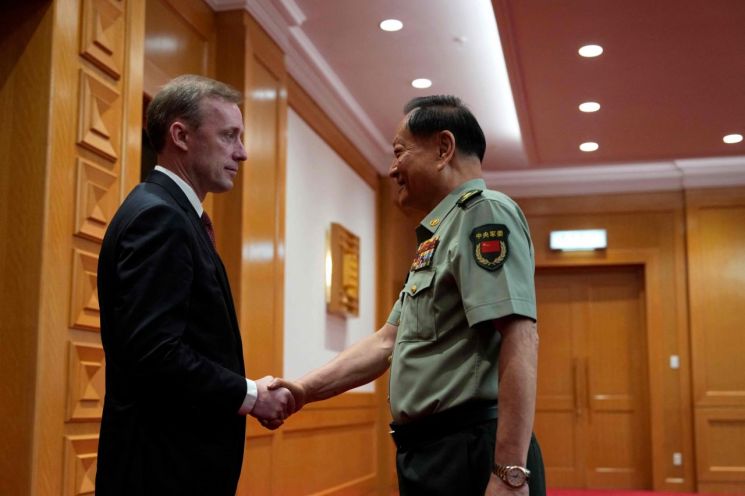 Jake Sullivan, U.S. National Security Advisor at the White House, is shaking hands with Zhang Youxia, Vice Chairman of the Central Military Commission of China, in Beijing, China, on the 29th of last month.
 [Photo by Yonhap News]
Although the United States and China continue to compete, they have recently been strengthening high-level military exchanges. Following discussions between the two countries on the South China Sea issue on the 10th, China will also attend a defense meeting hosted by the United States. Voice of America (VOA) reported on the 13th that Samuel Paparo, Commander of the U.S. Indo-Pacific Command, and Wu Yanan, Commander of the Chinese Southern Theater Command, discussed shared concerns including the South China Sea during a video call on the 10th.
The Chinese Ministry of National Defense stated that the two commanders "exchanged in-depth views on common interests." On that day, the U.S. side conveyed that Commander Paparo urged that "the Chinese military reconsider tactics that could potentially escalate tensions in and beyond the South China Sea." Following the recent video call, Commander Wu will also attend the defense meeting hosted by Commander Paparo next week. The meeting will be held in Hawaii.
The United States and China are continuing military communication through the annual multilateral security meeting, the Xiangshan Forum, which has been underway in Beijing since the 12th. Since last year, the U.S. has dispatched Michael Chase, Deputy Assistant Secretary of Defense for China, Taiwan, and Mongolia, to this meeting. The U.S. Department of Defense stated that this conference was "arranged to emphasize the shared vision of the United States for the region."
Additionally, according to the Hong Kong South China Morning Post (SCMP), the two countries are jointly participating in the 'Formosa' exercises held in Brazil. This joint military exercise, led by the Brazilian Navy, began in 1988. This year marks the first time both countries have simultaneously dispatched naval forces to this exercise. Last year, the U.S. sent forces, but China did not.
The expansion of military exchanges between the two countries has taken place since Jake Sullivan, U.S. National Security Advisor, visited China at the end of last month and met with Zhang Youxia, Vice Chairman of the Central Military Commission and the second-in-command of the Chinese military. Joint exercises between the U.S. and China are the first since the U.S. invited China to RIMPAC (Rim of the Pacific Exercise) in 2016.
While the U.S. and China continue military exchanges, tensions remain high. This is due to various issues such as repeated clashes between Chinese and Philippine vessels near disputed reefs in the South China Sea, and increased Chinese military activities in waters and airspace near Taiwan and Japan.
Experts say that the resumption of high-level communication between the two countries may reduce the possibility of accidental clashes in the South China Sea, but they assess that it is difficult to achieve complete tension relief. Yoon Sun, Director of the China Program at the Stimson Center in Washington, said, "Military tensions reflect the political differences between the two countries surrounding Taiwan and the South China Sea," adding, "If the differences between the two countries are not resolved, the possibility of permanently easing military tensions is very low."
© The Asia Business Daily(www.asiae.co.kr). All rights reserved.
![Clutching a Stolen Dior Bag, Saying "I Hate Being Poor but Real"... The Grotesque Con of a "Human Knockoff" [Slate]](https://cwcontent.asiae.co.kr/asiaresize/183/2026021902243444107_1771435474.jpg)
















