First Meeting with Heads of Research Institutes Since Minister Yu's Inauguration
Minister Yu Sang-im of the Ministry of Science and ICT held the first meeting with heads of government-funded research institutes at Seoul Central Post Office on the 13th since taking office, discussing the dismantling of barriers between research institutes, leading national research through communication, and fostering world-class research institutions.
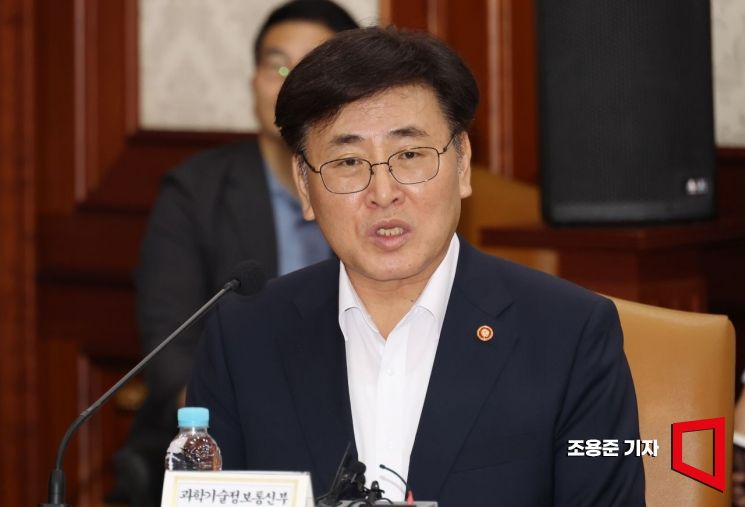 Yoo Sang-im, the newly appointed Minister of Science and ICT, is delivering a greeting at the Economic Ministers' Meeting held on the 28th at the Government Seoul Office in Jongno-gu, Seoul. Photo by Jo Yong-jun jun21@
Emphasizing change within government-funded research institutes, Minister Yu plans to meet with institute heads twice. At the first meeting, 14 institutes including KIST, Korea Basic Science Institute, Korea Research Institute of Bioscience and Biotechnology, Korea Institute of Science and Technology Information, ETRI, Korea Research Institute of Standards and Science, Korea Food Research Institute, Korea Institute of Machinery and Materials, Korea Institute of Energy Research, Korea Electrotechnology Research Institute, Korea Research Institute of Chemical Technology, Korea Atomic Energy Research Institute, Korea Institute of Materials Science, and National Fusion Research Institute attended, introducing strategies for securing key technologies and suggesting policies currently being pursued.
The 14 participating institutes introduced their development directions, including key technologies focused on AI, semiconductors, advanced bio, quantum, and hydrogen, considering international circumstances and the capabilities of domestic innovation entities, as well as cooperation systems to secure these technologies.
Oh Sang-rok, President of KIST, introduced the plan to establish mission-oriented research centers to secure national strategic technologies in five areas: ▲ next-generation semiconductors, ▲ clean hydrogen fusion, ▲ AI and robotics, ▲ climate and environment, and ▲ natural products and new drugs. He aims to solidify KIST’s role as a hub for consolidating scientific and technological capabilities that contribute to improving citizens’ quality of life, thereby leading an innovative R&D ecosystem beyond differentiation from universities or companies.
The National Research Council of Science & Technology released a statement titled "Expectations for the New Minister," reflecting the hopes and suggestions of government-funded research institute members toward the new minister, which served as a basis for discussion.
According to the Ministry of Science and ICT, the event started at 9:30 a.m., with participants listening to presentations over boxed lunches and continued intensively until 2 p.m.
Minister Yu said, “This was a time to communicate about the development directions each institute is pursuing independently and to deepen mutual understanding,” adding, “Currently, government-funded research institutes are undergoing changes from being designated as public institutions to a system befitting their status as national research and development agencies. It requires proactive leadership from institute heads to actively communicate and build trust with both external and internal members, including the government, and to cooperate.”
Minister Yu continued, “I feel honored to be in a responsible position at a time when government-funded research institutes are poised to reemerge as key players in our R&D ecosystem,” and stated, “The Ministry of Science and ICT will take responsibility for various issues surrounding these institutes, actively communicate, and do its best to provide necessary financial and policy support.”
Meanwhile, the second meeting is scheduled to be held on the 30th, with participation from 11 institutes including the Korea Institute of Green Technology, KISTI, Korea Institute of Oriental Medicine, National Institute of Biological Resources, Korea Institute of Civil Engineering and Building Technology, Korea Railroad Research Institute, Kimchi Research Institute, Korea Institute of Geoscience and Mineral Resources, Korea Institute of Toxicology, Korea Astronomy and Space Science Institute, and Korea Aerospace Research Institute.
© The Asia Business Daily(www.asiae.co.kr). All rights reserved.
![Clutching a Stolen Dior Bag, Saying "I Hate Being Poor but Real"... The Grotesque Con of a "Human Knockoff" [Slate]](https://cwcontent.asiae.co.kr/asiaresize/183/2026021902243444107_1771435474.jpg)















