Hyundai Motor Teams Up with GM After Toyota
Toyota Forms Alliance with BMW
Gathering for Practical Gains Ahead of Future Car Transition
Reducing Costs and Risks, Increasing Scale to Boost Negotiation Power
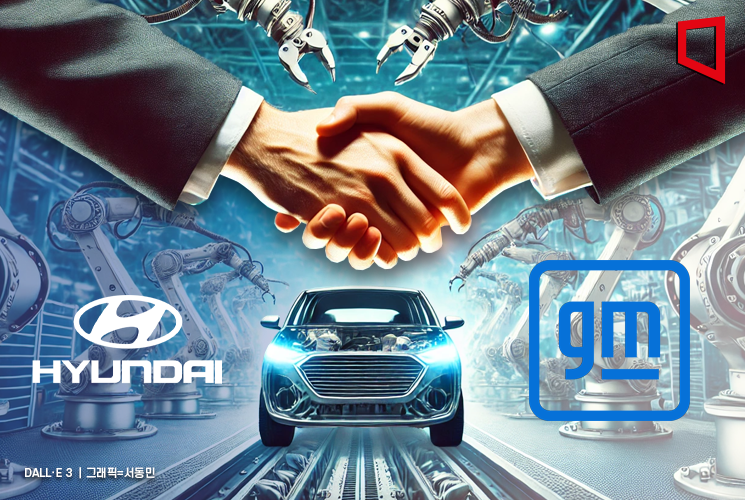
Hyundai Motor Group has joined hands with the American General Motors (GM) following Japan's Toyota Motor Group. The trend in the automotive industry is increasingly characterized by frequent 'alliances and mergers' where companies collaborate regardless of competitors if it benefits them.
According to industry sources on the 13th, Hyundai Motor Group signed a memorandum of understanding (MOU) in New York yesterday for comprehensive cooperation with GM to jointly develop and produce not only passenger cars but also commercial vehicles. Following the recent announcement of a 'hydrogen alliance' with Japan's Toyota Motor Group, Hyundai is actively partnering with overseas automakers. In a situation where the focus is shifting from internal combustion engines to electric vehicles, alliances and mergers have become essential for survival and profit, regardless of whether the partners are competitors or startups.
Toyota recently formed a fuel cell vehicle (FCV) alliance with Germany's BMW. Toyota supplies key components such as hydrogen tanks and fuel cells for vehicles produced by BMW, while BMW handles driving-related technologies and parts. The strategy is to minimize development costs by each party focusing on their areas of expertise.
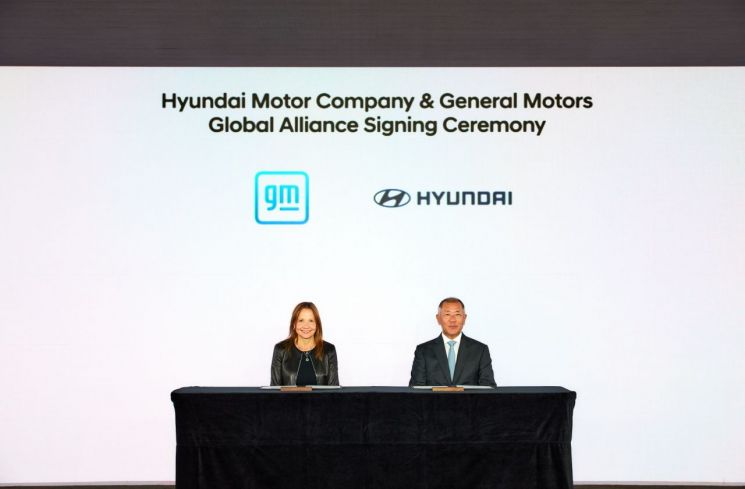 Hyundai Motor Group Chairman Chung Euisun (right) is taking a commemorative photo with GM Chairwoman Mary Barra after signing a comprehensive cooperation memorandum of understanding (MOU) at the Genesis House in New York, USA, on the 12th (local time). (Photo by Hyundai Motor)
In June, Germany's Volkswagen decided to invest $5 billion (approximately 6.69 trillion KRW) in the American electric vehicle company Rivian. Once considered the 'second Tesla,' Rivian was struggling with sales of its main electric pickup trucks and facing cash shortages, making Volkswagen's investment a much-needed boost. Utilizing Volkswagen's production infrastructure also offers the advantage of improving production cost efficiency. Volkswagen needed Rivian as well. Although it is the world's second-largest automaker by sales volume, Volkswagen has been somewhat slow in transitioning to future vehicle sectors such as electric vehicles (EVs) and software-defined vehicles (SDVs). In this context, Volkswagen saw an opportunity to adopt Rivian's software technology.
Japan's three major automakers have also joined forces. Recently, Toyota, Honda, and Nissan have been discussing collaboration on software development. Furthermore, other automakers such as Suzuki, Mazda, Subaru, and Mitsubishi are expanding the scope of cooperation, interpreted as a move to secure national competitiveness in automotive software.
There are even cases where companies have merged completely. The Stellantis Group, ranked fifth globally in vehicle sales from January to August this year, is a prime example. It was formed in January 2021 by merging Fiat Chrysler Automobiles (FCA) and Peugeot Citro?n (PSA) Group in a 50-50 ratio. Currently, Stellantis includes 18 automotive brands from countries such as the United States, Italy, and France. China's Geely Automobile also absorbed Sweden's Volvo and Britain's Lotus, simultaneously acquiring the recognition and technological capabilities it previously lacked.
© The Asia Business Daily(www.asiae.co.kr). All rights reserved.
![Clutching a Stolen Dior Bag, Saying "I Hate Being Poor but Real"... The Grotesque Con of a "Human Knockoff" [Slate]](https://cwcontent.asiae.co.kr/asiaresize/183/2026021902243444107_1771435474.jpg)

















