An integrated electrode for water electrolysis and a single pyrolysis process that can improve energy efficiency have been developed.
On the 13th, the Korea Research Foundation announced that a joint research team led by Professor Oh-Jung Kwon of Incheon National University, Professor Myung-Jun Kim of Sungkyunkwan University, and Professor Young-Eun Sung of Seoul National University developed electrodes and processes that enhance energy efficiency in the high-current region of water electrolysis technology for hydrogen production.
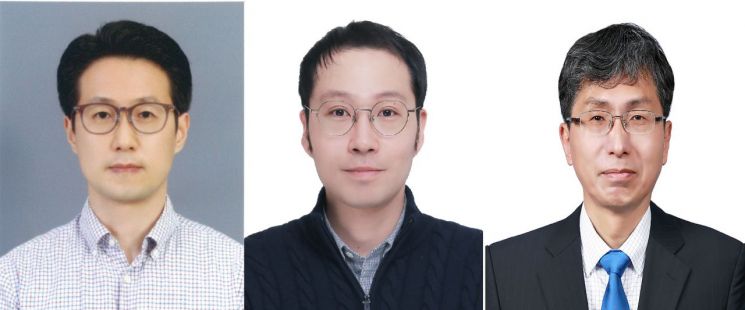 (From left) Kwon Oh-jung, Professor at Incheon National University; Kim Myung-jun, Professor at Sungkyunkwan University; Sung Young-eun, Professor at Seoul National University. Provided by the National Research Foundation of Korea
Water electrolysis technology is a method of producing hydrogen by electrolyzing water, converting electrical energy into chemical energy for storage.
In this technology, the electrodes for hydrogen generation reaction and oxygen evolution reaction require water (reactant) and oxygen (product) to move in opposite directions to maintain smooth reactions.
However, these two phases have properties that interfere with each other's flow, which hinders the characteristics of water electrolysis. This property becomes stronger in the high-current region. Therefore, there was a need to develop a new type of electrode that facilitates the movement of water and oxygen while increasing the reaction activity when using water electrolysis technology.
The joint research team met this demand by developing an integrated electrode structure that can achieve high efficiency at high currents, complementing the existing drawbacks through a porous transport layer and catalyst layer integrated electrode and a single pyrolysis process.
The porous transport layer refers to a Ti felt with a porous structure that can conduct electricity for water electrolysis while simultaneously enabling oxygen discharge and water supply.
The integrated electrode has the advantage of having catalysts evenly distributed on the porous transport layer, but it has the disadvantage of a limited catalyst amount due to its relatively small surface area.
The joint research team resolved this drawback of the integrated electrode by forming a porous carbon support with a check pattern on the porous transport layer to increase the electrode's surface area, and created catalysts that are evenly distributed not only on the surface but also inside the support. This ensures that even if the surface carbon is lost, the catalysts inside remain continuously exposed to maintain activity.
At this time, while the catalyst layer is evenly formed inside the porous transport layer, the pores of the porous transport layer are not blocked, allowing oxygen to be generated evenly throughout the electrode and facilitating smooth water supply.
The joint research team explained that this principle enables excellent water electrolysis performance even in the high-current region. In fact, through experiments, the team demonstrated that high activity is maintained with a small amount of precious metal catalyst and that material transport proceeds smoothly even in the high-current region.
The newly developed integrated electrode is expected to be applicable to electrochemical systems.
Meanwhile, the joint research team conducted this study with support from the Ministry of Science and ICT and the Korea Research Foundation through the Mid-career Researcher Program and the Excellent Young Researcher Program. The research results were published in the online edition of the international journal in the energy materials field, Advanced Energy Materials, on August 29.
© The Asia Business Daily(www.asiae.co.kr). All rights reserved.
![Clutching a Stolen Dior Bag, Saying "I Hate Being Poor but Real"... The Grotesque Con of a "Human Knockoff" [Slate]](https://cwcontent.asiae.co.kr/asiaresize/183/2026021902243444107_1771435474.jpg)
















