Ruling Party: "Let's Form a Special Committee First to Discuss Structural Reform Together"
Opposition: "Instead of a Special Committee, Discuss Electoral Reform First in the Welfare Committee"
Three months have passed since the 22nd National Assembly convened and the Chuseok holiday has arrived, but discussions on pension reform between the ruling and opposition parties have yet to take their first step. While the two sides fail to find common ground, the National Pension Fund is rapidly heading toward depletion. The government and ruling party estimate that the burden increases by 148 billion KRW per day the pension reform is delayed.
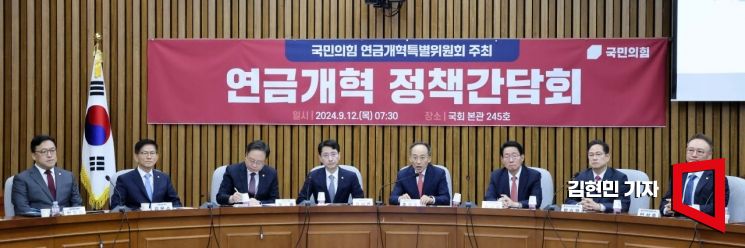 Chu Kyung-ho, floor leader of the People Power Party, is speaking at the pension reform policy forum hosted by the People Power Party's Pension Reform Special Committee at the National Assembly on the 12th. Photo by Hyunmin Kim kimhyun81@
According to political circles on the 13th, the ruling and opposition parties still have not narrowed their differences regarding the content and method of pension reform discussions, and have yet to establish even a special committee on pension reform at the National Assembly level. This contrasts with the 21st National Assembly, where the ruling and opposition parties operated a special pension reform committee until the end of the term, went through a public discourse process, and presented a comprehensive pension reform plan. In the 21st National Assembly, the two sides nearly reached an agreement on a 13% contribution rate and a 44% income replacement rate. However, the plan was scrapped due to the government and ruling party’s opposition, insisting that structural reform must accompany the comprehensive reform.
Comprehensive reform refers to maintaining the existing pension system framework while adjusting detailed figures for financial stabilization. Reforms such as raising the National Pension contribution rate or lowering the income replacement rate fall under this category. Structural reform, simply put, means changing the structure of the pension system and transforming its functions and roles, not just adjusting numerical values. Since the 22nd National Assembly began, the People Power Party has maintained the position that both comprehensive and structural reforms should be included in pension reform discussions. The Democratic Party insists that at least the comprehensive reform, which nearly reached agreement in the 21st National Assembly’s pension special committee, should be implemented first.
Both sides agree on the urgency of pension reform, but critics point out that they are wasting meaningless time by maintaining positions that have not significantly changed since the Assembly convened. The ruling party argues that, as in the 21st Assembly, a pension reform special committee should be formed to conduct multi-layered discussions. This is because the Ministry of Health and Welfare, which oversees the National Pension, and the National Assembly’s Health and Welfare Committee can focus only on discussions about the National Pension itself. They argue that structural reform should include not only the National Pension but also the Basic Pension, Retirement Pension, and Private Pensions. Therefore, a cross-government and cross-National Assembly discussion body is needed, involving related ministries such as the Ministry of Employment and Labor, the Financial Services Commission, and the Ministry of Economy and Finance.
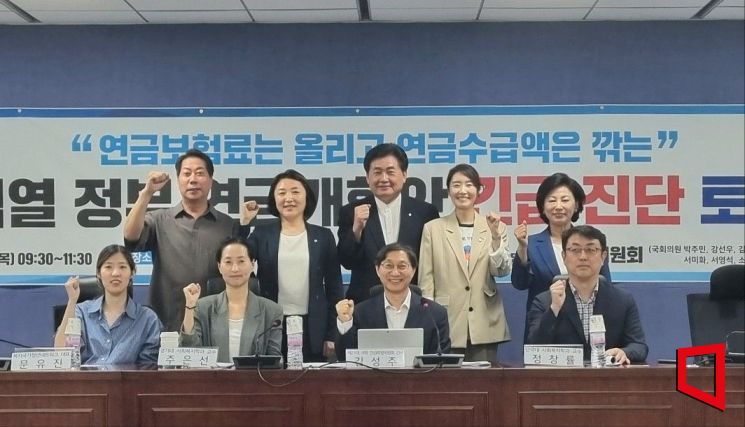
On the other hand, the Democratic Party argues that since the ruling and opposition parties had already worked in the special committee and nearly reached an agreement in the 21st National Assembly but failed to implement even the comprehensive reform, it is better to start with executing the National Pension comprehensive reform in the subcommittee of the National Assembly’s Health and Welfare Committee rather than forming the special committee again.
The fundamental reason for the difference in opinion between the two sides regarding the discussion body is reportedly that if a special committee is formed, its members are composed equally from both ruling and opposition parties, whereas in a subcommittee, the opposition party can maintain its majority of seats.
On the 4th, after the government announced a pension reform plan raising the National Pension contribution rate from the existing 9% to 13% and increasing the income replacement rate from 40% to 42%, the People Power Party proposed to the Democratic Party to complete the comprehensive reform this year and finish the first phase of structural reform by the regular National Assembly session next year. However, since the Democratic Party has not cooperated in forming the pension reform special committee, there has been no progress in discussions. Besides the method and agenda of pension reform discussions, there are also significant differences regarding the content of the reform. The Democratic Party views the automatic stabilization mechanism included in the government’s plan as potentially reducing the actual pension benefits. Given the large gap in views between the ruling and opposition parties surrounding the National Pension, there are concerns that prompt discussions may not be easy.
© The Asia Business Daily(www.asiae.co.kr). All rights reserved.
![Clutching a Stolen Dior Bag, Saying "I Hate Being Poor but Real"... The Grotesque Con of a "Human Knockoff" [Slate]](https://cwcontent.asiae.co.kr/asiaresize/183/2026021902243444107_1771435474.jpg)

















