Ministry of Land, Infrastructure and Transport's 'Rationalization Plan for Official Price Calculation System'
Applying 'Market Fluctuation Rate' Instead of 'Price Reflection Rate'
Official Price of 900 Million Won House Next Year 632 Million Won
#. There is a multi-family housing unit with a market price of 900 million KRW and an official assessed price of 622 million KRW this year. Reflecting the existing official price realization plan, the official price for next year is expected to be 650 million KRW, calculated by adding the 9 million KRW change rate for multi-family housing this year (1.52%) and the annual increase under the realization plan (an additional 19 million KRW for houses priced between 900 million KRW and less than 1.5 billion KRW with a 3 percentage point application). However, under the new system, the official price will be set at 632 million KRW by adding only the 9 million KRW change to this year's official price, which is expected to have the effect of lowering the official price.
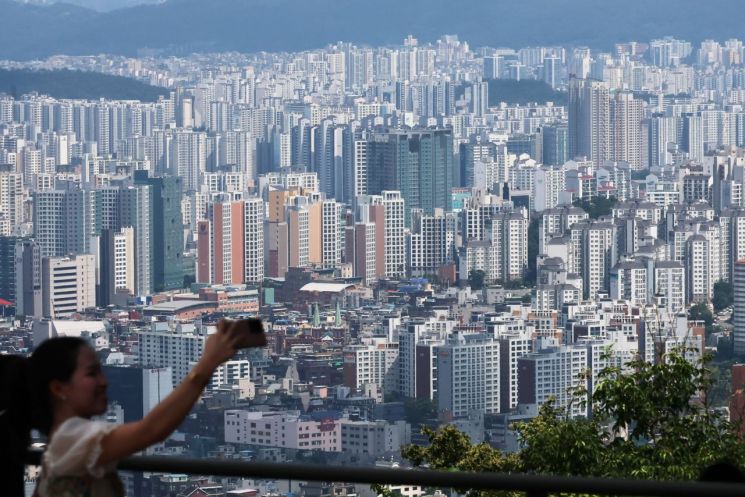
The government announced on the 12th the 'Rationalization Plan for the Real Estate Official Price Assessment System' (hereafter referred to as the Rationalization Plan), which changes the official price calculation method from reflecting the market price realization rate to judging based on market fluctuation rates.
This Rationalization Plan is part of President Yoon Seok-yeol's announcement at the March public discussion on livelihood issues to completely abolish the official price realization plan. It was prepared through research by the Korea Research Institute for Human Settlements, expert consultations, public perception surveys, and deliberations by the Central Real Estate Price Public Announcement Committee. The core idea is to abolish the official price realization plan introduced by the previous administration to align market prices and official prices, and to ensure that official price fluctuations do not deviate significantly from market price changes. Official prices are important indicators used as basic data for 67 administrative systems, including property tax, health insurance premiums, basic pensions, and land compensation.
The Ministry of Land, Infrastructure and Transport decided to change the official price calculation formula from the existing 'market price × (market price reflection rate + market price reflection rate enhancement)' to 'previous year's official price × (1 + market fluctuation rate)'. The new system is expected to secure credibility by allowing official prices to fluctuate at levels similar to market value changes, and to reduce the occurrence of real transaction price reversals by calculating official prices based on levels before the introduction of the realization plan. According to simulations, assuming a 1.52% change rate for multi-family housing this year, the official price fluctuation range for multi-family housing priced between 900 million KRW and 1.2 billion KRW is expected to be the largest (increasing from 4.52% to 1.52%).
Additionally, the plan includes selecting and improving regions and real estate where the balance of official prices has significantly deteriorated, and gradually promoting balance enhancement to minimize the burden on the public. In stages, each city, county, and district will evaluate whether official prices are appropriate, and for properties with excessively high or low prices, the Central Real Estate Price Public Announcement Committee will re-assess the official prices. The re-assessed official prices will be finally reviewed by external experts such as university professors and then disclosed to the public. Currently, the Korea Real Estate Board (for housing) and appraisers (for land) calculate standard official prices, and local governments calculate individual housing and land official prices based on these.
Nam Young-woo, Director of Land Policy at the Ministry of Land, Infrastructure and Transport, explained at a briefing held at the Government Sejong Complex that "the new system aims to remove artificial increases" and added, "It is not appropriate to set annual realization rate targets and continuously raise prices regardless of market conditions." He further stated, "Changing the calculation method does not mean the previous method was entirely wrong, but that it did not reflect actual market conditions."
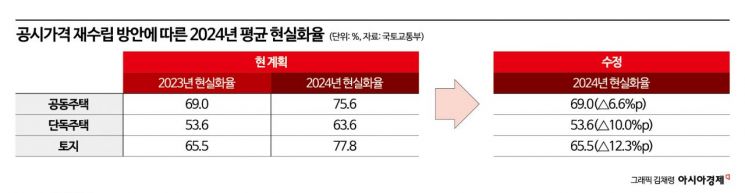
The official price realization plan was introduced in 2020 during the Moon Jae-in administration. The goal was to increase the realization rate annually until 2030 for multi-family housing, 2035 for standard housing, and 2028 for standard land. However, as housing prices rose, the official prices used as tax bases also increased, leading to criticism over the growing tax burden. The Yoon Seok-yeol administration initially considered revising the realization rate targets but ultimately decided to abolish the plan.
However, abolishing the official price realization plan requires legal amendments. Article 26, Paragraph 2 of the current Real Estate Price Public Announcement Act states that "the Minister of Land, Infrastructure and Transport shall set target rates for reflecting real estate market prices and establish plans to achieve these targets by presidential decree to ensure appropriate official prices and balance according to real estate types and regions."
Director Nam said, "We will focus as much as possible on balance and explain and persuade the National Assembly about the necessity." He added, "We need to prepare next year's official prices by November. Whether bipartisan consultations are possible will be specifically presented at that time."
Meanwhile, experts evaluated the abolition of the official price realization plan positively from the perspective of market normalization, while also expressing concerns about polarization side effects and limited effectiveness.
Ham Young-jin, Head of the Real Estate Research Lab at Woori Bank, said, "The speed of reflecting actual transaction prices is expected to slow down compared to the previous roadmap, and the issue of sudden heavy property tax burdens is likely to ease." However, he added, "In areas like Seoul and the metropolitan area where actual transaction prices have risen, the increase in official prices may be higher than in other regions, leading to regional polarization of official prices."
Lee Eun-hyung, Research Fellow at the Korea Institute of Construction Policy, said, "It is positive for market normalization, but it is difficult to judge whether this alone will activate transactions. For example, recent household loan regulations have a more immediate and visible impact on market transactions."
© The Asia Business Daily(www.asiae.co.kr). All rights reserved.
![Clutching a Stolen Dior Bag, Saying "I Hate Being Poor but Real"... The Grotesque Con of a "Human Knockoff" [Slate]](https://cwcontent.asiae.co.kr/asiaresize/183/2026021902243444107_1771435474.jpg)

















