Population per person in charge: 1,186
Three-person ambulance operation rate: 51%
The population living in Gyeonggi-do reaches 13.66 million, but it has been revealed that firefighting personnel are severely insufficient. Due to the government's small government policy, manpower expansion has not been achieved, raising concerns that it threatens the lives and safety of the public.
According to the Fire Agency on the 13th, as of last year, the number of people served per firefighter nationwide is 777. In Gyeonggi-do, one firefighter is responsible for 1,186 people, which is the second highest figure after Seoul.
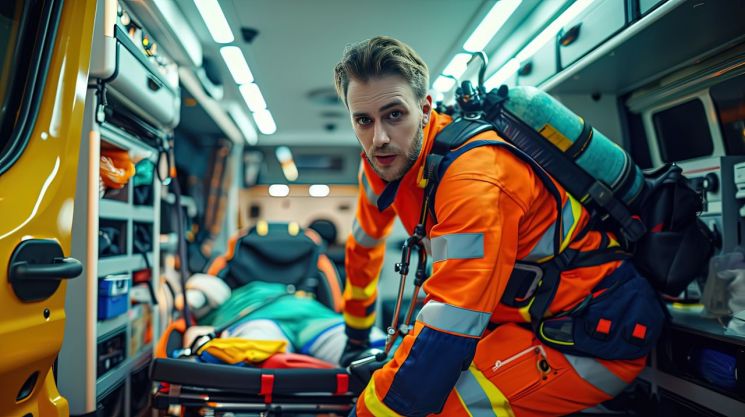
Currently, the operation rate of three-person ambulances in Gyeonggi-do is only about 51%, with 156 out of 305 ambulances equipped for three personnel. Two-person ambulances require one member to drive and the other to provide emergency treatment. A, who works at Yangju Fire Station, said, “If one person is absent, ambulance operation becomes impossible, so the crew members riding two-person ambulances cannot take vacations comfortably. If they inevitably take leave, untrained suppression team members have to ride the ambulance, which poses a significant threat to public safety.”
Park, a 7-year veteran paramedic (33), pointed out, “There are many cases of cardiac arrest during patient transport. When there are two members in the treatment room, one can perform chest compressions while the other secures the airway to supply oxygen or operate the defibrillator. However, if only one member is in the treatment room, this is impossible. In the case of severe trauma patients with heavy bleeding, intravenous fluid supply is essential, but a single member cannot simultaneously secure the vein and administer fluids.”
As firefighting personnel are not being supplemented, dissatisfaction among firefighters is increasing. Jeon (36) said, “The population of Gyeonggi-do keeps increasing, but the number of staff remains the same, which only accumulates fatigue and causes skepticism about the workplace. If more centers are established in the future, I don’t know how long the remaining staff can endure. We are already exhausted.” B, a firefighter with 10 years of experience, criticized, “If new fire stations or safety centers are established, there will be no one to work there, and the current staff will be split to cover them. Even now, operations are makeshift, and the problems will become more serious in the future.”
Professor Gong Ha-seong of the Department of Fire and Disaster Prevention at Woosuk University said, “The number of people served per firefighter, regional area, response time, and traffic conditions should be comprehensively considered to first reallocate personnel, and if insufficient, reinforce manpower through additional recruitment.”
© The Asia Business Daily(www.asiae.co.kr). All rights reserved.
![Clutching a Stolen Dior Bag, Saying "I Hate Being Poor but Real"... The Grotesque Con of a "Human Knockoff" [Slate]](https://cwcontent.asiae.co.kr/asiaresize/183/2026021902243444107_1771435474.jpg)















