Financial Services Commission to Hold Meeting on Digitizing Real-World Insurance Claims on the 12th
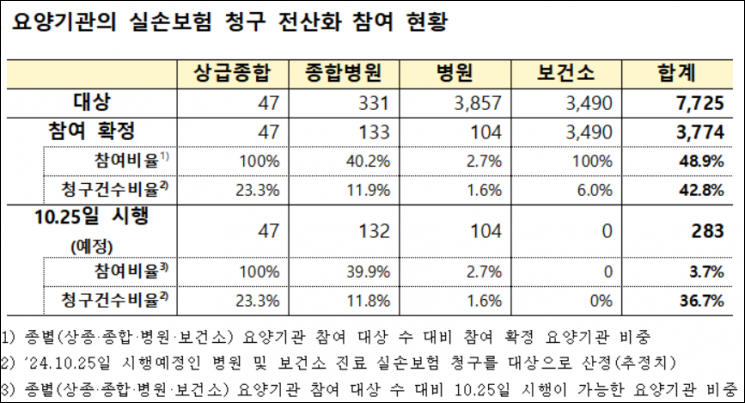
From the 25th of next month, the computerization of indemnity insurance claims will be implemented, but the participation rate of domestic medical institutions is only about 3.7%.

On the 12th, the Financial Services Commission announced that it held a meeting on the computerization of indemnity insurance claims, chaired by Secretary-General Kwon Daeyoung, with the Ministry of Health and Welfare, electronic medical record (EMR) companies, the insurance industry, and the Korea Insurance Development Institute. Secretary-General Kwon said, "To ensure the smooth implementation of the computerization of indemnity insurance claims, the government, medical community, and insurance industry have actively coordinated their differences and proceeded with the project," adding, "However, from the public’s perspective, there are still shortcomings, and it is time to make further efforts to expand it."
Starting October 25, the computerization of indemnity insurance claims will be implemented for 7,725 medical institutions (4,235 hospitals with 30 or more beds and 3,490 public health centers). So far, a total of 3,774 medical institutions (48.9%) have confirmed participation. Among them, 283 hospitals (3.7%) will immediately proceed with the computerization of indemnity insurance claims from the 25th of next month. Other medical institutions will proceed sequentially, considering their own system revision schedules and issues related to concentrating on the same system.
Secretary-General Kwon said, "As a result of discussions between the financial authorities, insurance industry, and electronic medical record (EMR) companies on appropriate cost levels, some progress has been made," adding, "Due to the nature of this newly launched project, it is difficult to estimate future cost levels, but for the sake of improving public convenience, I ask both industries to promptly coordinate their final opinions."
He continued, "Various measures are also being prepared to prevent the burden of complaints on the medical community," and said, "We are preparing ways for insurance companies, not hospitals, to respond to complaints as much as possible through sending advance notices to indemnity insurance subscribers, operating a dedicated call center for indemnity claims, and distributing posters and leaflets."
Furthermore, Secretary-General Kwon explained, "Medical information will not be concentrated in transmission agencies," and added, "Under the Insurance Business Act, the concentration of medical information in transmission agencies is prohibited, and if requested by the medical community, the medical community will participate in the operation of transmission agencies to regularly monitor the information concentration situation."
The health authorities attending the meeting said they would consider providing incentives to medical institutions participating in the computerization of indemnity insurance claims. EMR companies expressed their willingness to cooperate, stating that the computerization of indemnity insurance claims is necessary for the public interest of improving convenience. However, as private businesses, they also emphasized the need for appropriate compensation.
© The Asia Business Daily(www.asiae.co.kr). All rights reserved.
![Clutching a Stolen Dior Bag, Saying "I Hate Being Poor but Real"... The Grotesque Con of a "Human Knockoff" [Slate]](https://cwcontent.asiae.co.kr/asiaresize/183/2026021902243444107_1771435474.jpg)

















