12th '60th Anniversary of Korea Industrial Complex' Ceremony
Lee Sang-hoon, Korea Industrial Complex Corporation President, Presents Future Vision of Industrial Complex
"Industrial complexes will transform into vibrant spaces full of youth and energy." The words spoken by Lee Sang-hoon, Chairman of the Korea Industrial Complex Corporation, at the ‘60th Anniversary of Korea’s Industrial Complexes’ ceremony held on the 12th at the G-Tower Convention in Guro, Seoul, succinctly describe the future path of industrial complexes. As of the end of last year, 1,306 industrial complexes nationwide house 120,000 companies and employ 2.3 million people. With a production value of 1,262 trillion won and exports worth 420 billion dollars, industrial complexes have played a central role in South Korea’s economy. However, aging infrastructure has led to an image of these complexes as spaces avoided by young people. The core strategy for rejuvenating the industrial complexes, which are celebrating their 60th anniversary this year, is ‘culture.’
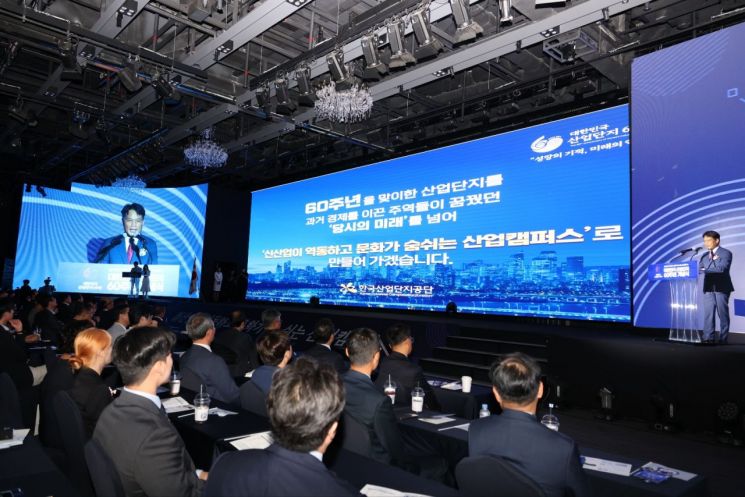 On the 12th, at the G Tower Convention in Guro-gu, Seoul, Lee Sang-hoon, the President of the Korea Industrial Complex Corporation, is presenting the vision of industrial complexes at the "60th Anniversary Ceremony of Korea's Industrial Complexes."
According to the Korea Industrial Complex Corporation on the 13th, the theme of the 60th anniversary ceremony held the previous day was ‘An Industrial Campus Where New Industries Are Dynamic and Culture Breathes.’ Industrial complexes began with the enactment of the ‘Export Industrial Complex Development Act’ on September 14, 1964, and were first established in Guro-dong, Seoul, under the name Korea Export Industrial Complex. Over the past 60 years, they have played a key role in national economic development. At this event, strategies were shared to reinvent industrial complexes, which represent the history of South Korea’s economic growth, as hubs for advanced and new industries and as integrated spaces of industry and culture where young people want to visit and stay.
Chairman Lee announced the vision for industrial complexes, including the expansion of cultural spaces and program development, digital and carbon-neutral transitions, regulatory reforms, and investment activation. To transform into industrial complexes where industry and culture converge, a total of 10 leading cultural industrial complexes will be selected and intensively supported by 2027. Fifteen newly established national industrial complexes will be designated as special planning zones to expand the construction of specialized cultural facilities utilizing private sector creativity. Additionally, each industrial complex will establish an ‘Industrial Complex Cultural Convergence Council’ composed of local governments, resident companies, and cultural organizations to develop cultural convergence plans, which the government will support with tailored projects. Through this, the government plans to integrate culture into industrial complexes with the private sector taking the lead from the perspective of young people.
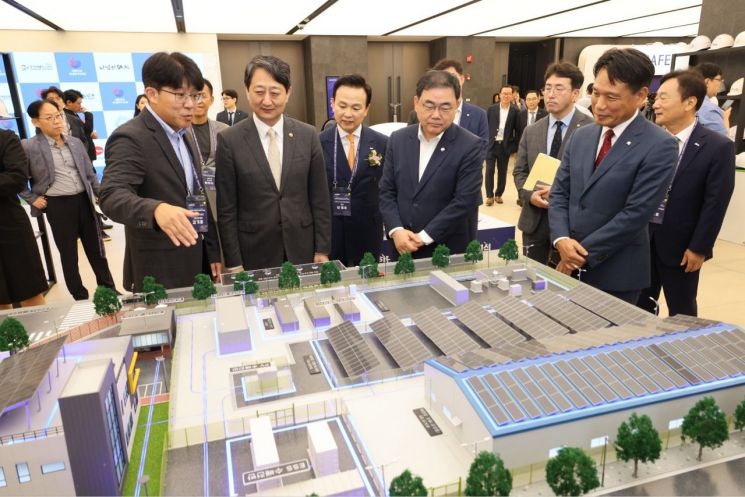 Before the '60th Anniversary Ceremony of Korea's Industrial Complexes' held on the 12th at G Tower Convention in Guro-gu, Seoul, attendees are listening to an explanation about the eco-friendly energy development project in industrial complexes. (From the second person on the left in the photo: Ahn Deok-geun, Minister of Trade, Industry and Energy; Lee Gye-woo, Chairman of the Korea Industrial Complex Managers Association; Heo Seong-mu, Member of the National Assembly; Lee Sang-hoon, President of the Korea Industrial Complex Corporation) Photo by [Photographer's Name]
Specifically, spaces that embody the history of industrial complexes will be reinterpreted to build landmarks such as corporate experience centers, around which specialized brand spaces like plazas and parks will be developed to create popular local attractions featuring content convergence, exhibitions, and experiences. To recreate everyday industrial complex spaces through culture, incentives will be provided by evaluating factory designs and cultural spaces, and support for improving the interior and exterior of small, aging factories will be significantly strengthened.
To dispel concerns that industrial complexes might become crime-prone areas at night, a public art project combining industrial complex infrastructure with sculptures and media art will be promoted to create ‘industrial complexes that shine at night.’ Each industrial complex will appoint a general director to plan region-specific content such as cultural experiences and exhibitions by local artists through a ‘Culture Delivery to Every Corner’ initiative. The ‘Industrial Complex Culture Week’ will be operated to activate festivals in each complex, and tourism content utilizing industrial complex brands and products will also be developed.
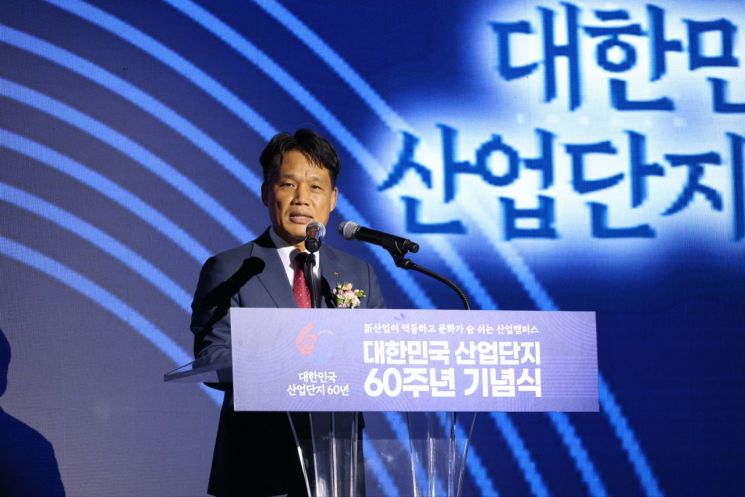 On the 12th, at the '60th Anniversary Ceremony of Korea Industrial Complex' held at G Tower Convention in Guro-gu, Seoul, Lee Sang-hoon, Chairman of the Korea Industrial Complex Corporation, is presenting the vision of the industrial complex.
To promote the entry of youth-preferred cultural and knowledge industries into industrial complexes, affordable startup and collaboration spaces will be provided for young people. An accelerating zone supporting consulting, technology collaboration between large and medium-sized enterprises, and overseas expansion will be established, along with startup and management support centers for content companies such as game and animation firms. To foster the convergence of manufacturing and cultural industries, artist residency spaces such as open workshops for young craftspeople will also be created within industrial complexes. Chairman Lee said, "We will create industrial complexes where advanced technology and creative ideas converge beyond simple manufacturing, and where workplaces and living spaces are organically connected."
© The Asia Business Daily(www.asiae.co.kr). All rights reserved.
![Clutching a Stolen Dior Bag, Saying "I Hate Being Poor but Real"... The Grotesque Con of a "Human Knockoff" [Slate]](https://cwcontent.asiae.co.kr/asiaresize/183/2026021902243444107_1771435474.jpg)


















