Korea Real Estate Board 'Apartment Price Trends for the Second Week of September'
Seoul Apartment Listings Sell Slower
Record High Transactions in Some Reconstruction and New Complexes
Lease Prices Rise Sharply Ahead of Moving Season
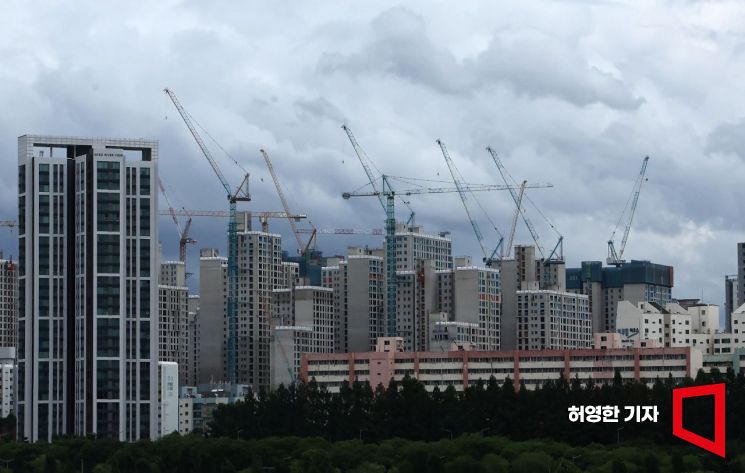 When crossing the Banpo Bridge in Seoul, you can see new apartments, old apartments, and apartments under construction all at once in the Sinbanpo area. The new apartments on the left are Acro Riverview Sinbanpo, the low old apartments on the right are Sinbanpo 2nd Complex, and the apartments under construction in the back are the Maple Xi construction site. Photo by Younghan Heo younghan@
As bank loan regulations tighten, the pace of inventory depletion in the Seoul apartment sales market has slowed, but the price increase of Seoul apartments has expanded again as record-high transactions occurred mainly in some redevelopment and newly built complexes. With the autumn moving season, the demand for jeonse (long-term lease) has increased, leading to a larger rise in Seoul apartment jeonse prices.
According to the 'Apartment Price Trends for the Second Week of September (as of the 9th)' released by the Korea Real Estate Board on the 12th, the apartment sales price index in Seoul rose by 0.23% compared to the previous week, continuing its upward trend for 25 consecutive weeks. The rate of increase slightly expanded compared to the previous week's 0.21%.
Seoul apartment prices jumped 0.32% in the second week of August, marking the highest increase in 5 years and 11 months. Since then, due to loan regulations and other factors, the rate of increase declined for three consecutive weeks starting from the third week of August, but this week the increase rate expanded again.
The Korea Real Estate Board explained, "Although the pace of inventory depletion is slowing due to recent changes in the loan environment and fatigue from rapid price rises, record-high contracts have been signed mainly in some redevelopment complexes and preferred newly built complexes within the region, slightly expanding the overall rate of increase."
By district, Seocho-gu recorded the highest increase rate of 0.44%, mainly in semi-new complexes in Seocho and Banpo-dong. Seongdong-gu, which rose mainly in preferred complexes in Geumho and Hawangsimni-dong, followed with a 0.41% increase. Songpa-gu (0.35%), Yongsan-gu (0.34%), Gwangjin-gu (0.34%), Gangnam-gu (0.31%), Mapo-gu (0.29%), and Yeongdeungpo-gu (0.25%) also showed significant increases.
In Incheon (0.13% → 0.10%), the rate of increase slowed. On the other hand, Gyeonggi Province (0.10% → 0.13%) saw an expanded increase, raising the overall metropolitan area increase from 0.14% to 0.15%.
Unlike the metropolitan area, apartment prices in provincial areas, where prices are falling, saw a reduced decline of 0.01% this week compared to -0.02% last week. Accordingly, the nationwide apartment price increase rate slightly expanded from 0.06% last week to 0.07% this week.
The rise in jeonse prices is also accelerating with the autumn moving season. The metropolitan area (0.14% → 0.17%) and Seoul (0.15% → 0.17%) saw an increase in the rate of jeonse price rises. In Seoul, the jeonse price increase trend has continued for 69 consecutive weeks.
Incheon recorded a relatively high increase rate of 0.26%, although it decreased from 0.30% last week. The increase rate in Gyeonggi Province (0.09% → 0.15%) expanded compared to last week. Provincial areas (0.00% → 0.00%) remained flat. Nationwide, the jeonse price increase rate rose from 0.07% last week to 0.08% this week.
The Korea Real Estate Board explained, "Due to the autumn moving season, waiting demand has increased mainly in preferred complexes such as those near subway stations, newly built complexes, and school districts. As contracts are steadily signed at higher prices due to a shortage of listings, the overall increase rate in Seoul has slightly expanded."
© The Asia Business Daily(www.asiae.co.kr). All rights reserved.
![Clutching a Stolen Dior Bag, Saying "I Hate Being Poor but Real"... The Grotesque Con of a "Human Knockoff" [Slate]](https://cwcontent.asiae.co.kr/asiaresize/183/2026021902243444107_1771435474.jpg)















