Bank of Korea Monetary and Credit Policy Report
Recent 3-Year Treasury Bond Decline, External Factors Contribute 86%
"Low Possibility of Sharp Short-Term Decline"
Analysis suggests that the rapid decline in South Korea's long-term interest rates since May is due to 'external factors,' such as growing expectations of interest rate cuts by the U.S. Federal Reserve (Fed).
According to the 'Monetary and Credit Policy Report' released by the Bank of Korea on the 12th, external factors accounted for 86% of the fluctuations in South Korea's 3-year government bond yields since May. For the 10-year bonds, the contribution of external factors was estimated to be as high as 91%.
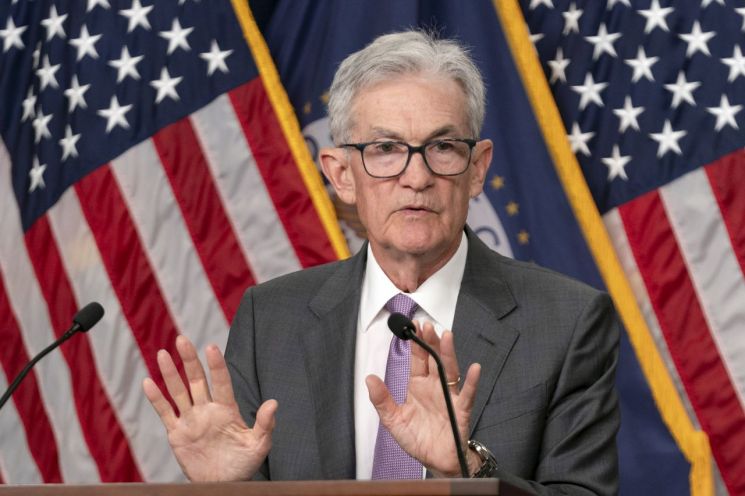
In particular, changes in expectations regarding U.S. monetary policy had the largest impact on the 3-year government bond yield fluctuations (42%), while net purchases of government bond futures by foreigners and downward revisions of expected inflation contributed 34% and 12%, respectively.
The recent decline in long-term interest rates has been both large in magnitude and rapid in speed. South Korea's 3-year government bond yield fell quickly after May and has fluctuated around 3.0% since August. Recently (from April 29 to August 26), the decline from the peak of the 3-year yield was 66 basis points (bp), with an average daily decline rate of 0.66%. In comparison, during previous periods when monetary policy shifted from tightening to easing?July 2012, August 2014, and July 2019?the respective declines and average daily rates were 45bp and 0.41%, 41bp and 0.18%, and 44bp and 0.33%.
The report evaluated that domestic market participants' expectations for the benchmark interest rate have been slightly adjusted toward easing over the medium to long term, and expectations for U.S. monetary policy also changed considerably toward easing during the same period. In fact, the expected path for the U.S. policy rate at the end of this year (based on FFR futures rates) gradually decreased before the Federal Open Market Committee (FOMC) meetings in May, June, and July, from 5.22%, 5.16%, and 4.91%, respectively, to 4.66% recently (August 26). Expectations for the policy rate at the end of next year also fell from 4.64%, 4.31%, and 3.72% to 3.25% recently.
During this process, foreign investors significantly increased their investments in domestic government bond futures, causing government bond yields to fall sharply. For the 3-year government bond, foreigners' cumulative net purchases from May 30 to August 26 reached 273,061 contracts, far exceeding the long-term average of 99,639 contracts. The cumulative net purchases for the 10-year bonds also reached 188,864 contracts, well above the long-term average of 52,486 contracts. The pace of net purchases accelerated as well. The average daily net purchase speed of foreigners for the 3-year government bond was 4,334 contracts, significantly surpassing the long-term average of 2,702, and for the 10-year bonds, it was 2,075 contracts, exceeding the long-term average of 1,018.
Looking ahead, the possibility of a sharp decline in government bond yields in the short term is considered low. A Bank of Korea official explained, "Expectations for a shift in the U.S. Fed's policy stance have already been largely priced in, and the foreign investors' futures buying momentum is expected to calm down."
He added, "However, given the high uncertainty in external conditions, it is necessary to continue closely monitoring related risk factors."
© The Asia Business Daily(www.asiae.co.kr). All rights reserved.
![Clutching a Stolen Dior Bag, Saying "I Hate Being Poor but Real"... The Grotesque Con of a "Human Knockoff" [Slate]](https://cwcontent.asiae.co.kr/asiaresize/183/2026021902243444107_1771435474.jpg)















