Harris and Trump, First TV Debate
Blame Game from the Start
Clash over Immigration, Abortion, Tariffs, and More
On October 10 (local time), exactly eight weeks (56 days) before the U.S. presidential election on November 5, Vice President Kamala Harris and former President Donald Trump clashed over issues such as inflation, the economy, trade, immigration, and abortion during a presidential TV debate. This was the first debate since the Democratic presidential candidate was changed from President Joe Biden, who suffered a complete defeat in the June TV debate, to Vice President Harris. The two candidates confronted each other head-on on key issues, starting with inflation and economic matters. With the candidates showing a neck-and-neck race in the polls and no additional debates scheduled at present, both sides engaged in a tense battle, aware that a fatal mistake could leave no chance for recovery.
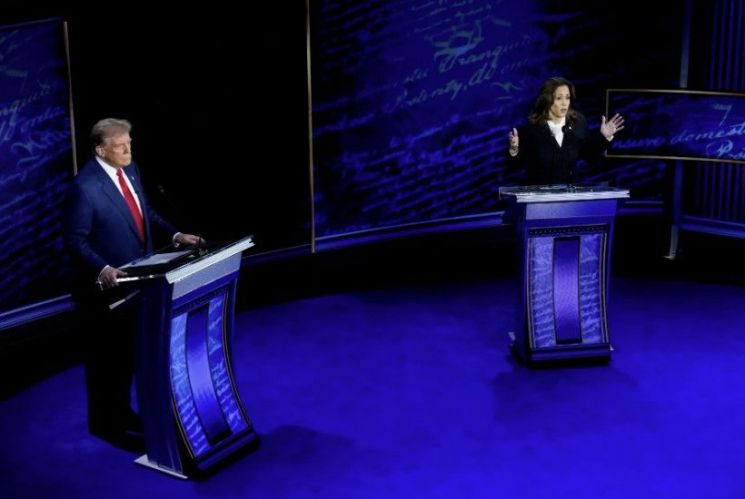
Vice President Harris and former President Trump faced off for the first time in a TV debate hosted by ABC at the National Constitution Center in Philadelphia, Pennsylvania, one of the most fiercely contested swing states. Vice President Harris approached former President Trump first, introduced herself as "Kamala Harris," and extended her hand for a handshake, which Trump reciprocated, marking their face-to-face encounter.
From the beginning of the debate, the two candidates clashed over economic issues including inflation. When asked whether Americans are economically better off than four years ago, Vice President Harris opened by stating that she is "the only candidate who grew up in a middle-class family." She mentioned an "economy of opportunity" and promised child tax credits and support for small businesses.
Vice President Harris said, "I will work to provide child tax credit support for middle-class families," adding, "We will offer up to $6,000 annually in child tax benefits." She emphasized, "I grew up as a middle-class child and am the only person on this stage who actually plans to help America's middle class and workers," while fiercely criticizing former President Trump's economic policies as "tax cuts for the wealthiest people."
She continued sharp attacks on former President Trump's tariff policies, referring to tariffs as the "Trump surtax," and pointed out, "He is worsening the lives of small businesses and the middle class while trying to reduce taxes for billionaires."
In response, former President Trump argued, "If you don't like tariffs, (the Biden administration) should have removed them," claiming that the tariffs he imposed on China during his term brought billions of dollars in tariff revenue to the U.S. He also launched an offensive, saying inflation surged under the Biden administration. He emphasized, "We experienced the worst inflation during President Biden's term," and "There was no inflation like this during my term. They destroyed the economy."
The two candidates also clashed directly on the abortion issue. Regarding the overturning of Roe v. Wade, which recognized abortion rights at the federal level, Vice President Harris said, "If Trump is elected, he will sign a nationwide abortion ban again." She added, "The government and Trump should not dictate what women do with their bodies," and emphasized, "I will sign a bill to restore abortion rights." Former President Trump rebutted, calling this "a lie," and said, "Abortion is now the responsibility of the people, not the federal government, and decisions are made at the state level. My position does not matter."
They also confronted each other on illegal immigration, one of the major issues. Former President Trump attacked, saying, "Biden and Harris have allowed illegal immigrants into the U.S. They have taken jobs from Americans and brought in numerous criminals. This is causing significant losses to the U.S. economy."
Vice President Harris continued her fierce criticism of 'Project 2025,' led by the Heritage Foundation, a conservative U.S. think tank known for its far-right policies. Earlier, she had criticized Project 2025, saying, "We're not going back." Former President Trump responded, "I have nothing to do with Project 2025," adding, "There are good ideas and bad ideas, but these are ideas made by people not related to me."
The debate, which started at 10 a.m. Korean time on the 11th and lasted 90 minutes, saw the two candidates engage with only a pen, a blank notepad, and a bottle of water in front of them. Each candidate was given two minutes to answer questions from the moderator. After answering, they were allowed two minutes to rebut the opponent's response and one minute for additional explanation. Microphones were turned on only during their speaking time and muted otherwise. Two breaks were given for commercials, but there was no contact with campaign staff during the debate.
This debate is expected to be a critical turning point in the U.S. presidential race, which is currently extremely close, potentially swaying voters' decisions. According to a poll jointly conducted and released on the 8th by The New York Times (NYT) and Siena College, former President Trump and Vice President Harris each had support rates of 48% and 47%, respectively, showing a tight race. In swing states, both sides were evenly matched. Among seven swing states, Nevada, Georgia, North Carolina, and Arizona each showed a tie with 48% support for both candidates. Meanwhile, in Wisconsin, Michigan, and Pennsylvania, Vice President Harris led former President Trump by 1 to 2 percentage points. Notably, Pennsylvania, where this debate was held, is the swing state with the largest number of electoral votes at 19, making it the most crucial battleground that must be won to enter the White House.
© The Asia Business Daily(www.asiae.co.kr). All rights reserved.
![Clutching a Stolen Dior Bag, Saying "I Hate Being Poor but Real"... The Grotesque Con of a "Human Knockoff" [Slate]](https://cwcontent.asiae.co.kr/asiaresize/183/2026021902243444107_1771435474.jpg)















