Expecting Buffer Function... Expansion Starting with 50 Trees
Driver Protection Possible through Tree Elasticity
Reviewing Zelkova, Ginkgo, and Maple Trees
Seoul City announced on the 10th that it will plant 2,000 'Sturdy Street Trees' by 2026 in areas vulnerable to traffic accidents to enhance pedestrian safety. This initiative follows a wrong-way driving accident near City Hall Station in July, with the expectation that the street trees will serve as a buffer.
The goal is to plant 2,000 trees by 2026, with 50 trees planted this year, 1,000 in 2025, and an additional 950 in 2026. A Seoul city official explained, "By expanding the planting of street trees in places where people stop and wait, such as crosswalks and traffic islands, we expect to reduce citizens' anxiety and improve pedestrian safety."
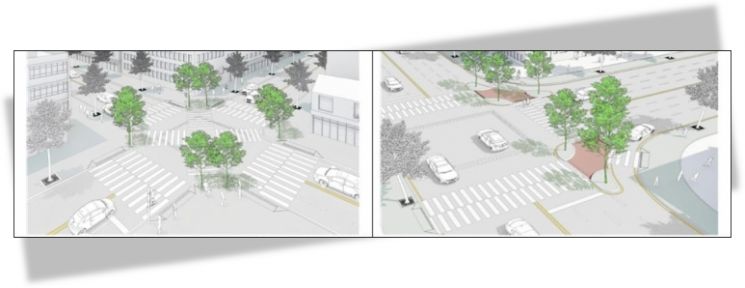 Conceptual diagram of roadside tree planting at intersections and other locations. [Provided by Seoul City]
According to overseas research, the larger the diameter of a tree, the higher its predicted ability to withstand vehicle collisions. Above all, compared to artificial structures, the elasticity of trees absorbs impact, protecting not only pedestrians but also drivers. In traffic accident cases, there have been instances where trucks collided with street trees and stopped without serious injuries.
The tree species under consideration for the Sturdy Street Trees project include Zelkova, Ginkgo, and Maple, which grow well in the metropolitan area, have deep root systems, and possess wood with good density, hardness, and durability. Furthermore, according to a 2022 report by the Seoul Institute of Technology, street trees designed for 'heatwave preparedness' reduce heat by 25% more than shade shelters. This initiative also aims to address climate and environmental changes. Street trees have excellent carbon absorption capabilities, significantly contributing to carbon reduction. The annual carbon absorption per tree is 203.3 kg, so planting 2,000 trees would absorb 406.6 tons of carbon annually, equivalent to the yearly carbon emissions of 170 cars.
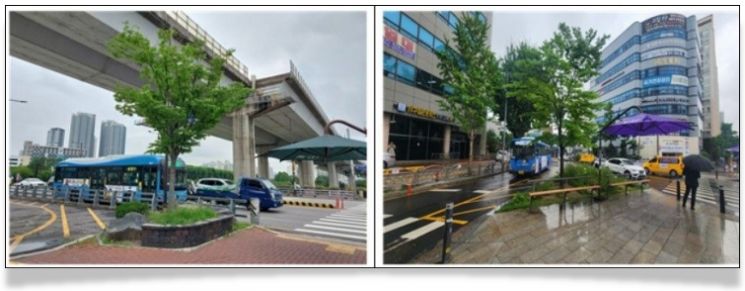
The pilot project sites include the traffic island at Sejong-daero Intersection. Initially, 50 trees will be planted there, and after evaluating the project's effects, the plan is to expand it significantly in 2025. Concerns that street trees might obstruct drivers' views or block nearby building signs will also be reflected in the policy. To ensure drivers' visibility, Seoul City plans to raise the underground height of street trees on the roadside and, if necessary, change tree supports from above-ground to buried types.
Lee Su-yeon, Director of the Seoul City Garden and Urban Forestry Bureau, stated, "Planting street trees is a future-oriented and effective measure not only for pedestrian safety but also for responding to climate and environmental changes. We aim to create a green, nature-friendly city where people walking in downtown Seoul can see attractive gardens below and street trees ahead."
© The Asia Business Daily(www.asiae.co.kr). All rights reserved.
![Clutching a Stolen Dior Bag, Saying "I Hate Being Poor but Real"... The Grotesque Con of a "Human Knockoff" [Slate]](https://cwcontent.asiae.co.kr/asiaresize/183/2026021902243444107_1771435474.jpg)

















