"Lost Both Fiscal Soundness and Fiscal Responsibility"
Criticism of Tax Cut Policy... "No Trickle-Down Effect"
Harsh criticism of the Yoon Seok-yeol administration's budget proposal for next year continued at the Democratic Party study group. The study group lecturers pointed out that the tight fiscal policy caused domestic demand to stagnate while tax cuts led to a revenue shortfall.
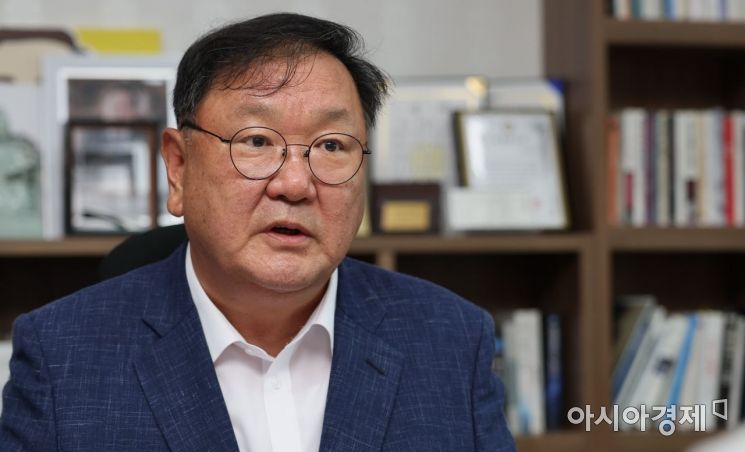
Kim Tae-nyeon, a Democratic Party lawmaker and head of the Democratic Party study group 'Economy is Democratic Party,' hosted a lecture on June 10 at the National Assembly in Yeouido, Seoul, titled "Understanding Finance and Taxation." 'Economy is Democratic Party' is the largest lawmaker study group with 107 active Democratic Party members participating. On this day, lawmakers Jin Sun-mi, Kim Han-gyu, Choi Min-hee, Kim Dong-a, Moon Dae-rim, and Park Jeong-hyun also attended.
The lecturers at the study group harshly criticized the Yoon administration's budget proposal for next year. They argued that reducing fiscal spending negatively affected domestic demand while implementing tax cuts worsened fiscal soundness. The government finalized next year’s budget at 677.4 trillion won, announcing it as a tight budget with only a 3.2% increase compared to this year, but a tax revenue shortfall of about 32 trillion won is expected this year. Furthermore, the progress rate, which refers to the ratio of targeted tax revenue to actual collected tax revenue, was 56.8%, down 6.4 percentage points from 63.2% the previous year. Lee Sang-min, senior research fellow at the Nara Salrim Research Institute, said, "To summarize next year’s budget in one line, it misses both fiscal responsibility and fiscal soundness," adding, "The reason for missing both is tax cuts."
They also pointed out that the responsibility for increasing debt should not be shifted to the previous administration. On May 26, the Presidential Office responded to criticism that national debt and household debt exceeded 3,000 trillion won by stating, "National debt increased by 400 trillion won during the Moon Jae-in administration." Hong Seong-guk, former Democratic Party lawmaker and CEO of Hyean Research, said, "The current administration explains the criticism of national debt by saying the previous administration spent a lot of budget, but they only talk about the amount of 400 trillion won. In terms of ratio, it did not increase significantly," adding, "There was also the special situation of COVID-19, but the current administration does not mention this part."
There was also an argument that active fiscal policy is needed rather than expecting a trickle-down effect from tax cuts. Hong said, "The Reagan administration in the U.S. implemented large tax cuts, but it did not lead to a trickle-down effect," adding, "It is better to support sectors related to the country's future strategy rather than universally cutting taxes." He continued, "When a structural crisis comes, the government must roll up its sleeves and expand fiscal spending," emphasizing, "The current administration has neither a future strategy nor tactics for the country, nor a perspective on the economy."
However, there was also criticism that if fiscal policy is actively used, it must produce results. Jang Woo-hyun, senior research fellow at the Korea Institute of Public Finance, said, "The direction of fiscal policy may cause conflicts among policies by only meeting some objectives," adding, "Continuous performance management is essential to harmonize medium- to long-term policy goals."
© The Asia Business Daily(www.asiae.co.kr). All rights reserved.
![Clutching a Stolen Dior Bag, Saying "I Hate Being Poor but Real"... The Grotesque Con of a "Human Knockoff" [Slate]](https://cwcontent.asiae.co.kr/asiaresize/183/2026021902243444107_1771435474.jpg)















