Deputy Prime Minister Choi Sang-mok's Press Briefing on the 9th
"Inheritance Tax Amendment Bill to be Submitted in the First Half"
Abolition of Unified Deduction, New Tax Base Established
Personal Pension Lifetime Receipt Tax Rate 4%→3%
Tax Benefits Increase When Receiving Retirement Pay as Pension
Retirement Income Tax Rate 50% for Over 20 Years
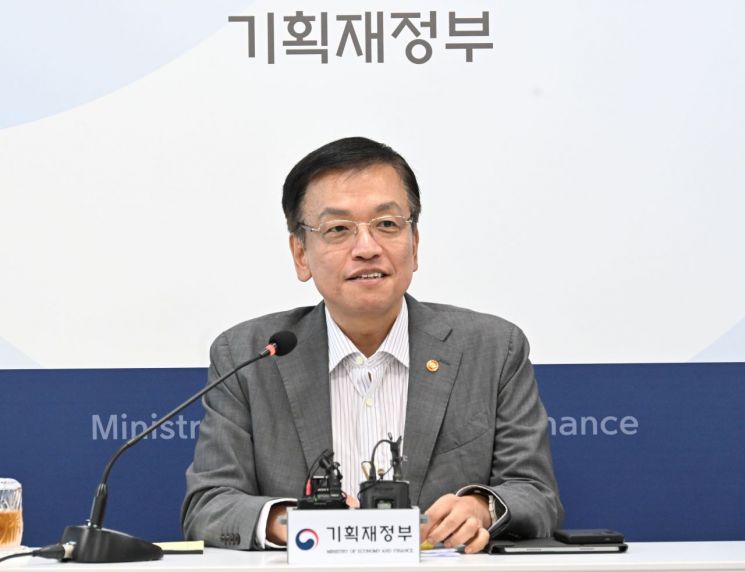 Choi Sang-mok, Deputy Prime Minister and Minister of Economy and Finance, is delivering opening remarks at a press conference held at the government Sejong complex press room on the 9th. Photo by Ministry of Economy and Finance
The government plans to promote a measure to convert the inheritance tax based on estate tax into an inheritance acquisition tax as early as the first half of next year. The unified deduction will be abolished to align with the purpose of the inheritance acquisition tax, which levies taxes on each heir individually. Additionally, tax benefits for long-term pension recipients will be increased to ensure the public's retirement security.
Choi Sang-mok, Deputy Prime Minister for Economy and Minister of Strategy and Finance, held a press conference at the Government Complex Sejong on the 9th and said, “We will proceed with a process to gather diverse opinions from various sectors to build public consensus on the introduction of the inheritance acquisition tax,” adding, “We plan to submit a bill to the National Assembly to convert to the inheritance acquisition tax as early as the first half of next year.”
Currently, inheritance tax follows the estate tax rules. Estate tax is levied on the total amount of assets left by the decedent. In contrast, inheritance acquisition tax is levied individually on the assets received by each heir. Since inheritance tax is progressive, inheritance acquisition tax has advantages in tax savings. The transition to inheritance acquisition tax is a campaign pledge of President Yoon Suk-yeol, but it has not been included in the Ministry of Strategy and Finance’s tax law amendment proposals until now.
With the introduction of inheritance acquisition tax, the unified tax credit of 500 million KRW will be eliminated. Deputy Prime Minister Choi stated, “It is necessary to change the current deduction system to a deduction from each heir’s inherited property in line with the purpose of the inheritance acquisition tax,” and added, “The unified deduction applied for taxpayer convenience needs to be abolished.” However, he explained that the extent of deduction benefits for heirs such as spouses and children will be “decided based on the results of discussions in the regular National Assembly session.”
The tax base is expected to become a new issue. While estate tax considers only the total inheritance scale of the decedent, inheritance acquisition tax applies different tax bases for each heir. Deputy Prime Minister Choi emphasized, “Major advanced countries determine tax bases in various ways, such as through wills or negotiated division of statutory inheritance shares,” and said, “We are reviewing methods suitable for our Civil Code and inheritance property division practices based on cases from advanced countries.” He added, “We are primarily considering methods that reflect the actual inheritance property outcomes as much as possible.”
Deputy Prime Minister Choi also announced plans to strengthen tax benefits for long-term individual pension recipients. On the 29th of last month, President Yoon Suk-yeol stated that a reform plan focusing on expanding incentives such as individual pension tax benefits would be announced soon. First, the tax rate on lifelong individual pension receipts will be lowered. Currently, if the annual pension receipt is 15 million KRW or less, a low-rate separate taxation is possible depending on age. However, for lifelong receipts, a 4% tax rate is applied, which will be reduced by 1 percentage point to 3%.
Tax benefits will also increase when retirement pay is received as a pension over a long period. Under current law, if retirement pay is transferred to a pension account, it is received as a pension after age 55. No retirement income tax is incurred at the time of transfer, but pension income tax applies when pension payments begin. The tax rate varies by year: up to the 10th year, 70% of the retirement income tax rate applies; from the 11th year, 60% applies. Deputy Prime Minister Choi’s plan is to introduce a new category for periods exceeding 20 years and apply 50% of the retirement income tax rate to expand the reduction rate.
A plan focused on attracting and utilizing advanced talents for future generations will also be announced soon in the second half of the year. Deputy Prime Minister Choi said, “We plan to specify tasks that interest future generations and announce them in a series in the second half,” adding, “It will be a measure to create opportunities for future generations to network or strengthen cooperation in the global market.” Additionally, a stabilization plan for rising construction costs, which are causing difficulties at construction sites, will be announced this month, and a second social mobility measure will be disclosed in the second half of the year.
Deputy Prime Minister Choi also said that the government’s position on the amendment to the Commercial Act, which aims to expand directors’ fiduciary duties, will be announced soon. Since June, when Lee Bok-hyun, Governor of the Financial Supervisory Service, argued that the scope of directors’ fiduciary duties should be expanded from “company” to “company and shareholders,” controversy over the amendment to the Commercial Act has continued. Especially as corporate decisions against the interests of minority shareholders have been repeated, public support for the amendment is growing. Deputy Prime Minister Choi said, “We are reviewing it in a way that alleviates business concerns while effectively protecting shareholders,” and added, “The government is organizing its position internally and will decide soon.”
He also reaffirmed the view that the financial investment income tax should be abolished. Deputy Prime Minister Choi said, “Since it causes market instability, doubts about the implementation of the financial investment income tax are increasing,” and stated, “Instead of implementing the financial investment income tax, I believe that stock market-related tax systems should be reviewed from zero base, comprehensively considering asset movements and domestic and international economic conditions.”
Regarding the Democratic Party’s decision to pass the Local Currency Act as a party resolution at the final plenary session on the 12th, he expressed concerns. Deputy Prime Minister Choi said, “I want to emphasize that experts are very skeptical about the overall consumption stimulation effect nationwide,” and pointed out, “Budget allocation related to laws is the government’s authority under the Constitution, so there is a possibility of infringing on the government’s budget allocation rights.”
© The Asia Business Daily(www.asiae.co.kr). All rights reserved.
![Clutching a Stolen Dior Bag, Saying "I Hate Being Poor but Real"... The Grotesque Con of a "Human Knockoff" [Slate]](https://cwcontent.asiae.co.kr/asiaresize/183/2026021902243444107_1771435474.jpg)
















