Choi Wonyoung Research Team Successfully Develops New Metal-Organic Framework Structure
Accelerates High-Performance Porous Material Development, Published in Nature Synthesis
Through a new material design strategy, 26 zirconium-based metal-organic framework (MOF) structures have been identified.
This is expected to significantly accelerate the development of high-performance materials for solving environmental issues.
A research team led by Professor Choi Wonyoung from the Department of Chemistry at UNIST (President Park Jongrae) has developed a design strategy that enables more efficient discovery of MOFs, which are attracting attention as next-generation carbon-neutral materials. This strategy paves the way for the rapid and easy discovery of new materials that were difficult to find using conventional methods.
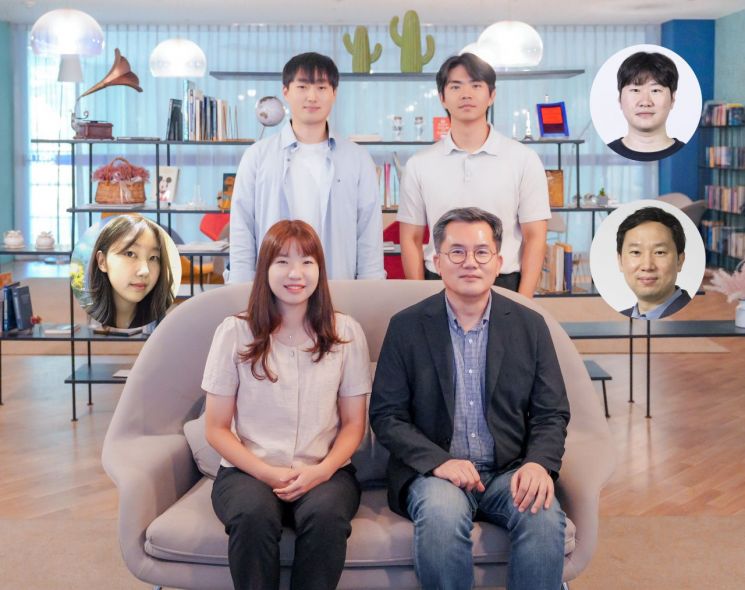 From the left below, counterclockwise: Hyejin Cho researcher (first author), Jiyeon Kim researcher (first author), Wonyoung Choi professor, Jihan Kim professor, Dongsik Nam researcher (first author).
The “up-down approach” proposed by the research team is a method that efficiently discovers new material structures by combining two existing approaches. The bottom-up method involves designing by building up from small units, while the top-down method sets a target structure first and then finds suitable materials for it.
The team first explored structures that could be designed using small metal pieces called “metal clusters.” They then identified organic linkers known as “ligands” to connect these clusters and complete new material structures. This approach overcomes the limitations of existing material development methods and enables more precise structural design.
MOFs are porous structures composed of metals and organic compounds, and have demonstrated excellent performance in various fields such as carbon dioxide separation and storage, and catalytic reactions. However, previous methods were limited by predefined components or structures, restricting the broad exploration of synthesizable structures.
The research team discovered 26 new structures using zirconium, and successfully synthesized two of them. They also introduced a “ribbon representation” method that allows for more precise ligand design, further improving synthesis accuracy.
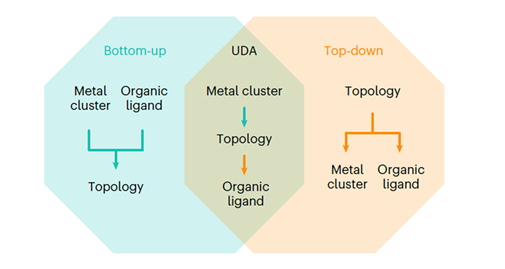 Comparison of Top-Down and Bottom-Up Approaches and Conventional Bottom-Up and Top-Down Methods for Discovering New Metal-Organic Frameworks.
First author Kim Jiyeon stated, “This approach is a powerful tool for rapidly exploring and developing new materials,” while co-first author Nam Dongsik added, “It has paved the way for the rapid discovery of innovative materials in various fields such as catalysis, gas storage, and environmental remediation.”
Professor Choi Wonyoung expressed his expectations, saying, “The chemical diversity of MOFs will be greatly expanded, broadening their range of applications,” and “This will present a new turning point in functional material research.”
The research was supported by the National Research Foundation of Korea (NRF) and UNIST, with joint participation from Professor Kim Jihan’s team at KAIST. The results were published in Nature Synthesis, a sister journal of Nature, on September 5.
© The Asia Business Daily(www.asiae.co.kr). All rights reserved.
![Clutching a Stolen Dior Bag, Saying "I Hate Being Poor but Real"... The Grotesque Con of a "Human Knockoff" [Slate]](https://cwcontent.asiae.co.kr/asiaresize/183/2026021902243444107_1771435474.jpg)
















