Concerns over economic slowdown have resurfaced due to disappointing US employment data, putting the KOSPI 2500 level at risk. The KOSPI, which has been declining for five consecutive days, briefly fell below the 2500 mark at the start of trading on the 9th. With the Chuseok holiday market closure, the US September Federal Open Market Committee (FOMC) meeting, US presidential candidate debates, and inflation data releases all lined up, a precarious market environment is expected to continue.
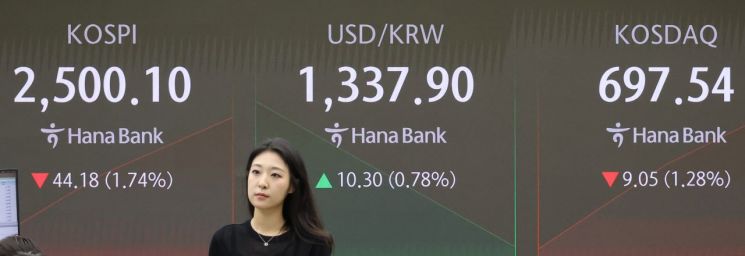
As of 9:10 AM on the 9th, the KOSPI stood at 2507.21, down 37.07 points (1.46%) from the previous session. The index opened below 2500 at 2498.67 but later narrowed its losses and recovered above the 2500 level.
This is attributed to the sharp decline in the US stock market on the 6th due to disappointing employment data. The Dow Jones Industrial Average fell 1.01%, the S&P 500 dropped 1.73%, and the Nasdaq declined 2.55%. Kim Seok-hwan, a researcher at Mirae Asset Securities, analyzed, "With August nonfarm payrolls falling short of expectations, US stocks closed lower amid widespread selling driven by growing concerns over economic slowdown. The absence of foreign demand, weakness in semiconductors, and increased pressure from economic slowdown are factors that heighten downside risks in the stock market, necessitating risk management."
However, there are opinions that the stock price could recover near the low 2500 level. Han Ji-young, a researcher at Kiwoom Securities, said, "Since the market is exposed to the same negative factors as in early August, it may temporarily fall below 2500, but considering the pre-reflection of related negative factors and the learning effect, resilience in stock prices is expected to form near the low 2500 level."
A conservative approach focusing on defensive stocks seems necessary. Kim Dae-jun, a researcher at Korea Investment & Securities, explained, "With macroeconomic instability and bonds showing strong performance, and the Chuseok holiday approaching, it is difficult to actively adjust investment portfolios. Maintaining weight in defensive sectors such as pharmaceuticals, tobacco, telecommunications, and utilities will be advantageous for protecting returns."
© The Asia Business Daily(www.asiae.co.kr). All rights reserved.