Anode Material Supply Chain Crisis... Institutional Support Needed
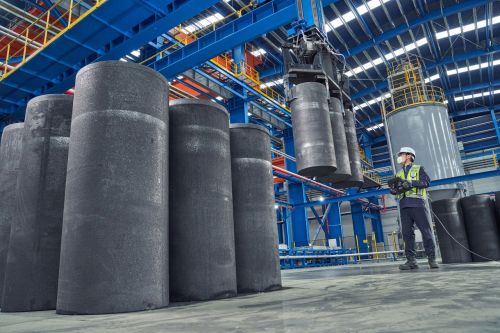
It has been revealed that POSCO Future M's natural graphite anode material plant operated at a rate in the 40% range this year. The company is the only one in South Korea producing battery anode materials.
According to industry sources on the 9th, POSCO Future M's anode material plant operation rate dropped from the 70% range in 2021 to the 60% range in 2022, then to the 50% range in 2023, and recorded the 40% range in the first half of this year. POSCO Future M's anode material sales in the first half of this year amounted to 99.6 billion KRW, down about 19.6% compared to 123.9 billion KRW in the same period last year.
Anode material, one of the four core battery materials, affects charging speed and lifespan. Chinese companies, leveraging low electricity costs and cheap labor, account for more than 90% of production. Except for POSCO Future M, all companies within the top 10 anode material market share are Chinese companies. Even for graphite, a key anode material, dependence on Chinese products is overwhelmingly high. According to a Korea International Trade Association survey, last year South Korea relied on Chinese imports for 97.2% of natural graphite and 95.3% of artificial graphite.
In this situation, POSCO Future M also faced the adverse effect of demand decline due to the electric vehicle chasm (temporary demand stagnation).
The U.S. Inflation Reduction Act (IRA) excludes Chinese graphite under the 'Foreign Entities of Concern (FEOC) regulation,' which has been deferred for two years until 2026, leading even domestic battery companies to flock to cheaper Chinese anode materials, further shrinking POSCO Future M's business. Initially, insiders in the battery materials industry expected POSCO Future M to emerge as a global alternative to Chinese companies in the anode material market. However, with the FEOC regulation deferred for two years, battery companies can use cheaper Chinese anode materials until the end of 2026, directly impacting POSCO Future M's anode material sales.
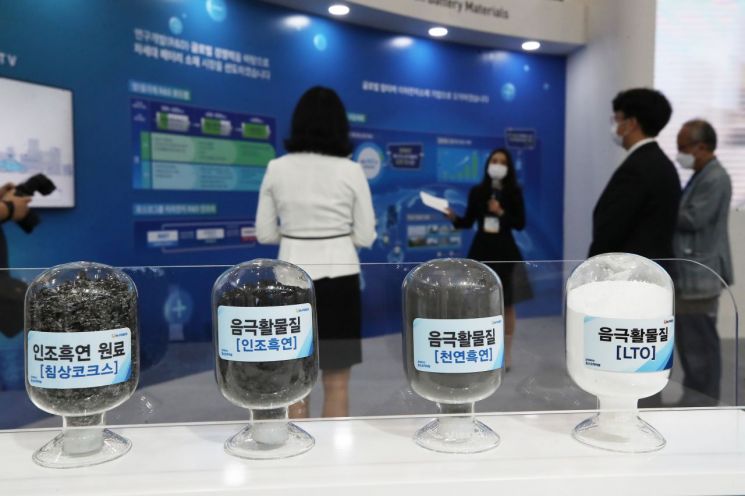 InterBattery visitors are examining natural graphite anode materials at the POSCO Future M booth.
 [Image source=Yonhap News]
Just 10 months ago, the anode material supply chain was the hottest issue in the battery industry. At the end of last year, the Chinese government announced measures to control exports of high-purity graphite, a raw material for anode materials. Concerns arose that tightening supply of this key material could disrupt domestic battery production itself. POSCO Future M emerged as the only countermeasure amid the poor anode material supply chain situation. The industry points out that institutional support such as subsidies is necessary to strengthen the anode material supply chain in the future.
In a recent report titled '2024 Economic Analysis and Industrial Trade and Energy Policy Direction Study,' the Korea Institute for Industrial Economics and Trade suggested, "The battery sector should consider production subsidies for domestic anode material plants, similar to China's electric vehicle production subsidies and the U.S.'s cell production subsidies," adding, "Although POSCO Future M produces anode materials, its plant operation rate is low at around 40%, so it is important to enhance price competitiveness through production subsidies."
© The Asia Business Daily(www.asiae.co.kr). All rights reserved.


















