Financial Services Commission Chairman Points Out at Mutual Finance Sector Meeting with ShinHyup, NongHyup, Saemaeul Geumgo, etc.
'Same Work-Same Regulation' Principle, Strengthening Regulations on Governance and Business Practices
Orders to Resolve Non-performing PF within 6 Months... Soundness Recovery Plan by Year-End
"Time for Fundamental Review of Operation Structure and Methods Needed"
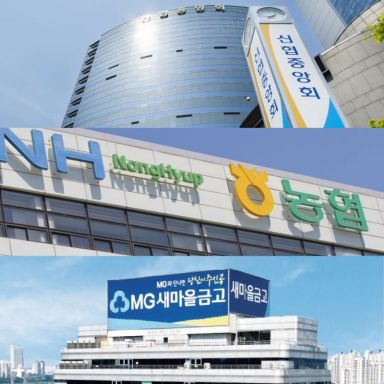
Kim Byung-hwan, Chairman of the Financial Services Commission, met with the mutual finance sector and pointed out that it had focused solely on external growth, neglecting its role as a regional and grassroots financial institution. He urged efforts to restore soundness and strengthen risk management capabilities while seeking ways to regain its original identity.
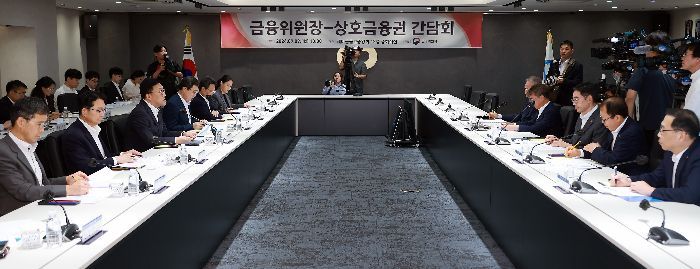
On the 9th, Chairman Kim met with representatives from related ministries including the Ministry of the Interior and Safety, Ministry of Agriculture, Food and Rural Affairs, Ministry of Oceans and Fisheries, and Korea Forest Service, as well as CEOs of five mutual finance central associations at the National Credit Union Federation of Korea. This was the seventh session of the financial sector relay meeting, where they discussed the direction the mutual finance sector should take to regain public trust and transform into a face-to-face, relationship-based financial institution.
In his opening remarks, Chairman Kim said, "Although mutual finance institutions were established as 'non-profit regional and grassroots financial institutions' based on 'community bonds and mutual trust,' there are concerns that they have recently neglected their original role by focusing only on external growth." He added, "As a result of excessive deposit competition based on tax-exempt benefits without sufficient asset management capabilities and fund operation plans, the asset size has expanded far beyond the level manageable by risk management capabilities," calling for self-reflection.
He emphasized that the most urgent task surrounding the mutual finance sector is to promptly resolve the problematic real estate project financing (PF). Chairman Kim stated, "For projects rated as having concerns about insolvency based on PF feasibility assessments, please promptly complete the restructuring and resolution plans prepared internally within six months."
He also urged that measures for resolving non-performing loans and enhancing loss absorption capacity, as well as other plans to restore soundness, be implemented without delay by the end of the year. The mutual finance sector must operate non-performing loan resolution subsidiaries and engage in bulk sales of non-performing loans through accounting firms, in accordance with the non-performing loan resolution plan announced by financial authorities.
To enhance loss absorption capacity, from the end of this year, standards must be met such as limiting real estate and construction sector loans to within 30% each (50% combined) of total loans, and maintaining liquid assets at 100% or more of liquid liabilities (90% for assets under 100 billion KRW for one year).
In particular, Chairman Kim noted, "Due to their unique nature, mutual finance institutions have been subject to looser regulations compared to other financial institutions, but under the fundamental principle of 'same business, same regulation,' it is necessary to adjust regulations to a level comparable to other financial institutions." He added, "We will sequentially consult with related ministries and agencies on the direction of regulatory system reforms by sector, including governance, business conduct, and resolution of insolvency."
He also called for the restoration of the mutual finance sector’s original role and strengthening of its capabilities. Over the past decade, the total assets of the mutual finance sector have rapidly doubled to 1,033 trillion KRW, raising concerns that the asset size is too large compared to the cooperative nature of mutual aid.
Chairman Kim said, "It is anticipated that the asset size will continue to expand due to favorable deposit conditions, so it is time for fundamental reconsideration of the operational structure and methods." He emphasized, "It is essential to swiftly enhance risk management capabilities and fund operation skills, innovate systems to advance credit screening abilities, and secure operational stability through strengthening asset management capabilities."
He added, "The solution to the crisis faced by the mutual finance sector lies in returning to the 'essence' and 'basics' of mutual finance." He continued, "It must return to being an institution that provides customized financial products and services to local residents and grassroots customers by utilizing analog deep data accumulated through close interaction with the community and the underprivileged."
Meanwhile, the mutual finance sector attendees at the meeting proposed regulatory relaxations such as introducing grace measures allowing a one-time extension of loan periods if the asset and capital of cooperatives decrease due to the sale of non-performing loans, which in turn reduces the loan limit for the same borrower. They also requested policy considerations for small cooperatives that lack sufficient personnel and resources when various regulations are introduced.
Cho Sung-hwan, Director of the Regional Economic Support Bureau at the Ministry of the Interior and Safety, said, "A closer cooperation system between the Ministry of the Interior and Safety and financial authorities has been established through MOUs, enhanced joint audits, and the launch of the mutual finance team." He requested active support from the Financial Services Commission in institutional improvements and legislative processes to help the mutual finance sector, including Saemaeul Geumgo, regain its original role.
© The Asia Business Daily(www.asiae.co.kr). All rights reserved.
![Clutching a Stolen Dior Bag, Saying "I Hate Being Poor but Real"... The Grotesque Con of a "Human Knockoff" [Slate]](https://cwcontent.asiae.co.kr/asiaresize/183/2026021902243444107_1771435474.jpg)
















