After Macroeconomic and Financial Issues Meeting, Briefing Reveals
"Banks Familiar with Borrowers' Situations Must Manage Independently"
Policy Funds Affect Household Debt Increase... "Plan to Strengthen Management"
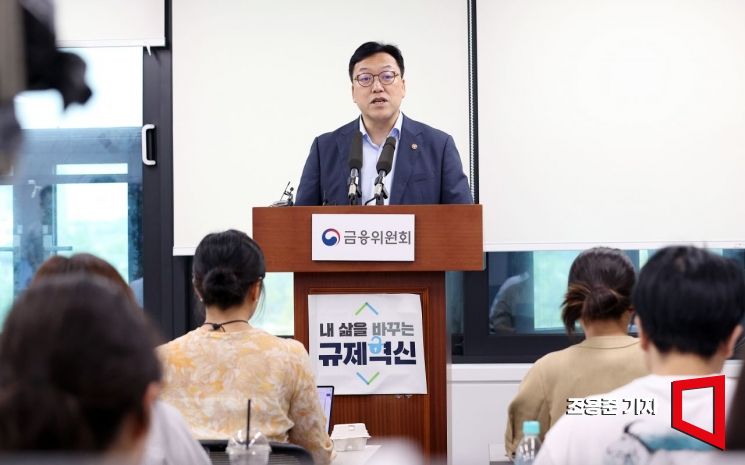 Financial Services Commission Chairman Kim Byung-hwan is giving a briefing on household debt at the Government Seoul Office in Jongno, Seoul, on the 6th. Photo by Jo Yong-jun jun21@
The government reiterated that there is no change in its stance on strengthening the management of the rapid increase in household debt, and stated that if the situation worsens, it will boldly implement all possible management measures. Contrary to the sharp criticism of the banking sector's loan interest rate hikes by Financial Supervisory Service Governor Lee Bok-hyun, the government expressed the view that autonomous management by banks is preferable to uniform government control.
On the 6th, Financial Services Commission Chairman Kim Byung-hwan said in a briefing after a macroeconomic and financial issues meeting held at the Government Seoul Office, "There is no change whatsoever in the policy of strengthening household debt management." The meeting was attended by Deputy Prime Minister for Economy Choi Sang-mok, Minister of Land, Infrastructure and Transport Park Sang-woo, Financial Supervisory Service Governor Lee Bok-hyun, and Presidential Office Economic Secretary Park Chun-seop, among others.
Chairman Kim voluntarily held the unannounced briefing in response to opinions calling for a clear statement on the government's recent policy direction. He said, "As the housing market overheats, household loans are rapidly increasing," adding, "Controlling household loans is essential to stabilize the macroeconomy and the housing market, and to benefit the public."
He continued, "Banks are autonomously making various efforts to manage loans, but as various discussions arise during this process, there was a consensus on the need to clarify the government's position, so I am stating it now," emphasizing, "Rather than uniform government control, it is important for individual financial institutions to assess risk levels and borrower characteristics and manage accordingly, such as restricting speculative demand."
He also noted that uniform government control could cause significant side effects. Since frontline banks can more effectively understand and respond to individual borrowers' circumstances, uniform control could instead cause greater inconvenience.
Chairman Kim said, "The government's consistent position is to stably reduce the household debt ratio to achieve stability in the macroeconomy and financial markets," adding, "If the household debt burden accumulates, it will place a strain on the macroeconomy and cause a vicious cycle of housing market overheating and financial market instability."
He reiterated the government's willingness to promptly implement additional management measures for household debt if the situation worsens. He explained, "If the housing market continues to overheat and household debt rapidly increases, we will boldly implement the prepared additional management measures in a timely manner," adding, "We are basically preparing measures centered on the Debt Service Ratio (DSR), and will swiftly take necessary actions at the appropriate time, focusing on areas where loans are rapidly increasing."
Meanwhile, he expressed the intention to strengthen management of policy fund loans, which have contributed to the increase in household loans. Chairman Kim said, "It is true that policy funds accounted for a high proportion of the overall increase in household loans since April," adding, "We plan to strengthen management of policy funds going forward." He also urged, "We hope financial companies will thoroughly manage their loans themselves," and "We hope the public will avoid hastily purchasing homes by taking on loans they cannot afford."
© The Asia Business Daily(www.asiae.co.kr). All rights reserved.
![Clutching a Stolen Dior Bag, Saying "I Hate Being Poor but Real"... The Grotesque Con of a "Human Knockoff" [Slate]](https://cwcontent.asiae.co.kr/asiaresize/183/2026021902243444107_1771435474.jpg)
















