Domestic PEF Operators Association New Chair Company to Launch Next Month
Domestic Private Equity Fund Market Expected to Surpass 150 Trillion Won This Year
Focus on Mandatory Tender Offer System and Financial Holding Capital Regulation Response
H&Q Korea has been appointed as the new chair company representing the domestic private equity fund (PEF) operators' association.
According to the investment banking (IB) industry on the 9th, the PEF Operators' Association plans to hold its regular general meeting at the end of October to appoint Lim Yoo-cheol, CEO of H&Q Korea, as the 8th chairman. The term is one year, and Daishin Private Equity (Daishin PE) has been designated as the vice-chair company.
Expected to Surpass 150 Trillion Won Within the Year... Roles and Current Issues of the PEF Operators' Association
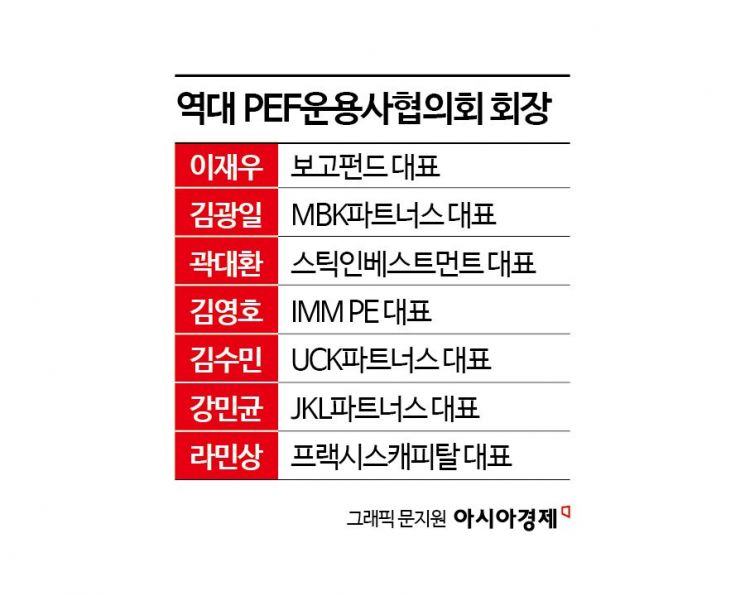
The PEF Operators' Association, the official channel handling domestic PEF issues, has had a series of chairpersons starting with Lee Jae-woo, CEO of Bogop Fund, followed by Kim Kwang-il of MBK Partners, Kwak Dae-hwan of Stick Investment, Kim Young-ho of IMM PE, Kim Soo-min of UCK Partners, Kang Min-gyun of JKL Partners, and Ramin Sang of Praxis Capital. The association has about 100 member companies, and the domestic private equity fund market exceeded 143 trillion won at the end of last year, with expectations to surpass the 150 trillion won mark within this year.
Currently, the 7th PEF Operators' Association, led by CEO Ramin Sang, achieved a result in the introduction of the insider trading pre-disclosure system by continuously communicating with the financial investment industry and authorities. The system, implemented in July this year, excludes PEF equity sales from the pre-disclosure requirements. The newly launched 8th PEF Operators' Association is expected to focus on the mandatory tender offer system, which requires amendments to the Capital Markets Act, and responses to financial holding company capital regulations. The mandatory tender offer system, a major issue in the PEF industry, stipulates that when acquiring shares of a target company for mergers and acquisitions (M&A), the controlling shareholder must also make a mandatory tender offer for all remaining shares after the acquisition. Regarding the other issue of financial holding company capital regulations, financial holding companies apply a 400% risk-weighted asset factor when investing in PEFs and venture capital, causing difficulties in forming new funds, thus raising the need for regulatory easing.
What Kind of Company is H&Q Korea, the 8th Chair Company... Partner of the National Pension Service, First Generation Korean PEF
H&Q Korea, a first-generation domestic PEF operator, originated from the global PEF operator H&Q, which first entered Korea in 1998, and transformed into a native PEF by spinning off its domestic office in 2005. The PEF system was introduced domestically in 2004 following the revision of the Capital Markets Act, and in the following year, it raised the first blind fund, 'H&Q-National Pension Service No. 1,' with a scale of 300 billion won. Subsequently, the National Pension Service invested in all the 2nd to 4th blind funds raised by H&Q. H&Q Korea has also received investments from other pension funds and mutual aid associations. The average tenure of its four core personnel is 22 years. The four co-CEOs are Lee Jong-won, Lee Jung-jin, Lim Yoo-cheol, and Kim Hoo-jung. CEOs Lee Jong-won and Kim Hoo-jung have been with H&Q Korea since its days as a Korean branch in 1998. CEO Lim Yoo-cheol joined H&Q Korea in 2002 after working at ReTowerTech and Leadcorp. CEO Lee Jung-jin, who joined in 2008, is a financial veteran with experience at Seoul Securities, Hanil Investment Trust Management, ValueQuest, and Leadcorp. These four CEOs have steadily built their track record together through the ups and downs of the capital market, including the IMF foreign exchange crisis, the 2008 global financial crisis, and the COVID-19 pandemic. They do not limit their investments to specific industries. The first fund focused on manufacturing, such as automotive parts and ship engine parts, while the second fund was mainly consumer goods. The third fund ventured into bio-pharmaceuticals and platform businesses. The fourth fund, formed in 2020, has Hyundai Elevator, which received 310 billion won in investment, as its core portfolio. This year, H&Q plans to raise its first 1 trillion won-class fund through the 5th blind fund since its founding.
© The Asia Business Daily(www.asiae.co.kr). All rights reserved.
![Clutching a Stolen Dior Bag, Saying "I Hate Being Poor but Real"... The Grotesque Con of a "Human Knockoff" [Slate]](https://cwcontent.asiae.co.kr/asiaresize/183/2026021902243444107_1771435474.jpg)
















