Ministry of Economy and Finance Announces Strategic Knowledge Sharing Project Plan
Leading Project Selection and Establishing Implementation Plans
Deputy Prime Minister Choi Sang-mok: "Supporting Our Companies' Exports"
The government is reforming the Knowledge Sharing Program (KSP) that shares South Korea's economic development experience with developing countries. The system will shift from a passive approach where partner countries select desired projects to a structure where Korea proactively proposes projects first, while also enhancing project speed and evaluation standards.
On the 6th, Choi Sang-mok, Deputy Prime Minister and Minister of Economy and Finance, held the Foreign Economic Ministers' Meeting at the Government Complex Seoul and discussed and approved the "Strategic Knowledge Sharing Program Promotion Plan" containing these details. This plan was prepared to improve the project approach in response to the changing economic cooperation environment and to support Korean companies.
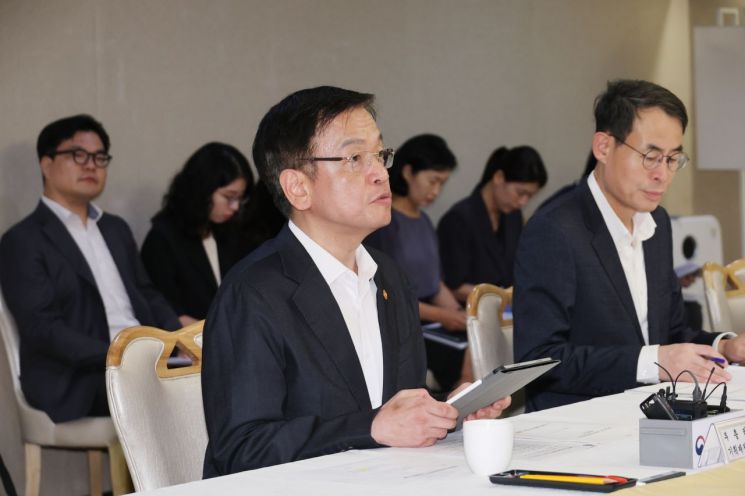 Choi Sang-mok, Deputy Prime Minister for Economic Affairs and Minister of Economy and Finance, is presiding over the Foreign Economic Ministers' Meeting held at the Government Seoul Office in Jongno-gu, Seoul on the 6th.
 Photo by Yonhap News Agency
The government plans to take the lead in changing the project selection system. Until now, KSP projects were conducted by selecting projects submitted by partner countries. Going forward, the Korean government will first propose projects considering the demands of domestic companies. Projects will be determined based on domestic mid- to long-term strategies, field demands, and economic diplomacy achievements. Project discovery will utilize the Economic Development Cooperation Fund (EDCF), Economic Joint Committee, Multilateral Development Banks (MDB), and others.
Additionally, to carry out strategic projects, implementation plans will be established every three years. Strategies will be developed through research divided by region and sector in the first and second halves of the year.
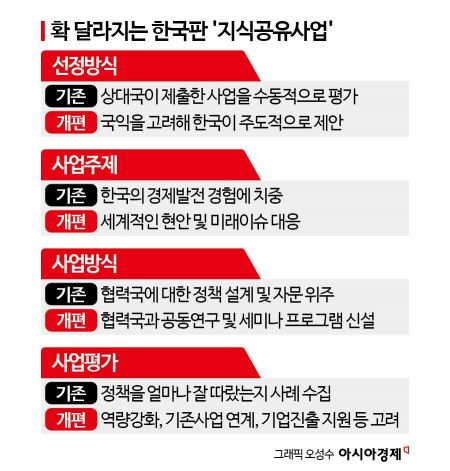
Measures to accelerate project speed are also included. In principle, KSP projects must be proposed two years in advance. This caused a drawback where partner countries' proposals could not be accepted quickly. Accordingly, the government will expand the budget for "emergency projects" that can start immediately from the current 20% to 40%. A system will be established to promptly implement additional capacity-building projects or dispatch experts so that results can appear quickly.
Cooperation with external parties will also be strengthened. The government will create new projects that conduct joint research or seminars with partner countries. Joint research outcomes will be officially discussed between governments, and knowledge-sharing seminars will be held during high-level meetings. Common issues of emerging donor countries such as Thailand, Kazakhstan, and Turkey will be prioritized, and knowledge cooperation partnerships will be established with development aid agencies of advanced countries. Among international organizations, cooperation with MDBs will be further advanced.
The evaluation system will be reorganized. Until now, performance monitoring only assessed how well policies were implemented, but going forward, it will also consider how much capacity has increased and how much support was provided for Korean companies' market entry. To reflect partner countries' opinions, local officials' views will be gathered and incorporated when preparing policy reports.
Deputy Prime Minister Choi said, "Through the implementation of the Knowledge Sharing Program reform plan, we will contribute to solving global issues while actively supporting our companies' overseas orders and exports."
© The Asia Business Daily(www.asiae.co.kr). All rights reserved.


















