60 Days Before Early General Election
Republican Member... 'Mr. Brexit' Veteran Politician
Left-Wing Coalition "Election Stolen"
French President Emmanuel Macron on the 5th (local time) appointed former minister Michel Barnier, a member of the right-wing Republican Party, as Prime Minister. This marked the birth of the fourth cohabitation government of the French Fifth Republic, just 60 days after the early general election.
The ?lys?e Palace stated that "the President has entrusted him with the task of forming a unified government to serve the nation and the French people," adding, "This appointment followed an unprecedented series of consultations, and in accordance with constitutional duties, the President ensured that the next Prime Minister and government would have conditions to receive as stable and broad support as possible."
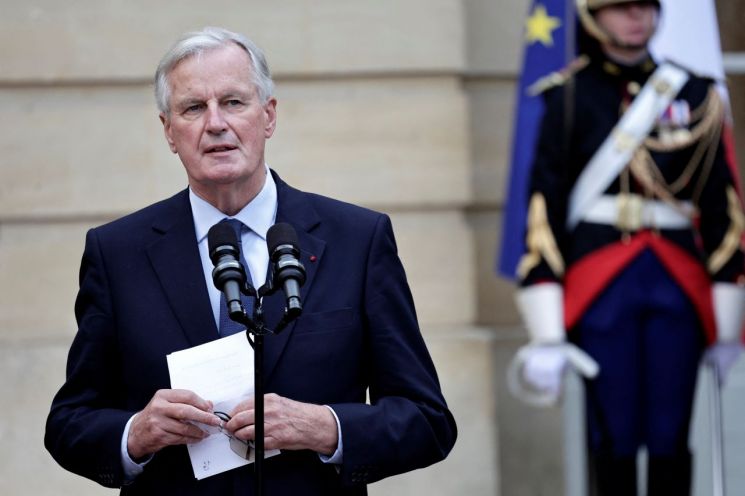
With President Macron appointing the new Prime Minister on this day, the interim government that had lasted for over 50 days since the cabinet resignation on July 16 also came to an end.
At the inauguration ceremony in the afternoon, Prime Minister Barnier said, "We are now in a serious situation. To make this period useful for the French people, decisive action is necessary," and presented policy tasks including ▲access to public services ▲school issues ▲daily safety ▲immigration control ▲improving the living standards of the French people.
Barnier continued, saying that what the people expect from the Prime Minister is honesty, stating, "First, we must speak the truth about the financial debt and ecological debt that heavily weigh on the shoulders of our children."
Born in 1951, Barnier is 73 years old this year. He is the oldest Prime Minister since the establishment of the French Fifth Republic in 1958. He has served three terms as a member of the National Assembly, one term as a senator, and three times as a minister. He has twice served as a European Union (EU) Commissioner and is a veteran politician who played a key role as the chief negotiator when the EU discussed Brexit (the UK's withdrawal from the EU). He earned the nickname "Mr. Brexit" during that time.
With the appointment of Prime Minister Barnier, the fourth cohabitation government in the history of the French Fifth Republic was formed. President Macron belongs to the centrist Renaissance party, while Prime Minister Barnier is from the traditional right-wing Republican Party, meaning their affiliated parties differ.
In the early general elections held on June 30 and July 7 (runoff), the broad pro-government coalition including Renaissance won 168 out of 577 seats in the National Assembly. This placed them second behind the left-wing coalition New Popular Front (NFP), which won 182 seats. It is impossible to govern alone. The Republican Party ranked fourth.
Since June 23, President Macron has been meeting with leaders of various parties to search for a prime minister candidate. Although several moderate left and right figures were mentioned, none reached final appointment due to the high likelihood of a no-confidence vote in the National Assembly. The French President has the right to appoint the Prime Minister, but the National Assembly can pass a no-confidence motion against the government.
Among the candidates, Prime Minister Barnier was considered least likely to face a no-confidence vote, could receive support from the Republican Party in government operations, and was unlikely to run in the 2027 presidential election. These factors were cited as reasons for his appointment. According to local media reports citing Macron’s close aides, there was also a belief that the right-wing Barnier would not reverse the policies implemented by the Macron government over the past seven years.
Prime Minister Barnier will form a coalition government that unites the broad pro-government camp and moderate left and right factions. However, as a coalition government, Barnier’s room for maneuver will inevitably be limited. The leadership of the cohabitation government is expected to remain with President Macron.
The news of Barnier’s appointment sparked strong opposition from left-wing parties affiliated with the NFP, who came in first in the general election but were deprived of the prime minister position.
Jean-Luc M?lenchon, leader of the far-left party La France Insoumise (LFI) within the NFP, criticized on his YouTube channel, saying, "The election was stolen," and added, "The second round of the general election focused on blocking the far-right National Rally (RN), and the person closest to that (political) position was appointed." Olivier Faure, leader of the Socialist Party, protested, saying, "This is the peak of denial of democracy. The person from the party that came in fourth in the election became Prime Minister." Marine Tondelier, leader of the Green Party, also reacted, saying, "Who are you mocking?"
© The Asia Business Daily(www.asiae.co.kr). All rights reserved.
![Clutching a Stolen Dior Bag, Saying "I Hate Being Poor but Real"... The Grotesque Con of a "Human Knockoff" [Slate]](https://cwcontent.asiae.co.kr/asiaresize/183/2026021902243444107_1771435474.jpg)















