Yanolja Research, First Half Inbound Tourism Statistics
7.7 Million Arrivals in First Half of This Year... 74% Increase YoY
Average Spending per Person 1.34 Million KRW, Decrease of 810,000 KRW
Decrease in Spending by Chinese Visitors with Highest Arrivals
The number of foreign tourists visiting South Korea in the first half of this year increased by more than 70% compared to the same period last year, recovering to 90% of the pre-COVID-19 level. However, the amount spent by inbound tourists during the same period decreased by nearly 40%. Despite the increase in visitor numbers, the decline in spending highlights the need to strengthen the substance of inbound tourism, which promotes K-tourism sales.
 Foreign visitors are shopping for cosmetics at a cosmetics shopping mall in Myeongdong, Seoul. Photo by Younghan Heo younghan@
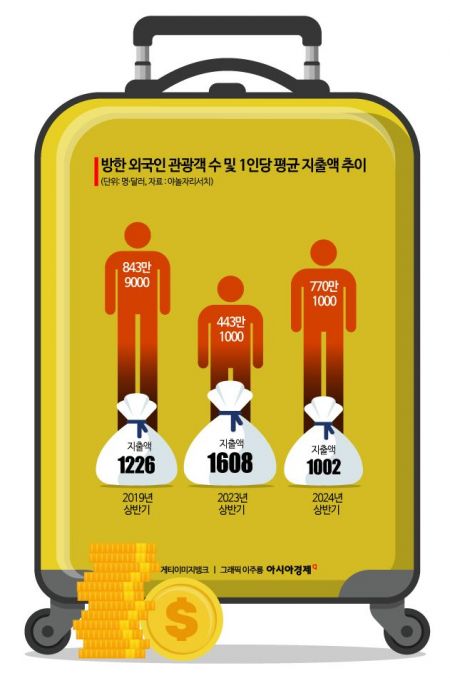
According to the "2024 First Half South Korea Inbound and Outbound Tourism" report released on the 5th by Yanolja Research, an independent private travel industry research institute, the number of foreign tourists visiting South Korea in the first half of this year was 7,701,407, a 73.8% increase compared to about 4,431,000 in the same period last year. Compared to the first half of 2019, before the COVID-19 pandemic, when there were about 8,439,000 visitors, the number of inbound tourists has recovered to 91.2% of that level.
By region, Chinese tourists were the largest group with about 2.22 million, followed by Japan (about 1.43 million), Taiwan (about 690,000), and the United States (about 640,000). Since group tours abroad resumed last year, the number of Chinese tourists visiting Korea in the first half of this year increased more than fourfold compared to the same period last year (about 550,000).
Although the Korean government has set an annual target of 20 million foreign tourists and the actual number of visitors is rapidly recovering to pre-COVID-19 levels, the spending by travelers is on a downward trend. The average expenditure per inbound tourist in the first half of this year was about $1,002 (approximately 1.34 million KRW), a 37.7% decrease from $1,608 (about 2.15 million KRW) in the same period last year. Compared to $1,225 (about 1.64 million KRW) in 2019, it is also an 18.3% decrease. As a result, despite the significant increase in inbound tourists, South Korea's tourism revenue in the first half of this year was about $7.7 billion (approximately 10.28 trillion KRW), only about 8% higher than the same period last year. Compared to the first half of 2019, it is 74.6% of that level.
Hong Seok-won, senior researcher at Yanolja Research, explained, "Among Chinese tourists in the first half of this year, a considerable number were cruise travelers who departed from their home country, stopped over in Jeju, and then proceeded to Japan or other countries. When counting inbound tourists, these numbers are included, but since no spending occurs at the stopover, the overall average expenditure per person did not increase." He added, "The length of stay and spending of Chinese tourists, who accounted for a large portion of tourism revenue, have decreased compared to before. The increase in individual travelers rather than business visitors is also believed to have contributed to the decline in spending."
Meanwhile, the number of outbound tourists (Koreans traveling abroad) in the first half of this year was 14,023,382, a 41.2% increase compared to the same period last year. Compared to the first half of 2019, it has recovered to about 93.4%. The average expenditure per outbound tourist was about $934 (approximately 1.35 million KRW). The total overseas tourism expenditure was about $13.1 billion (approximately 17.5 trillion KRW), resulting in a tourism balance deficit of $5.4 billion (approximately 7.51 trillion KRW) for South Korea in the first half of the year.
Yanolja Research emphasized, "Ultimately, to improve the tourism balance, inbound tourism must be further activated. It is necessary to actively attract foreign tourists through a national strategic approach and focus on developing high value-added tourism products and services."
© The Asia Business Daily(www.asiae.co.kr). All rights reserved.
![Clutching a Stolen Dior Bag, Saying "I Hate Being Poor but Real"... The Grotesque Con of a "Human Knockoff" [Slate]](https://cwcontent.asiae.co.kr/asiaresize/183/2026021902243444107_1771435474.jpg)
















