Collaboration with Busan Citizens' Media Center
Barrier-Free Environment Planning Class
Papers that deeply analyze the effects of unique government-academic cooperation lectures have recently been published in succession, drawing much attention.
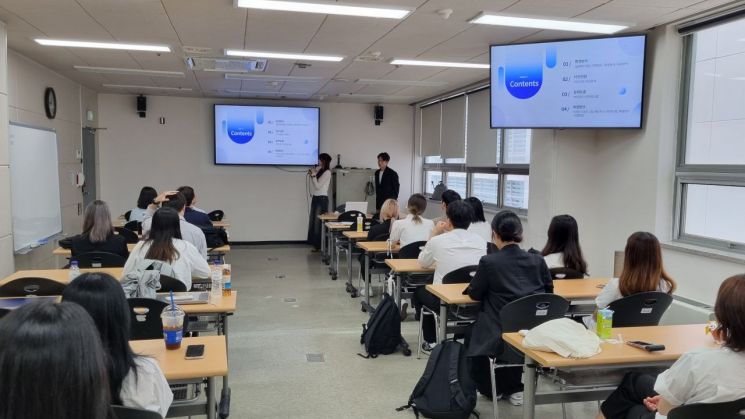
Professor Lee Jeonggi of Tongmyong University (Department of Advertising and Public Relations) published a paper on August 31 analyzing the outcomes of a government-academic cooperation class operated in partnership with the Busan Audience Media Center of the Korea Press Foundation.
The paper, titled "A Study on the Effects of Government-Academic Cooperation Living Lab (Barrier-Free Environment Planning Class): Focusing on Understanding of Barrier-Free, Minority Human Rights Issues, and Problem-Solving Competency," was published in Volume 32, Issue 3 of the Journal of Humanities and Social Sciences Research.
'Barrier-free' refers to a movement aimed at breaking down physical and institutional barriers to create a better society for socially disadvantaged groups, such as the elderly and people with disabilities.
Since 2023, the Department of Advertising and Public Relations at Tongmyong University has been running "Creative Planning and Problem-Solving Methods_Living Lab" (a second-year major course) as a government-academic cooperation subject for two consecutive years.
Based on their studies of human rights and barrier-free concepts, students identified relevant issues in the Busan area and wrote planning proposals to solve these problems through collaboration with the local community.
Projects included the Barrier-Free Environment Creation Project at Ilgwang Beach, the Barrier-Free Campus Project for International Students, and the Popup Store Barrier-Free Environment Project.
They also carried out the Barrier-Free Environment Creation Project at the Nam-gu National Sports Center in Busan. This paper is the first to verify the effects of such a government-academic cooperation living lab class by analyzing students' reflective journals.
According to the paper, students (23 in total) who took the government-academic cooperation living lab class jointly planned and team-taught by the Department of Advertising and Public Relations at Tongmyong University and the Busan Audience Media Center showed a significant increase in their understanding of and awareness of the importance of barrier-free concepts compared to before the class.
Their understanding of minority human rights issues in the local community, as well as their problem-solving competencies, also improved noticeably.
This paper demonstrates that government-academic cooperation classes, where local universities and public institutions collaborate closely, can be effective in enhancing students' awareness of human rights and their problem-solving abilities.
Professor Lee Jeonggi's paper will soon be available through academic journal search sites such as 'DBpia.' The students' barrier-free environment planning proposals can be found on the website of the Department of Advertising and Public Relations at this university.
This is not the first time Professor Lee has published a paper analyzing the effects of government-academic cooperation classes. Previously, in February, he empirically verified the effects of such classes through the paper "A Study on the Effects of Region-Centered Government-Academic Cooperation Media Literacy Program: Focusing on the Government-Academic Cooperation Course of the Busan Audience Media Center and Tongmyong University Department of Advertising and Public Relations" (Region and Communication, Volume 28, Issue 1, co-authored with Professor Hwang Woonyeom).
© The Asia Business Daily(www.asiae.co.kr). All rights reserved.
![Clutching a Stolen Dior Bag, Saying "I Hate Being Poor but Real"... The Grotesque Con of a "Human Knockoff" [Slate]](https://cwcontent.asiae.co.kr/asiaresize/183/2026021902243444107_1771435474.jpg)
















