Jicheon Multipurpose Dam, Storage Capacity of 59 Million m³... Stable Water Supply Possible
Local Economy Expected to Grow with Development of Recreation, Tourism, Experience, and Residential Industry Zones
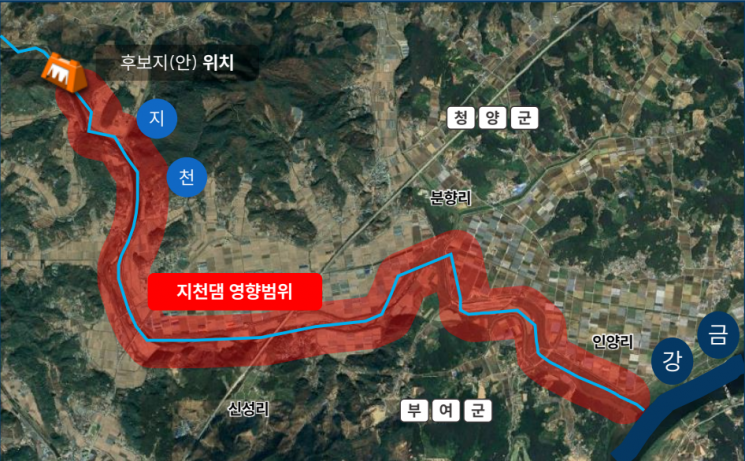 The lower stream of the tributary connecting Jangpyeong-myeon in Cheongyang-gun, Chungnam Province, to Eunsan-myeon in Buyeo-gun has been selected as a candidate site for the government's flood response dam. / Chungnam Province
The water resources in Chungnam are drying up due to the climate crisis. The ongoing heatwaves are worsening the water shortage problem, while heavy downpours continue to cause massive property damage. As natural disasters become increasingly severe each year, dam construction is emerging as an alternative for drought and flood control.
According to Chungnam Province on the 5th, from 2015 to 2017, repeated droughts in Chungnam led to Boryeong Dam, the main source of water for daily life and industry, recording its lowest-ever water storage rate (8.3%), exposing the reservoir bottom. Eventually, restricted water supply was implemented in the southwestern region of Chungnam, reducing water supply by 20%.
After the drought, torrential rains swept through Chungnam. From 2022 to 2024, heavy rainfall caused river flooding and the collapse of tributary embankments, resulting in damages exceeding 100 billion KRW. The government designated Cheongyang County, Buyeo County, and other severely affected areas as special disaster zones and supported recovery efforts. However, as torrential rains continued before recovery was complete, there is now an urgent need for fundamental measures against these recurring disasters.
The Geumgang basin has the second most severe water shortage after the Hangang basin. Chungnam receives water from Daecheong Dam, Yongdam Dam, Boryeong Dam, Asan Industrial Water, and local water supply systems. The available daily water supply is 2.06 million cubic meters, of which 1.371 million cubic meters are currently used. Although there is a surplus of 689,000 cubic meters, this amount has already been allocated to new industrial complexes in Seosan and Asan scheduled for 2030. In particular, over 80% of the southwestern region relies on Daecheong Dam, but even this dam is reaching its supply limit as inflow has decreased since the construction of Yongdam Dam.
Fortunately, by 2027, with the completion of the Seosan seawater desalination plant, the western Daecheong Dam project, and the Cheongyang groundwater dam, daily water supply will increase to 2.266 million cubic meters, allowing water provision to 13 industrial complexes, including Daesan Green Complex. However, if additional water sources are not secured by 2035, when 15 more industrial complexes such as Cheonan Future Mobility are established, demand will exceed supply from 2031, and by 2035, there will be a daily shortage of 178,000 cubic meters.
The government’s announcement of plans to build climate response dams at 14 locations nationwide is a measure to address the worsening climate crisis and future water shortages. The government has considered alternatives such as seawater desalination, seawater reuse, and groundwater storage dams, but judged these insufficient to resolve the water shortage. As countries like the United States, Japan, China, and Indonesia are also constructing new dams to prepare for droughts and floods, it is urgent for Korea to secure new water resources.
The climate response dams will be built by basin: four in the Hangang basin, six in the Nakdonggang basin, one in the Geumgang basin, and three in the Yeongsangang/Sumjingang basin. These include three multipurpose dams, seven flood control dams, and four water supply dams.
In the Geumgang basin, the lower reaches of the Jicheon stream, running from Jangpyeong-myeon in Cheongyang County to Eunsan-myeon in Buyeo County, have been selected as a candidate site for a multipurpose dam. The Jicheon Multipurpose Dam will have a storage capacity of 59 million cubic meters, supplying 55 million cubic meters annually (110,000 cubic meters daily), and providing 19 million cubic meters of flood control capacity. While Cheongyang and Buyeo counties currently rely on Daecheong and Boryeong dams, the new dam will prioritize supplying these counties once constructed.
The candidate site for the Jicheon Multipurpose Dam is geographically suitable due to the high terrain on both sides and is not designated as a natural environment conservation area or protected zone. Chungnam Province considers dam construction a project that will secure the region’s water future for the next 100 years and regards the Jicheon basin as the optimal location for the dam.
Upstream from Jicheon, there are tourist attractions such as Chilgapsan Recreation Land and camping sites, which are expected to be further developed in connection with the dam. The Ministry of Environment and the province are also preparing measures such as regulatory relaxation and support projects to minimize resident impact during dam construction.
Regarding the residents’ main concern about water source regulations, no water intake facilities will be installed at the Jicheon Multipurpose Dam, and existing Geumgang intake facilities will be used to ensure that the area is not designated as a water source protection zone. Similarly, Chungju Dam, Yeongju Dam, Gunwi Dam, and Bohyeonsan Dam do not have intake facilities and are not subject to water source regulations.
Support projects will divide the area near the dam into waterfront recreation zones, scenic tourism zones, ecological and educational experience zones, and residential-industrial zones to revitalize the region and provide economic opportunities for residents. The waterfront area created by the dam will feature a cultural center, lawn plaza, and floating stage, offering spaces for both nature appreciation and hands-on experiences.
In the tourism zone, a trail encircling the dam will be created in connection with Chilgapsan and Alps Village, along with observation decks, zip lines, and cafe streets. To promote the “4 days in the city, 3 days in the countryside” (4do 3chon) lifestyle, eco-parks, forest playgrounds, and experiential tourism content will also be developed.
For residents displaced by the dam construction, compensation of 12 to 24 million KRW for land, 20 million KRW per household for relocation and settlement, and 2.5 million KRW per person for livelihood stabilization will be provided. In addition, a relocation complex called “Zero Energy Town” for about 200 households, a suburban-style retirement village, and a premium condo complex will be built to help residents remain in their hometown.
Economic activities for relocated residents will be supported through local eco-markets for agricultural production and sales, convenience stores, fishing spots, and job training programs.
An official from the province stated, “In Yeongcheon, Gyeongbuk, after the construction of Bohyeonsan Dam, the area was developed with a suspension bridge, zip wire, astronomy museum, and natural recreation forest, attracting 670,000 tourists annually,” adding, “Once the Jicheon Dam construction is confirmed, we will swiftly promote support projects to revitalize the local economy.”
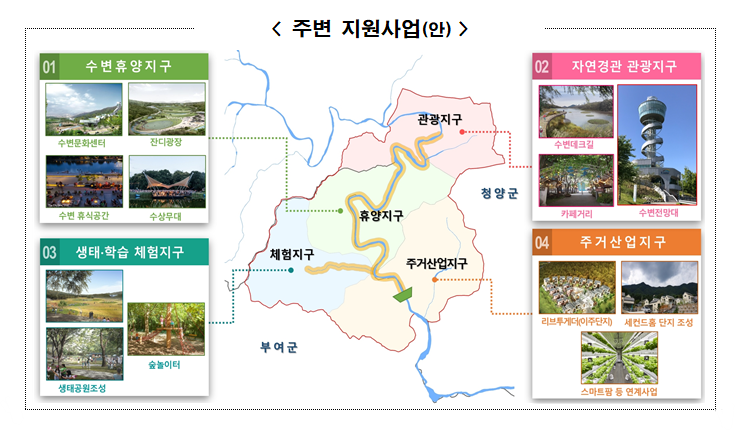 Support Project Plan for the Surrounding Area by Chungnam Province during the Construction of Jicheon Dam in Cheongyang. / Chungnam Province
© The Asia Business Daily(www.asiae.co.kr). All rights reserved.
![Clutching a Stolen Dior Bag, Saying "I Hate Being Poor but Real"... The Grotesque Con of a "Human Knockoff" [Slate]](https://cwcontent.asiae.co.kr/asiaresize/183/2026021902243444107_1771435474.jpg)

















