Limited to 'roads' within the target area
Decided to block alleyway splitting
The Seoul Metropolitan Government has designated 89 Moa Town target sites and their surrounding areas as land transaction permission zones. The purpose is to block abnormal speculative activities such as fragmenting ownership of alleyway shares into small portions.
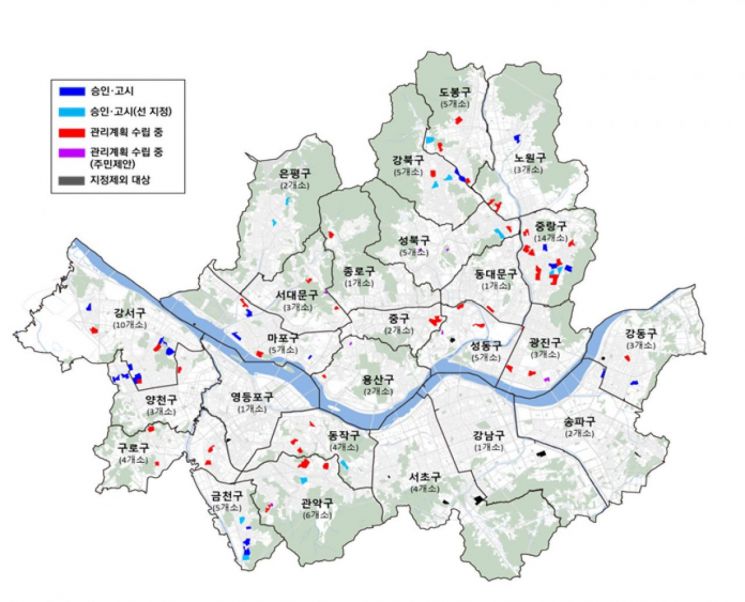
On the 4th, Seoul held the 13th Urban Planning Committee meeting and announced on the 5th that it approved the adjustment plan for the land transaction permission zones. The areas requiring permission are private roads (sado, private roads or alleyways) within the Moa Town project area, and transactions will be restricted for five years starting from the 10th. This is the first time that 'roads' have been designated as land transaction permission zones.
Once designated as a land transaction permission zone, permission from the head of the local government is required for land transactions exceeding a certain area. Considering the effectiveness of the permission zone designation, the city decided to maintain the land area requiring permission at over 6㎡ for residential areas and over 15㎡ for commercial areas.
This measure was promoted after discovering abnormal speculative activities aiming for development profits, such as planned real estate companies purchasing alleyways within the Moa Town target sites and collectively selling them through fractional ownership transactions (so-called share-splitting). The city announced last month that a full survey of the Moa Town project sites found share-splitting in 9 locations and 14 parcels. A Seoul city official explained, "There is concern that similar methods could spread to nearby Moa Towns, so the land transaction permission zones were designated to block this."
Moa Town is a small-scale housing maintenance project that bundles old low-rise residential areas within 100,000㎡, where large-scale redevelopment is difficult, into one area to develop it like a large apartment complex. A total of 89 sites are being promoted in Seoul, with Jungnang-gu having the most at 14 sites, followed by Gangseo-gu (9 sites) and Gwanak-gu (6 sites).
Jo Nam-jun, head of the Urban Space Headquarters, said, "Since this is a project aimed at improving deteriorated residential environments, we judged that quick action against illegal activities is necessary. If speculation is confirmed, the relevant parcels will be excluded from the project area, and if violations such as gap speculation are found, we plan to respond strongly, including filing complaints."
© The Asia Business Daily(www.asiae.co.kr). All rights reserved.
![Clutching a Stolen Dior Bag, Saying "I Hate Being Poor but Real"... The Grotesque Con of a "Human Knockoff" [Slate]](https://cwcontent.asiae.co.kr/asiaresize/183/2026021902243444107_1771435474.jpg)
















