Praise for Scholar Who Won Last Year's Nobel Chemistry Prize for Developing Quantum Dots
Samsung Mass Produces World's First Quantum Dot-Embedded 'QD-OLED'
A distinguished scholar who developed quantum dots (QD) and won the Nobel Prize in Chemistry last year highly praised Samsung Display's quantum dot technology. Samsung Display has mass-produced the world's first 'QD-organic light-emitting diode (OLED)' with embedded quantum dots.
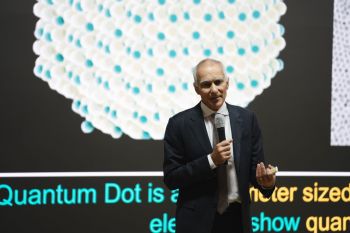 On the 4th, Moungi Bawendi, a Nobel Prize winner in Chemistry last year and a professor at the Massachusetts Institute of Technology (MIT), gave a lecture at Samsung Display's Giheung Campus.
 [Photo by Samsung Display]
On the 4th, Samsung Display announced that it invited Professor Moungi Bawendi from the Massachusetts Institute of Technology (MIT) in the United States to give a special lecture at Samsung Display's Giheung campus. The lecture topic was "Quantum Magic and Quantum Dot Technology: Synthetic Methods Opening the Journey to the Nano World." About 400 employees, including Vice President Jonghyuk Lee, head of the Large Business Division, attended the lecture.
Professor Bawendi emphasized, "Quantum dots are rapidly advancing in the display field by combining with Samsung's technological capabilities," adding, "In the future, they will expand into various applied technologies such as bioimaging and optical sensors."
Quantum dots refer to very small nanoscale (nm; 1 nm = one billionth of a meter) metal or semiconductor crystals. When voltage is applied, they emit various colors of light close to natural colors, making them a promising next-generation display element. For example, gold appears gold-colored to the human eye, but when the particle size is 7 nm, it appears red; at 5 nm and 3 nm, it appears green and blue, respectively.
Professor Bawendi discovered quantum dots and developed synthesis methods, winning the 2023 Nobel Prize in Chemistry together with Professor Louis Bruce from Columbia University and Chief Researcher Alexey Ekimov from Nanocrystal Technology. Notably, they developed technology to precisely control the size of nanoparticles and stably produce quantum dots, attracting significant attention.
Vice President Jonghyuk Lee said, "Thanks to the contributions of scientists who discovered quantum dots and developed synthesis methods pioneering the nanotechnology field, next-generation displays called QD-OLEDs could come into the world," adding, "Through close research and development (R&D) cooperation with the scientific community, we will introduce more innovative QD-OLED displays to consumers."
Samsung Display succeeded in developing QD-OLED with embedded quantum dots in panels for the first time in the world and began full-scale mass production at the end of 2021. Currently, QD-OLED is supplied to premium TV and monitor products. The third-generation QD-OLED, a new product this year, incorporates advanced panel driving technology and artificial intelligence (AI) technology. The maximum brightness, combining the brightness of red, green, and blue (R·G·B), exceeds 3,000 nits (nit = brightness of one candle), making it the brightest among existing OLED TVs.
© The Asia Business Daily(www.asiae.co.kr). All rights reserved.
![Clutching a Stolen Dior Bag, Saying "I Hate Being Poor but Real"... The Grotesque Con of a "Human Knockoff" [Slate]](https://cwcontent.asiae.co.kr/asiaresize/183/2026021902243444107_1771435474.jpg)















