Conflict Arises Among Residents Over Installation Location During Charging Facility Setup Within Legal Deadline
Resident Concerns Over Safety and Anxiety Must Be Considered
Amid lingering concerns about electric vehicles following the apartment fire incident in Cheongna-dong, Incheon, controversy has arisen over the location of electric vehicle charging facilities within apartment complexes. With the legal deadline for installing charging facilities approaching at the end of January next year, residents are increasingly worried that installation is proceeding without proper discussion on securing space and selecting appropriate locations for the chargers.
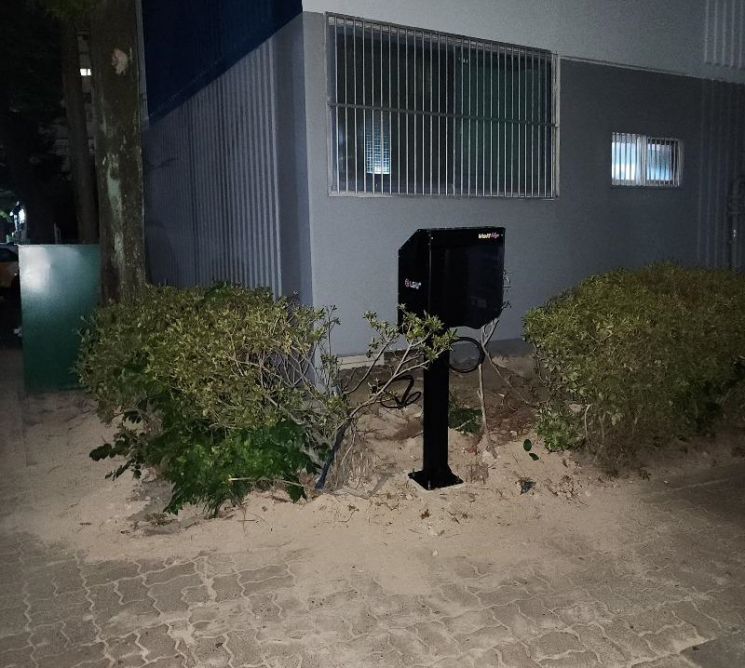 Electric vehicle slow charger located between the first-floor apartment room window, flower bed, and sidewalk blocks [Photo source=online community]
On January 28, 2022, the Eco-friendly Vehicle Act was amended to mandate the installation of dedicated parking spaces and charging facilities for electric vehicles in apartments with 100 or more households. Existing apartments must install charging facilities in at least 2% of total parking spaces, while newly constructed apartments after the amendment must install at least 5%. The installation deadline is within three years from the amendment date, by January 27 of the following year. However, in unavoidable circumstances, a one-year grace period can be applied with approval from the local government head. Violations may result in a penalty of up to 30 million KRW.
Following government policy, the number of charging stations in apartment complexes has surged. According to the “Electric Vehicle Charging Station Location and Operation Information” released by the Korea Environment Corporation, as of July 8, there were a total of 361,163 electric vehicle charging stations nationwide, with 223,158 (61.8%) located in apartments. The total number of charging stations increased by 260,775 (259.8%) over three years from 100,388 in October 2021 before the law amendment. For apartments, the increase was 168,421 (307.7%) during the same period. The growth rate of charging facilities in apartments far exceeded the overall increase.
Side effects have emerged during this process. The installation locations have become a point of contention. Despite widespread distrust of electric vehicle safety due to repeated fire incidents, installations are being rushed to meet the legal deadline, causing disagreements among residents. In some older apartment complexes where securing dedicated electric vehicle spaces is difficult, charging stations have been installed adjacent to children’s playgrounds, bicycle storage areas, in front of first-floor units, or near flower beds, sparking complaints from residents.
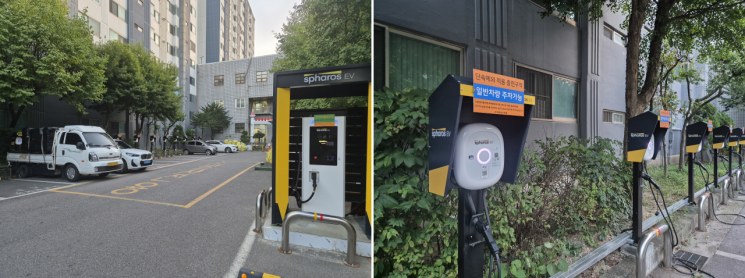
An apartment complex in Gwonseon-gu, Suwon-si, Gyeonggi Province, which is 26 years old, houses 713 households across six buildings. The electric vehicle chargers, approved by the residents’ representative meeting last year and operated since March 15 this year, include 16 units (1 rapid charger and 15 slow chargers). The 15 slow chargers are installed in a row behind building 105. The distance between the chargers and the first-floor units is only about 2.5 meters. Only eight electric vehicles are registered with the apartment management office. According to the “Apartment Electric Vehicle Fire Response Manual” distributed by the government last year, electric vehicle charging zones are recommended to be installed at least 10 meters away from adjacent buildings. However, this is not a mandatory regulation, so non-compliance is not penalized.
Choi, the head of the apartment management office, expressed frustration, saying, “I understand the residents’ opposition, but they misunderstand the installation process as reckless. We followed procedures because the government mandated it.” He also raised his voice, calling it a “NIMBY (Not In My Backyard) phenomenon.”
Jo Gyu-nam, head of the Electric Vehicle Subsidy Project Task Force at Korea Environment Corporation, questioned, “Who would have thought back then that chargers and electric vehicles would come to be in old apartments?” He added, “Because installations are being forced under the Eco-friendly Vehicle Act, they have to be placed somewhere, but the locations are not appropriate.”
 As electric vehicle fires continue to occur, interest in electric vehicle safety has increased, and a notice prohibiting electric vehicles is posted. Photo by Jinhyung Kang aymsdream@
Complaints about anxiety and inconvenience related to charging facilities have also appeared online. On the 30th of last month, a resident living on the first floor of an apartment posted on an online community, claiming that a charger was suddenly installed right in front of their window and shared photos. The charger was located in a somewhat unusual spot between the first-floor window, a flower bed, and the sidewalk blocks. The resident said they were not given any explanation about the installation and became angry, protesting to the management office, but were told, “It’s something the government is doing.” The resident expressed unease, saying, “A ticking time bomb is placed right next to my head without any safety devices.” They also worried, “What if the house price drops?” and wondered, “I’m curious if filing an official complaint would get it moved.”
Professor Kim Pil-su of the Department of Future Automotive at Daelim University expressed surprise, saying, “I have never seen such an installation before.” He pointed out, “From the perspective of a first-floor household, anxiety can be overwhelming. If the pedestrian path and charging cables overlap, accidents can happen anytime. It’s a complete failure in terms of safety.” He also added, “It seems like the installation was done just to meet the legal requirements.” Jo also emphasized, “To park and charge, the charging cable inevitably has to go over the sidewalk blocks, which could cause people to trip and fall. It’s obviously inappropriate.”
Both advised on the procedure for relocating the chargers. Professor Kim said, “If the residents’ representative meeting selects the location, the company just installs it. Since this is outside the road area, the government or public institutions cannot intervene. As long as legal conditions are met, the rest is decided by the residents’ representative meeting.” Jo also said, “The affected parties, the residents’ representative meeting, and the installation company should have a three-party meeting to discuss location changes.” A representative from LG Uplus Voltup, which installed the charger, explained, “There might be additional work like removing sidewalk blocks. If relocation is necessary, we will take responsibility for the costs.”
© The Asia Business Daily(www.asiae.co.kr). All rights reserved.
![Clutching a Stolen Dior Bag, Saying "I Hate Being Poor but Real"... The Grotesque Con of a "Human Knockoff" [Slate]](https://cwcontent.asiae.co.kr/asiaresize/183/2026021902243444107_1771435474.jpg)

















