Nominal Income Replacement Rate Raised to 42%
Different Premium Increase Rates Applied for Middle-aged and Young Adults
Basic Pension Raised by 400,000 Won for Low-income Groups
The government’s pension reform plan, focused on fiscal stability, has been unveiled. It proposes applying different contribution rate increases by generation, raising the contribution rate up to 13%, and adjusting the nominal income replacement rate to 42%. Additionally, the basic pension amount will be increased to 400,000 won, and the introduction of an automatic stabilization mechanism for pension fiscal stability will be considered.
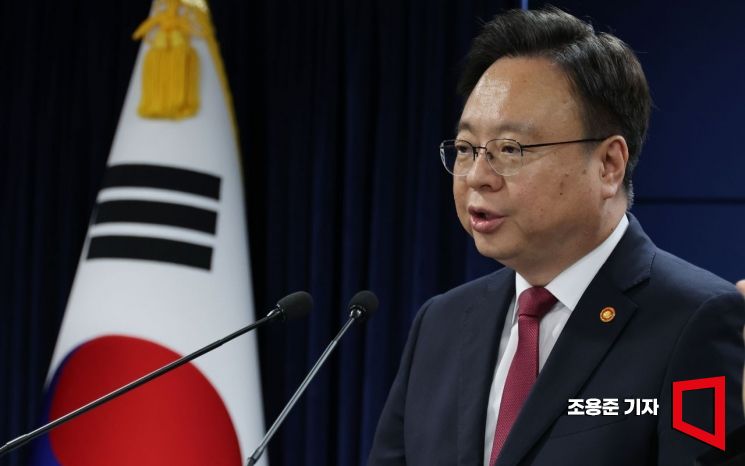 Minister of Health and Welfare Cho Kyu-hong is giving a briefing on the pension reform promotion plan on the 4th at the Government Seoul Office in Jongno, Seoul. Photo by Jo Yong-jun jun21@
On the 4th, the Ministry of Health and Welfare announced this pension reform plan. The ministry held the 3rd National Pension Deliberation Committee meeting to review and finalize the pension reform promotion plan. The ministry stated, “Since pension reform is an urgent task, we prepared this reform plan to create an opportunity for reform discussions and to facilitate prompt agreement between the ruling and opposition parties.”
This reform plan is a detailed version of the pension reform measures directly announced by President Yoon Seok-yeol during the national briefing on the 29th of last month. President Yoon emphasized that pension reform should focus on sustainability, intergenerational fairness, and old-age income security, and pledged to carry out reforms encompassing the entire system, including the basic pension and individual retirement pensions.
Contribution Rate Raised from 9% to 13%... Nominal Income Replacement Rate Set at 42%
The Ministry of Health and Welfare first announced plans to raise the current contribution rate from 9% to 13% and adjust the nominal income replacement rate to 42%. The nominal income replacement rate indicates the proportion of pre-retirement income replaced by the pension and reflects the income security level of the pension system. The 21st National Assembly’s Pension Reform Special Committee concluded that a 13% contribution rate and a 50% income replacement rate were necessary, but the government judged that a 40% replacement rate is reasonable for fiscal stability. The nominal income replacement rate was originally designed at 70% when the National Pension was introduced but was lowered to 50% in 2008 and has been scheduled to decrease by 0.5 percentage points annually until 2028.
A ministry official explained, “There were concerns about old-age income security,” adding, “Although there were opinions that the principle should be followed, considering the government’s schedule, it was seen as difficult to stop the schedule from lowering the (income replacement rate) compared to now.” If the government’s plan is accepted by the National Assembly, the contribution rate will be raised for the first time in 27 years, and the nominal income replacement rate will stop being adjusted for the first time since the introduction of the National Pension.
Applying Different Contribution Rate Increase Speeds by Generation... Emphasis on Pension Sustainability
The ministry also revealed different contribution rate increase schedules by generation. The government plans to raise the contribution rate to 13%, increasing it annually by 1 percentage point for subscribers in their 50s next year, 0.5 percentage points for those in their 40s, 0.3 percentage points for those in their 30s, and 0.25 percentage points for those in their 20s. This approach has no precedent worldwide.
In addition, the introduction of a fiscal stabilization mechanism will be considered. To ensure pension sustainability, this mechanism would link changes in life expectancy or the number of subscribers to pension payments. It could adjust payments differently depending on fiscal risk factors such as the point when benefit expenditures exceed contribution income, five years before fund depletion, or the time when the fund decreases. Currently, payments are adjusted only according to changes in the consumer price index.
Basic Pension Gradually Raised to 400,000 Won... Applied First to Low-Income Groups
The basic pension amount will be gradually increased to 400,000 won per month. The current basic pension is about 300,000 won per month. The ministry plans to first raise it to 400,000 won for low-income elderly by 2026 and then provide 400,000 won to all eligible elderly (bottom 70% income bracket) by 2027.
Along with this, the current system where receiving the basic pension reduces the livelihood benefit under the Basic Livelihood Security Program will be gradually improved. Currently, the basic pension is fully included as public transfer income when calculating recognized income for livelihood benefits. As a result, elderly recipients of livelihood benefits face a limitation where their livelihood benefits are reduced by the amount of the basic pension they receive. To alleviate elderly poverty, the ministry plans to provide an additional portion of the basic pension to elderly who receive both the basic pension and livelihood benefits and exclude this portion from recognized income.
To eliminate concerns among young people that they might pay National Pension contributions but not receive benefits due to fund depletion, the government will also pursue a legal guarantee of National Pension payments. Although the National Pension Act currently obliges the state to establish necessary policies to ensure stable and continuous pension payments, the government plans to clarify the guarantee of payments more explicitly.
Mandatory Retirement Pension Promotion... Expansion of Military Service and Childbirth Credits
Furthermore, the ministry plans to make retirement pensions mandatory to ensure they serve as a practical source of old-age income. The mandatory introduction of retirement pensions will begin with large workplaces, and incentives will be provided to encourage small and medium-sized enterprises with low subscription rates to join retirement pension funds. The ministry will also improve the default option system to support reasonable investments by retirement pension subscribers. Military service and childbirth credits will be expanded as well. The military service credit, currently recognized only for up to six months, will be extended to cover the entire military service period. Childbirth credits, currently applicable from the second child onward, will be discussed to be expanded to include the first child.
© The Asia Business Daily(www.asiae.co.kr). All rights reserved.
![Clutching a Stolen Dior Bag, Saying "I Hate Being Poor but Real"... The Grotesque Con of a "Human Knockoff" [Slate]](https://cwcontent.asiae.co.kr/asiaresize/183/2026021902243444107_1771435474.jpg)















