Frequently Sighted Near Golf Courses in Songdo
"Approaching Raccoon Dogs Can Cause Injury"
Raccoons have been repeatedly spotted in urban parks in Songdo International City, Incheon, prompting calls for public caution.
On the 4th, Yonhap News reported, "There have been continuous eyewitness accounts from citizens who have seen raccoons in urban parks such as Central Park and Haedoji Park in Songdo-dong, Yeonsu-gu recently." Around 7 a.m. on the 26th of last month, a raccoon that had fallen into the Central Park lake was rescued by firefighters following a citizen's report and handed over to relevant authorities. On July 31 and the 5th of last month, the Facilities Corporation also received complaint calls requesting the capture of raccoons appearing in Central Park.
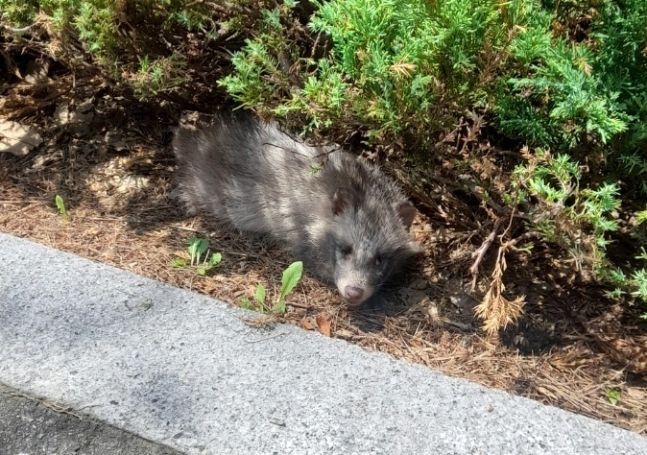 A raccoon dog spotted last July at Songdo Central Park. [Image source=Incheon Facilities Corporation·Yonhap News]
Raccoons have also been frequently spotted near the liquefied natural gas (LNG) base on the outskirts of Songdo and a nearby golf course. Golf course users posted on golf communities, "When the caddy gave dried fish snacks, the raccoon didn’t eat them but carried them away, possibly to feed its young," and "The raccoon seemed familiar with the caddy and approached when spoken to."
The local government, Yeonsu-gu, estimates that raccoons have moved into urban parks and other areas as development has progressed in their original habitats such as farmland and forest areas. The Incheon Wildlife Rescue Management Center has rescued and treated 25 raccoons injured or in poor health in Incheon this year. A Yeonsu-gu official said, "We believe many raccoons come into the city to eat food left out for stray cats by residents."
The Incheon Facilities Corporation has put up banners outlining preventive measures against raccoon-related damage due to their frequent appearances. The banners include the phrase "Caution: Wild Raccoon Sightings" and advise, "Since approaching closely may cause injury, please maintain a safe distance and ignore them if spotted."
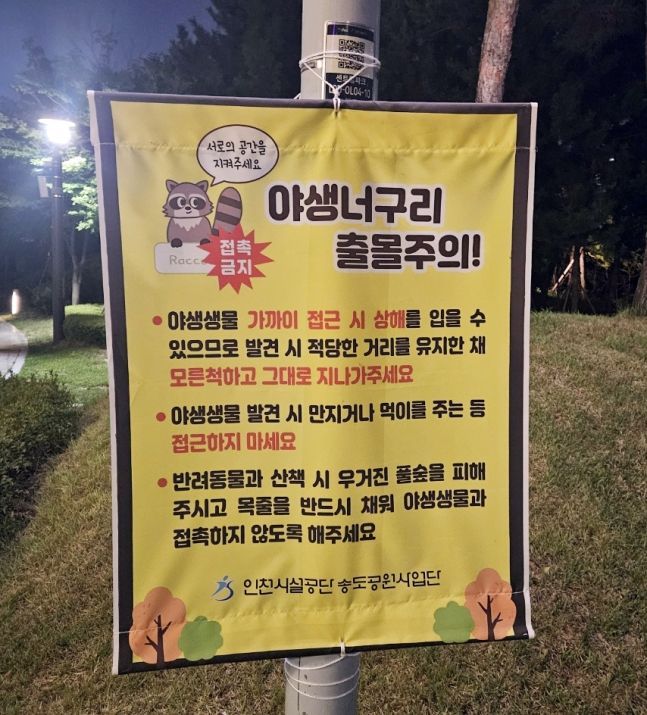
Meanwhile, if humans or animals come into contact with raccoons, there is a risk of parasite transmission or infection with the rabies virus. However, unlike wild boars, raccoons are not designated as harmful wildlife, so capturing or killing them is illegal.
Raccoons are mainly active at night, generally avoid humans, and are not aggressive, rarely attacking first. However, they may show aggression in self-defense if humans or pets approach closely or threaten them, especially during the breeding and nurturing period (March to September), when mother raccoons can be particularly sensitive to threats.
Jung Yoon-jung, director of the Incheon Wildlife Rescue Management Center, said, "Raccoons do not attack people if left alone, but caution is needed as young children trying to touch them may be perceived as a threat." She added, "The risk of raccoons living in urban areas having rabies is not very high, but since the possibility of infection cannot be completely ruled out, it is advisable to get checked at a hospital if bitten."
© The Asia Business Daily(www.asiae.co.kr). All rights reserved.
![Clutching a Stolen Dior Bag, Saying "I Hate Being Poor but Real"... The Grotesque Con of a "Human Knockoff" [Slate]](https://cwcontent.asiae.co.kr/asiaresize/183/2026021902243444107_1771435474.jpg)
















