A domestic research team has developed an 8-photon qubit integrated circuit chip using photon (光子, light particle) technology.
The Electronics and Telecommunications Research Institute (ETRI) announced on the 4th that it has expanded its silicon photonics quantum chip to complete a system capable of controlling 8 photons and is currently experimenting with quantum phenomena generated by 8 photons.
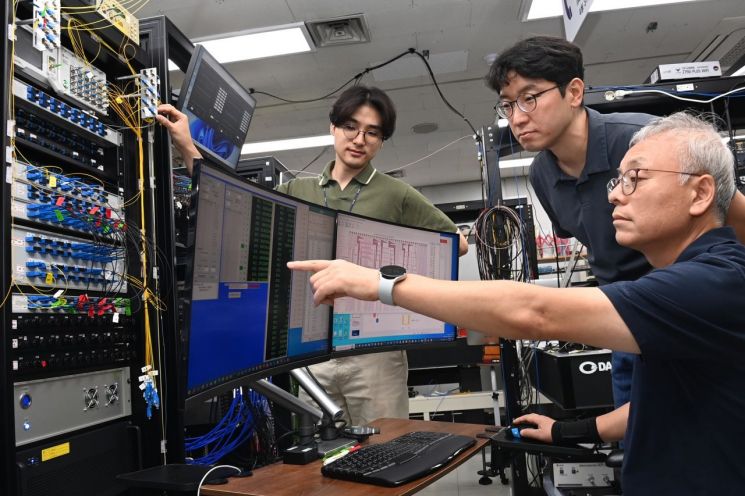 The research team is demonstrating the operation process of an 8-photon qubit chip for quantum computing. Photo by Electronics and Telecommunications Research Institute of Korea
According to ETRI, photons are represented by two directions: upward direction as 0 and downward direction as 1. For example, a 4-qubit system has a total of 8 paths combining upward and downward directions of light, and an 8-qubit system has 16 paths.
Based on this, ETRI succeeded in implementing a strongly quantum-entangled state between qubits within the chip.
Photon-based technology is considered one of the most promising methods for building quantum computers. The core idea is to create a silicon photonics quantum chip that includes photon-based quantum circuits on a fingernail-sized silicon chip, and to realize universal quantum computing by connecting multiple quantum chips through a network.
In particular, photon-based quantum computers have advantages such as high speed, room-temperature operation, low error rates, scalability, and low energy consumption.
ETRI integrated various optical components such as photon generators, phase modulators, and switches into the 8-photon qubit chip, then controlled the light paths to enable quantum interference. This made it possible to perform the basic functions of a computer, such as information transmission and transformation.
The chip contains eight nonlinear photon pair generation sources and about 40 optical switches that control the light paths, with around 20 of these switches functioning as quantum gates. This established the basic framework of a quantum computer that measures quantum states through single-photon detectors.
ETRI plans to improve the technological completeness and challenge the development of a 16-qubit chip within this year. Subsequently, they aim to expand to 32 qubits to enable applications in quantum computing research, including quantum machine learning (ML).
Yoon Cheon-ju, head of ETRI’s Quantum Technology Research Division, said, “ETRI aims to enhance technological completeness to enable cloud services with quantum computers within five years. We will focus on pioneering new academic fields to ensure the system operates properly even at the laboratory scale.”
© The Asia Business Daily(www.asiae.co.kr). All rights reserved.
![Clutching a Stolen Dior Bag, Saying "I Hate Being Poor but Real"... The Grotesque Con of a "Human Knockoff" [Slate]](https://cwcontent.asiae.co.kr/asiaresize/183/2026021902243444107_1771435474.jpg)















