ISM August Manufacturing PMI Contracts for 5th Consecutive Month
Recession Concerns Resurface
NVIDIA Plummets 9.5%... Semiconductor Stocks Tumble
The U.S. manufacturing sector has continued to contract for five consecutive months. This is a result of low investment intentions among companies due to monetary policy and election uncertainties. As concerns about an economic downturn resurfaced amid weak manufacturing indicators, the New York stock market fell across the board.

On the 3rd (local time), the Institute for Supply Management (ISM) announced that the August Manufacturing Purchasing Managers' Index (PMI) stood at 47.2. Although this was an increase from 46.8 in the previous month, it fell short of the expert forecast of 47.5.
The manufacturing PMI, a representative leading economic indicator, signals expansion when above 50 and contraction when below 50. Thus, the ISM manufacturing PMI remaining below 50 for five consecutive months suggests a continued contraction phase in the manufacturing sector, which accounts for 10.3% of the U.S. economy.
Manufacturing employment improved, but factory operations remained sluggish. The manufacturing new orders index, a sub-index of the manufacturing PMI, fell from 47.4 in July to 44.6 in August. The manufacturing production index also declined from 45.9 to 44.8 during the same period. Conversely, manufacturing employment rose from 43.4 to 46.
Timothy Fiore, chairman of the ISM Manufacturing Survey Committee, stated, "U.S. manufacturing activity is still in a contraction phase, but the pace of contraction has slowed compared to last month." He analyzed, "Due to current monetary policy and election uncertainties, companies are unwilling to invest in capital and inventory, so demand remains suppressed."
On the same day, S&P Global also reported that the August manufacturing PMI remained in contraction. S&P Global's August manufacturing PMI recorded 47.9, falling short of both the previous month's 49.6 and the forecast of 48.
Chris Williamson, chief business economist at S&P Global Market Intelligence, said, "The further slowdown in the PMI means the manufacturing sector is becoming a bigger drag on the economy in mid-third quarter." He added, "This leading economic indicator suggests that this burden could intensify over the coming months."
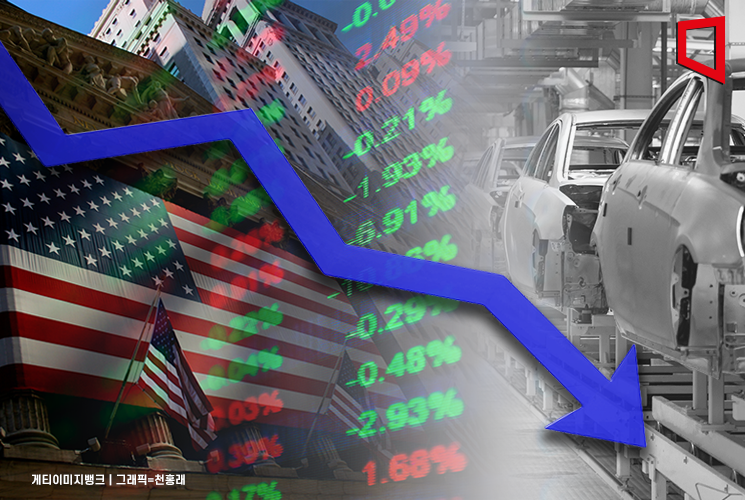
Amid concerns over economic slowdown due to weak U.S. manufacturing indicators, investor sentiment rapidly cooled, and on the first trading day of September, the New York stock market fell across the board. The Dow Jones Industrial Average dropped 1.51% from the previous trading day, the S&P 500 index fell 2.12%, and the Nasdaq index plunged 3.26%, marking its largest decline since the 5th of last month. Nvidia led the semiconductor sector's sharp decline with a 9.53% drop. Intel fell 8.8%, AMD declined 7.82%, while Qualcomm and Broadcom dropped 6.88% and 6.16%, respectively.
Expectations for a 'big cut' (0.5 percentage point interest rate cut) in September rose slightly. Currently, the interest rate futures market reflects a 63% probability that the Federal Reserve (Fed) will cut rates by 0.25 percentage points in September and a 37% chance of a 0.5 percentage point cut. The big cut expectation rose slightly from 35% in the morning of the same day.
Government bond yields are declining. The U.S. 10-year Treasury yield, a global bond yield benchmark, fell 7 basis points (1bp = 0.01 percentage points) from the previous trading day to 3.83%, while the 2-year Treasury yield dropped 3 basis points to 3.89%.
Larry Tentarelli, senior technical strategist at Blue Chip Trend Report, pointed out, "The market is currently overreacting to every incoming data point," adding, "The market has become highly dependent on data."
© The Asia Business Daily(www.asiae.co.kr). All rights reserved.
![Clutching a Stolen Dior Bag, Saying "I Hate Being Poor but Real"... The Grotesque Con of a "Human Knockoff" [Slate]](https://cwcontent.asiae.co.kr/asiaresize/183/2026021902243444107_1771435474.jpg)
















