Philoptics, a semiconductor and display process equipment company, will unveil its glass substrate processing technology, recognized as a game changer in the semiconductor industry. The company plans to participate in Korea's largest semiconductor packaging exhibition and showcase glass substrate samples processed with its self-developed equipment. This move aims to actively promote and communicate in line with the rapidly growing interest in glass substrates.
Philoptics announced on the 3rd that it will participate in the ‘KPCA SHOW 2024’ held from the 4th to the 6th at Songdo Convensia in Incheon. KPCA SHOW is an international PCB and semiconductor packaging industry exhibition hosted by the Korea PCB & Semiconductor Packaging Industry Association and organized by KY Expo.
At the exhibition, Philoptics plans to open a booth focusing on its semiconductor glass substrate process equipment, which has recently gained attention. Through extensive research and development (R&D), Philoptics has established its own value chain within the semiconductor glass substrate process, including △TGV (Through Glass Via, glass through-electrode manufacturing) △DI (Direct Imaging) exposure equipment △ABF (Ajinomoto Build-up Film) Drilling △Singulation. The company offers a product lineup capable of handling key processes in glass substrate processing. These are equipment infused with Philoptics’ precise optical design and laser processing capabilities.
In particular, the TGV equipment is regarded as a culmination of Philoptics’ laser processing technology and optical design expertise. The TGV equipment drills fine holes in glass substrates to create electrodes. Depending on the electrode design, △hole position △hole size, and other factors vary. Notably, Philoptics can process holes around 10㎛ (micrometers) in size. The range of hole sizes it can produce is also diverse. To date, Philoptics is the only laser equipment manufacturer worldwide capable of processing such various sizes of fine holes.
Additionally, the processing must be done without causing cracks in the glass substrate, and the processing speed must be increased to enhance productivity. Since all these factors are directly linked to yield (throughput), the technical difficulty of TGV equipment is quite high. Given the high entry barriers, Philoptics plans to focus on technological differentiation.
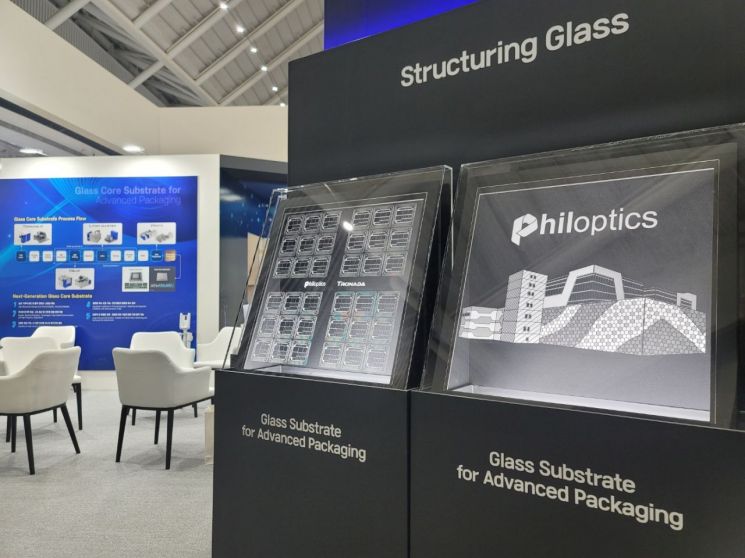
A highlight of this exhibition is the display of glass substrate samples. Philoptics plans to exhibit 500mm x 500mm glass substrate samples processed with its self-developed TGV equipment at its booth. A Philoptics representative said, “As interest in the glass substrate business grows, there is considerable demand to see glass substrates processed by TGV. By revealing Philoptics’ precise laser technology, we expect not only to enhance technical credibility but also to facilitate active communication with the market.”
Philoptics shipped mass production TGV (Through Glass Via) equipment to a client in the first quarter of this year. The company is strengthening its value chain by also supplying DI exposure equipment and ABF Drilling to the same client. Currently, it has received or is negotiating development equipment orders from several companies, including global clients.
© The Asia Business Daily(www.asiae.co.kr). All rights reserved.