Shoulder conditions that were once common mainly among people in their 50s and older are now increasingly seen in younger adults in their 30s and 40s, as sports activities and smartphone usage have become more prevalent.
If you experience shoulder pain or discomfort when raising your arm without any history of injury, you may suspect a ‘rotator cuff tear’.
The most characteristic symptom of a rotator cuff tear is pain when lifting the arm. If it is not in the acute stage, the pain is not severe at rest, but it intensifies during activities that require arm movement, making it difficult to raise the arm. In severe cases, the pain may even interfere with normal sleep.
Rotator cuff tears can be easily mistaken for frozen shoulder due to similar initial symptoms, so it is important not to ignore the condition. Frozen shoulder is caused by inflammation of the shoulder joint capsule, leading to pain and restricted movement.
Park Junho, head of the Joint Center at Centum General Hospital, said, “You can differentiate rotator cuff tears from frozen shoulder by comparing the range of arm movement. With frozen shoulder, not only is there pain, but the shoulder is stiff and difficult to lift even if someone else tries to help. In contrast, with a rotator cuff tear, although it is painful and hard to maintain the position for long, the shoulder can still be raised.”
He added, “If you mistake a rotator cuff tear for frozen shoulder and leave it untreated for a long time, you may lose the ability to lift your arm, and it could progress to shoulder arthritis. If you have frequent shoulder pain, it is crucial to visit a hospital for an accurate diagnosis and early treatment.”
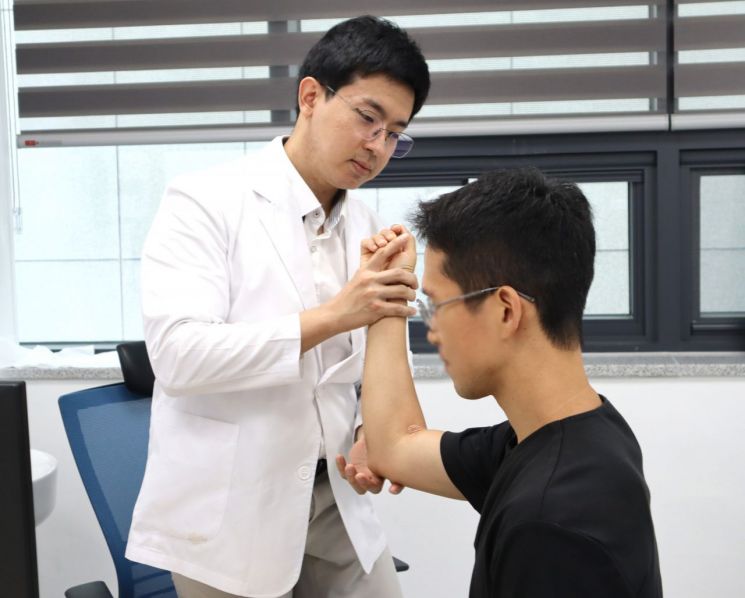
Rotator cuff tears can be diagnosed with ultrasound, but an MRI may be necessary to accurately assess the condition and structure of the muscles.
If a tear is diagnosed, the treatment method must be determined. In most cases of partial tears, injection or physical therapy is tried first. In the early stages, this can help improve symptoms and prevent recurrence. However, if the tear is larger than 1 cm, symptoms are usually more severe, and surgery is often required.
Park Junho explained, “Surgery involves suturing the torn area. Usually, four to five holes of 0.5 to 1 cm are made for arthroscopic surgery, and the damaged area is checked and repaired using an arthroscope. This method is preferred because the incision is small, resulting in less pain and scarring, and it offers high accuracy.”
To prevent rotator cuff tears, it is helpful to thoroughly stretch before exercise in daily life to relax the muscles and to strengthen the muscles around the shoulder.
Rotator cuff tears can occur gradually from overuse, not just from injury. Therefore, if shoulder pain persists, do not ignore it; visit a hospital as soon as possible for early treatment.
© The Asia Business Daily(www.asiae.co.kr). All rights reserved.
![Clutching a Stolen Dior Bag, Saying "I Hate Being Poor but Real"... The Grotesque Con of a "Human Knockoff" [Slate]](https://cwcontent.asiae.co.kr/asiaresize/183/2026021902243444107_1771435474.jpg)















