Analysis of 128 Companies in Leaders Index
"Cause is the Sluggish Growth of New Growth Industries"
The number of new hires at major conglomerates has decreased by about 20%, while the turnover rate of existing employees has declined, resulting in a deepening stagnation in the workforce. This phenomenon is accelerating as the growth of new growth engine industries slows down.
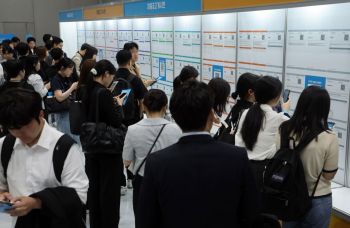 On May 21st, job seekers were looking at the job posting board at COEX in Seoul. Photo by Younghan Heo younghan@
According to Leaders Index, a corporate analysis research institute, on the 3rd, a survey of 128 companies among the top 500 companies by sales that published sustainability reports and disclosed new hires and turnover numbers this year showed that the number of new hires last year was 165,961.
This is a 21.2% decrease compared to 2022 (210,717). It also decreased by 11.6% compared to 2021 (187,673). Among the surveyed companies, 81 companies, accounting for 63%, reduced new hires, while only 43 companies, or 37%, increased them.
On the other hand, the turnover rate of existing employees declined. Among the surveyed companies, 88 companies that disclosed turnover numbers reported a turnover rate of 6.3% last year. This is 1.5 percentage points lower than 7.8% in 2022. The number of employees who left last year was 71,530, a 19.1% decrease compared to 88,423 in 2022.
Looking at new hires by age group, a trend of increasing workforce rigidity is evident. The number of new hires in their 20s, who are early-career workers, decreased by 7,918 (9.8%) from 80,394 in 2021 to 72,476 last year. During the same period, new hires aged 50 and above increased by 3,343 (54.7%) from 6,114 to 9,457.
Leaders Index explained, "This is evidence that companies prefer experienced workers."
The industry with the largest decrease in new hires was IT, Electrical and Electronics. While 70,645 new hires were made in 2021, the number dropped by 25,205 over two years to 45,440. The decrease rate was 35.7%. Meanwhile, turnover slightly increased from 23,712 to 26,873.
Other industries with significant decreases in new hires include secondary batteries (19,151 → 10,413), distribution (13,201 → 8,977), IT (6,442 → 4,759), trading companies (3,672 → 2,059), and petrochemicals (10,593 → 9,099).
Among 99 companies that disclosed new hires by age group, 16 out of 40 companies that reduced new hires in their 20s increased new hires aged 50 and above.
Koway saw a 67.5% decrease in new hires in their 20s over two years, while hires aged 50 and above more than doubled. Daol Investment & Securities also experienced a 55.4% decrease in 20s hires and a 133.3% increase in hires aged 50 and above. Samsung Life Insurance (20s down 26.5%, 50+ up 108.3%) and Hyundai Elevator (20s down 17.3%, 50+ up 280.0%) showed similar trends.
Meanwhile, the number of women newly hired last year was 53,538, down 18.5% from 65,709 the previous year, but their proportion of total hires increased by 1.1 percentage points (from 31.2% to 32.3%).
During this period, 56 companies, accounting for 43.7% of the surveyed companies, had a female new hire ratio exceeding 30%. Most of these were in the food and beverage, fashion, and distribution industries, but some IT companies such as Kakao (69.2%) and SK Telecom (59.0%) also had female new hire ratios above 50%.
© The Asia Business Daily(www.asiae.co.kr). All rights reserved.
![Clutching a Stolen Dior Bag, Saying "I Hate Being Poor but Real"... The Grotesque Con of a "Human Knockoff" [Slate]](https://cwcontent.asiae.co.kr/asiaresize/183/2026021902243444107_1771435474.jpg)















