Martial Arts International Trade and Commerce Research Institute Report
Expectations for Automobile, Medical Device, and Cosmetics Exports
Also Supports Local Spending on K-Content
35.4% of Companies "New to Agreements"
Government Needs to Promote Agreements
To fully benefit from the export growth effects of the Comprehensive Economic Partnership Agreement (CEPA) signed between South Korea and the United Arab Emirates (UAE) on May 29, prompt enforcement and increased awareness among exporting companies are necessary, experts have pointed out.
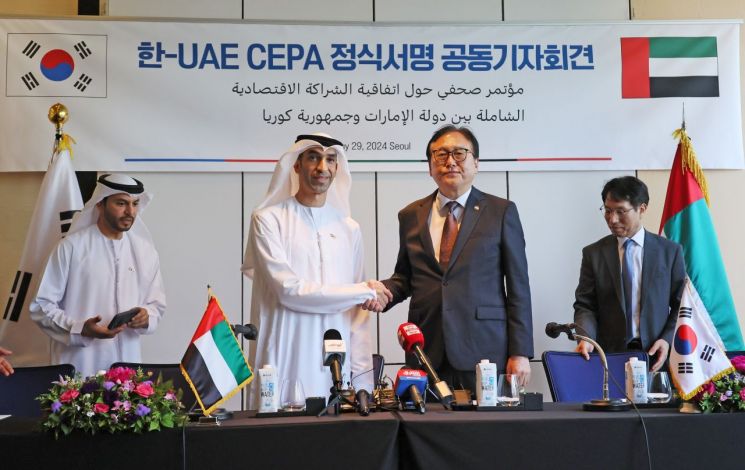 Jung In-kyo, Director General of the Trade Negotiations Bureau at the Ministry of Trade, Industry and Energy, and Thani bin Ahmed Al Zeyoudi, Minister of State for Foreign Trade at the UAE Ministry of Economy, shake hands at the joint press conference for the formal signing of the Korea-UAE Comprehensive Economic Partnership Agreement (CEPA) held last May at the Four Seasons Hotel in Jongno-gu, Seoul. [Image source=Yonhap News]
The Korea International Trade Association's International Trade and Commerce Research Institute stated this in its report titled 'Key Contents of the Korea-UAE CEPA and Survey on Awareness of Our Export Companies,' published on the 2nd.
The CEPA signed by South Korea and the UAE is a type of Free Trade Agreement (FTA) that includes not only expanded market access for goods and services through tariff reductions but also plans to strengthen cooperation and exchanges in various fields. Through this agreement, both countries have agreed to mutually open 92.5% and 91.2% of their markets by product categories over the next 10 years, respectively.
The report expects that the Korea-UAE CEPA will promote exports of Korean automobiles, auto parts, medical devices, cosmetics, and more. It also anticipates that the opening of service markets such as online gaming and medical services, along with the inclusion of high-level digital standards, will aid the local entry of K-content. In particular, tariffs on 'other vehicle parts,' which accounted for 6.5% of exports to the UAE as of last year, will be eliminated immediately upon enforcement, benefiting domestic small and medium-sized automobile parts manufacturers both directly and indirectly.
Tariffs on hybrid vehicles (HEV) and electric vehicles (EV) are scheduled to be phased out over 10 years, which is expected to enhance the price competitiveness of Korean electric vehicles in the UAE market.
The report advised, "Since competitors such as the United States, China, Japan, and the European Union (EU) have not yet signed FTAs with the UAE, it is necessary to actively utilize the Korea-UAE CEPA to maximize the market preemption effect." It also emphasized the need for the government to strengthen CEPA promotion so that UAE-exporting companies can fully utilize the agreement.
According to a survey conducted by the Trade Association in July, among 302 companies with export performance to the UAE in the past three years, 35.4% responded that they had 'never heard' of the Korea-UAE CEPA. Only 12.3% said they 'knew well,' while 52.3% answered that they had 'heard of it.'
When asked about the top priority tasks for the Korea-UAE CEPA with multiple responses allowed, the largest share, 57.9%, chose 'actively promoting the agreement so that export companies can utilize it,' followed by 'providing local market information' (55.6%) and 'providing professional information about CEPA' (49.7%). Companies preferred specific promotional methods such as holding briefing sessions (65.2%), publishing educational materials and booklets (40.1%), and individual guidance (32.8%).
Kang Geum-yoon, senior researcher at the Trade Association, said, "The UAE is an attractive export market where cooperation is strengthened based on high-level diplomacy and the Korean Wave effect is prominent. To realize the preemption effect of the Korea-UAE CEPA early, it is necessary to accelerate the remaining ratification procedures and focus on promotion and support tailored to corporate needs."
© The Asia Business Daily(www.asiae.co.kr). All rights reserved.

















