Ministry of Economy and Finance Prepares Mid- to Long-Term Financial Management Plan for Public Institutions
Debt Ratio to Reach 190% Range by 2028

Debt of 35 public institutions including Korea Electric Power Corporation, Korea Land and Housing Corporation (LH), and Korea Gas Corporation is expected to exceed 795 trillion won within four years, approaching the 800 trillion won mark. These institutions plan to improve fiscal soundness by selling owned assets such as land near subway stations and adjusting investment scales, aiming to reduce the debt ratio from 207.3% this year to 190.5% by 2028.
According to the "2024-2028 Mid-to-Long-Term Financial Management Plan for Public Institutions" submitted by the Ministry of Economy and Finance to the National Assembly on the 2nd, the assets of the 35 public institutions subject to mid-to-long-term financial management are projected to reach 1,212.4 trillion won by 2028. This is an increase of 171.9 trillion won compared to this year's estimate of 1,040.6 trillion won.
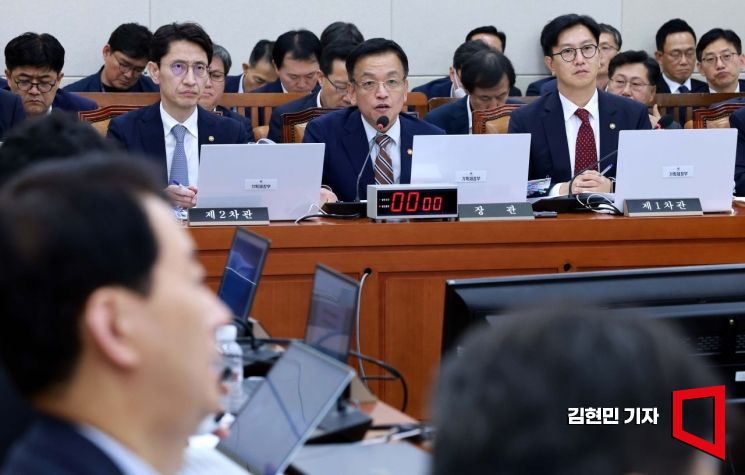 Choi Sang-mok, Deputy Prime Minister for Economic Affairs and Minister of Economy and Finance, is responding to lawmakers' questions at the plenary meeting of the Planning and Finance Committee held at the National Assembly on the 27th. Photo by Kim Hyun-min kimhyun81@
The asset increase was largely influenced by the expansion of social overhead capital (SOC) such as roads and housing, and policy finance. SOC assets are expected to increase by 111.6 trillion won due to expanded public housing supply and highway construction centered on LH and Korea Expressway Corporation, while energy assets will grow by 26.7 trillion won due to expansion of transmission and distribution facilities and nuclear power plant construction. Financial assets will increase by 28 trillion won due to policy finance expansion by institutions such as Korea Housing Finance Corporation and Korea Asset Management Corporation.
This year's debt is estimated to exceed 700 trillion won, reaching 701.9 trillion won. Following an increase of 37.8 trillion won from last year's 664.1 trillion won, debt is expected to reach 735.8 trillion won next year. Debt will continue to rise steadily, reaching 795.1 trillion won in 2028, four years from now.
The government aims to reduce the debt ratio to 190.5% in 2028, down 16.8 percentage points from this year. In the SOC sector, the debt ratio is expected to rise by 6.2 percentage points to 185.0% in 2028 due to expanded public housing supply, but in the energy sector, improvements in Korea Electric Power Corporation's operating profit and recovery of receivables by Korea Gas Corporation will lower the debt ratio to 383.2% in 2028, down 168.4 percentage points from this year's projection. In the financial sector, the debt ratio is planned to decrease by 4.6 percentage points from 104.6% this year to 100.0% in 2028.
Additionally, to ease the pressure of rising debt in public institutions, the government incorporated an additional 15.1 trillion won of self-help efforts into the 42.2 trillion won fiscal soundness plan established last year, reflecting a total fiscal soundness effort of 57.3 trillion won.
Specifically, 9.1 trillion won will be secured through asset sales such as the sale of Yongsan station area land owned by Korea Railroad Corporation and unused land near the 63 Building in Yeouido owned by LH, and 19.3 trillion won through business adjustments such as scaling back investments in renewable energy including Korea Hydro & Nuclear Power's solar power facilities. Alongside these, efforts for fiscal soundness will also include management efficiency improvements (11.9 trillion won), revenue expansion (6.2 trillion won), and capital reinforcement (10.8 trillion won).
The Ministry of Economy and Finance stated, "We plan to continuously improve the financial structure of public institutions so that their debt does not become a burden on the national economy by strengthening evaluation of efforts to implement the mid-to-long-term financial management plan."
© The Asia Business Daily(www.asiae.co.kr). All rights reserved.


















