Caution Against Premature Stock Market Direction Predictions and Portfolio Adjustments
Dividend and Export Stocks Benefit When Interest Rates and Dollar Value Fall
As the U.S. stock market enters September, historically the most volatile month, a seismic shift in investors' trading strategies is anticipated. Wall Street is urging caution against premature market direction predictions and portfolio adjustments. In particular, with a rate cut by financial authorities expected, dividend stocks and export stocks are projected to benefit.
Business Insider reported on the 1st (local time), "Although the summer vacation season in August has ended, the S&P 500's vacation may just be beginning," adding, "On average, it is not unusual for the entire market to close September in the red, not just individual stocks performing poorly." This serves as a warning that the market may take a breather ahead of the major political 'big event' in the U.S. this coming November.
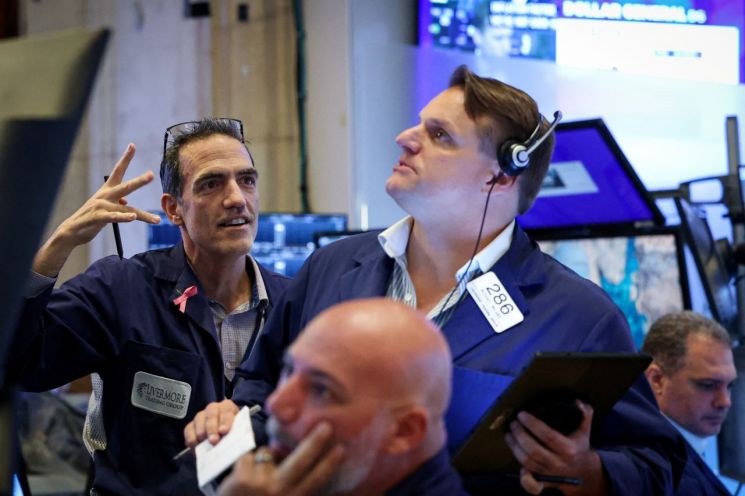
Historically, the September downturn is statistically verified. According to the Chicago Mercantile Exchange (CME), since 1928, the S&P 500 index has experienced a decline in September 55% of the time. Additionally, data from investment research firm CFRA shows that since World War II, September (-0.78%) has had the lowest average monthly return among the 12 months for the S&P 500 index.
Causes of the September Downturn
One reason for the generally weak market in September is the expansion of trading volume on Wall Street. As traders return to work after the August summer vacation and the Labor Day holiday in September, market trading volume surges, often resulting in downward volatility outpacing upward momentum.
Liz Young Thomas, Chief Investment Strategist at online financial company SoFi, stated, "The average monthly trading volume of the S&P 500 between June and August is 15.2 billion shares, but it jumps to 17.2 billion shares in September when investors return to their desks," adding, "It is common for the S&P 500 to fluctuate by 2% in either direction in September, with downward momentum significantly exceeding upward momentum."
However, the Federal Open Market Committee (FOMC) rate cut scheduled for the 17th-18th is considered a variable that could reverse the traditional September downturn. The market is anticipating a 'small cut' (0.25% rate reduction) by the Federal Reserve unless job data released this week, including nonfarm payrolls and unemployment rates, confirm a sharp cooling of the labor market. Adam Turnquist, Chief Technical Strategist at LPL Financial, said, "If economic data improves, a soft landing could gain traction, potentially ending the September downturn streak seen in recent years," but he also noted, "It is still true that downside risks appear higher."
Trading Strategies During the September Downturn
Even with the high likelihood of a September downturn, experts advise against premature portfolio adjustments or market direction predictions. The seasonal volatility of the September market is difficult to predict and is not a long-term phenomenon. Strategist Young Thomas emphasized, "In a scenario where rate cuts lead to declines in the dollar's value and bond yields, investors should look for stocks that will benefit from this," highlighting that 'dividend stocks' could be the key beneficiaries. When bond yields fall due to rate cuts, dividend stocks may become a new source of income for bond investors.
Export stocks may also shine. A rate cut implies a weaker dollar, benefiting U.S. export companies that earn relatively more expensive foreign currencies. Young Thomas pointed out, "A decline in the dollar's value will increase medical exports, and if trade is activated, aerospace and defense companies will also benefit."
There is also advice to use the September downturn as an opportunity for buying at lows. Strategist Turnquist explained, "Buying at lows in September or October is a very good trading strategy," adding, "If market conditions begin to improve in October and the year-end rally arrives in November and December, very high returns can be expected."
© The Asia Business Daily(www.asiae.co.kr). All rights reserved.
![Clutching a Stolen Dior Bag, Saying "I Hate Being Poor but Real"... The Grotesque Con of a "Human Knockoff" [Slate]](https://cwcontent.asiae.co.kr/asiaresize/183/2026021902243444107_1771435474.jpg)















