KCCI Publishes Second Half Issue of Wage and HR Research
"Creating Fair Compensation and Challenging Environment for MZ"
It has been pointed out that South Korea needs to raise its globally lowest level of employee engagement and increase productivity. In particular, it is analyzed that fair compensation and culture must be provided to draw out the engagement of the MZ generation (Millennials + Generation Z).
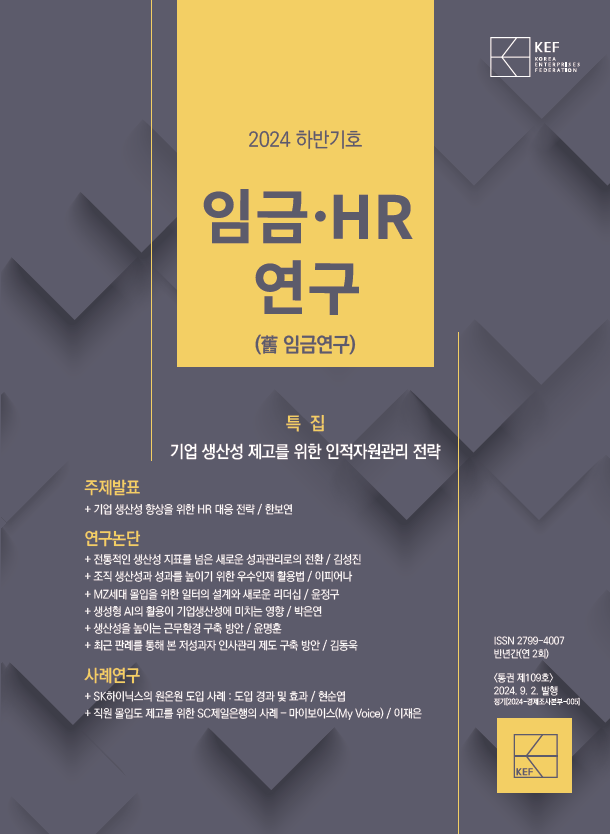
The Korea Employers Federation announced on the 2nd that it published the 2024 second half issue of its regular publication "Wages & HR Research," which contains such content. This issue features "Human Resource Management Strategies to Enhance Corporate Productivity" as its special topic and includes contributions from various experts.
Professor Yoon Jung-gu of Ewha Womans University’s Department of Business Administration highlighted the low engagement of Korean workers. Professor Yoon stated, "According to a Gallup survey released last year, South Korea ranked 107th out of 125 countries with only 12% of workers engaged in their work, placing it at the very bottom internationally. The reason for failing to solve the low engagement problem is that wages and welfare were excessively increased regardless of performance or productivity," he evaluated.
He emphasized the need to focus especially on the MZ generation to raise workers' engagement. Professor Yoon said, "Unlike Generation X, who were compensated for unfulfilled achievement and meaning through welfare or money, the MZ generation, which has recently emerged as a major component of the workplace, values both material success and the achievement and meaning gained through work. To draw out their engagement, it is necessary to create an environment where they can freely experiment, make mistakes, and learn how to produce results during the work process, thereby growing into experts, along with fair compensation," he suggested.
In addition, experts analyzed various human resource management measures, including ▲The impact of generative AI utilization on corporate productivity (Park Eun-yeon, Chair of Silicon Valley HR Forum) ▲Ways to build a work environment that enhances productivity (Yoon Myung-hoon, Director of Wanted Lab) ▲Measures to establish a low-performance employee management system based on recent court rulings (Kim Dong-wook, Lawyer at Sejong Law Firm) ▲Transition to new performance management beyond traditional productivity indicators (Kim Sung-jin, Partner at Deloitte Consulting) ▲Methods to utilize top talent to improve organizational productivity and performance (Lee Piona, People Data Scientist at Pinterest).
Ha Sang-woo, Head of the Economic Research Department at the Korea Employers Federation, emphasized, "Although our working hours have drastically decreased and are now close to the average of the Organization for Economic Cooperation and Development (OECD), the improvement in labor productivity has not met expectations. To enhance productivity, urgent measures must be devised to establish fair evaluation and wage systems, improve inefficient work processes, and increase employee engagement," he stressed.
© The Asia Business Daily(www.asiae.co.kr). All rights reserved.
![Clutching a Stolen Dior Bag, Saying "I Hate Being Poor but Real"... The Grotesque Con of a "Human Knockoff" [Slate]](https://cwcontent.asiae.co.kr/asiaresize/183/2026021902243444107_1771435474.jpg)















