5G Additional Allocation to Be Announced Next Year as 3G and 4G End
Frequency Opened to All Industries... "No Other Country Case"
The Ministry of Science and ICT announced the 'Korea Spectrum Plan' (hereinafter referred to as the Plan) on the 1st, which includes new frequency supply and utilization strategies. The additional allocation of the 5G frequency band (3.70?3.72 GHz) that SK Telecom had hoped for was canceled due to changes in corporate intentions and the government's direction for broadband supply. The government plans to announce additional 5G frequency supply plans, including bands above 3.70 GHz, in June next year, coinciding with the review period for the termination of 3G and 4G services and reallocation. Mobile communication frequencies will be opened to all industries, shifting the frequency supply system to be demand-driven.

The Ministry of Science and ICT aims to accelerate digital innovation across all industrial and public sectors through four strategies in this Plan: ▲ frequency reallocation and review of additional supply and broadband expansion of mobile communication frequencies, opening to industrial sectors ▲ timely frequency supply and active use of unlicensed frequencies ▲ securing public frequencies ▲ innovation of frequency utilization systems. The government has been establishing a mid- to long-term frequency strategy to respond to traffic increases and frequency demand due to the evolution of communication services. The Plan was prepared reflecting the results of the World Radiocommunication Conference (WRC) held at the end of last year, and the Ministry plans to establish the Spectrum Plan every four years based on the outcomes of the WRC.
Minister Yoo Sang-im of the Ministry of Science and ICT stated, "As we enter the era of deepening digitalization, frequency demand is expanding widely not only in mobile communications but also in various new industries and safety sectors, increasing the importance of efficient frequency supply and utilization." He added, "Through the smooth implementation of this Korea Spectrum Plan, we will actively support the acceleration of digital transformation across all sectors of our country's economy and society."
'SKT Adjacent' 5G Band to Be Supplied as Broadband... Additional Allocation Plan in June Next Year
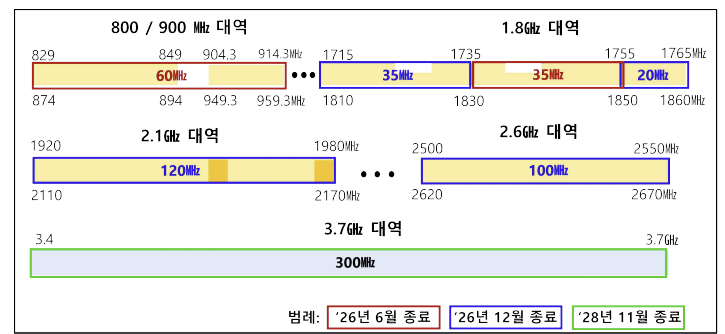
The government will promote reallocation of frequencies whose usage periods expire. The usage periods for 3G (20 MHz) and 4G (350 MHz) of the three mobile carriers will end in 2026, and 5G (300 MHz) in 2028. Considering the usage status at the end of the period, demand from communication operators, and the necessity of broadband supply, the government will review whether to reallocate all or partially terminate some bands.
3G frequencies may be terminated early before the reallocation period, and even upon reallocation, flexible usage periods or conversion to 4G or higher technology methods will be considered. Detailed reallocation plans for 3G and 4G will be established and announced by June next year, and for 5G by November 2027. The Ministry of Science and ICT will also pursue new acquisition of mobile communication frequencies previously used for other purposes (up to 378 MHz).
Additional allocation of 5G band frequencies will also be reviewed. The 5G frequency band above 3.7 GHz, which SKT had hoped for, will be supplied as broadband rather than partially (20 MHz). SKT had requested an additional 20 MHz allocation, raising fairness issues after LG Uplus received the 3.4?3.42 GHz (20 MHz) band in July 2022, but recently, with increased investment in artificial intelligence (AI), their demand intention has changed. Nam Young-jun, Head of the Frequency Policy Division at the Ministry of Science and ICT, said, "We will consider ensuring that the high utilization value of broadband is not compromised and that operators can competitively participate," adding, "There may be parts related to reallocation in connection with additional supply."
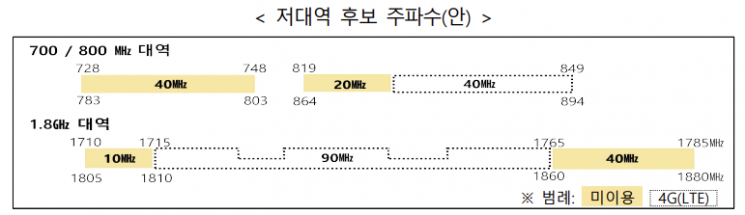
The necessity of additional allocation for the 3.5 GHz adjacent band and low-frequency bands will also be reviewed. Since there are no immediate issues such as traffic load, the decision on additional 5G frequency supply will be announced together with the 3G and 4G reallocation plans in June next year. Discussions are ongoing in a research group regarding the utilization plan for the 28 GHz band, which was scheduled to be supplied to the fourth mobile carrier.
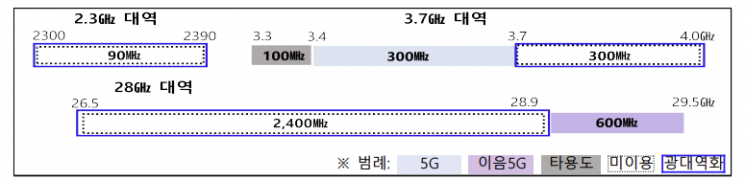
A total of 2790 MHz, including 3.70 GHz, has been secured as broadband frequencies, and the broadband expansion of 90 MHz of unallocated frequencies is also being reviewed. Using frequencies as broadband can improve efficiency and usage speed.
"Not Available in Other Countries" Opening Mobile Communication Frequencies to All Industries... Continuous 6G Research
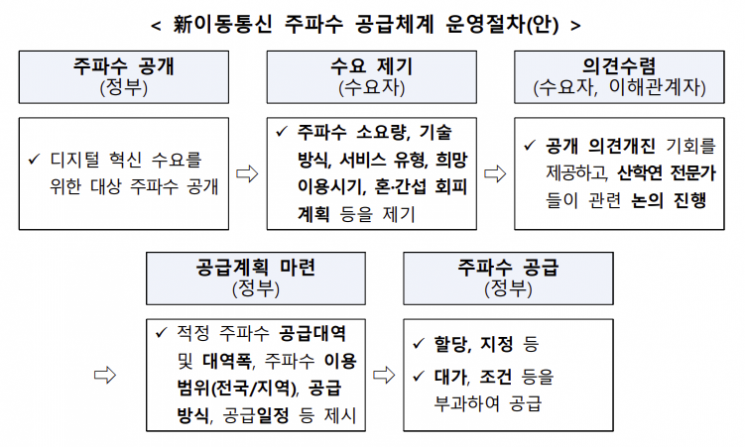
Mobile communication frequencies will be opened to all industrial sectors, shifting the frequency supply system to be demand-driven. When the government discloses frequencies for digital innovation demand, demanders publicly raise their needs. After expert discussions, the government prepares supply plans including supply methods and schedules, then supplies the frequencies. This will be piloted starting next year.
Mr. Nam explained, "When the government discloses available frequency bands, companies such as those in automobiles and robotics can also raise demands," adding, "Previously, the supply was a closed system centered on suppliers, but now it is being opened to allow proper and effective use of frequencies." He noted, "As far as I know, other countries do not have such a system."
With the approval of the 6G vision by the International Telecommunication Union (ITU), research on 6G candidate bands and technology standardization will be concretized through the WRC by 2027. The government plans to operate a WRC-27 preparatory research group to discover and study new bands identified at WRC-23 and existing communication bands favorable to the domestic industrial ecosystem, and to promote the selection of 6G candidate bands.
Full Effort to Support Growth of New Industries Such as UAM by Timely Frequency Supply
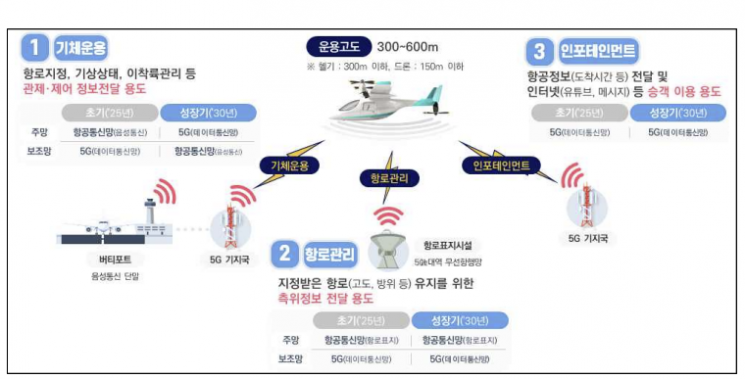
Timely frequency supply will support mobility innovations such as Urban Air Mobility (UAM) and autonomous ships. While major countries are developing aircraft and conducting experiments and demonstrations of related services for UAM, discussions on international standards and communication methods have not been concretized. The government will supply experimental and demonstration frequencies starting this year according to the K-UAM roadmap. To enable stable communication in ultra-spatial and disaster areas such as ships, the government will also support the activation of satellite communications. Before the activation of the low-earth orbit satellite communication market, the government is reviewing the expansion of 1000 MHz bandwidth available for satellite services. Additionally, plans include strengthening wireless infrastructure connectivity and expanding industrial and daily wireless services.
The government will also supply frequencies to strengthen disaster, safety, defense, and security. It plans to secure up to 40 MHz additional frequency for flood forecasting systems and prepare a supply and management system for ground-penetrating radar (GPR) frequencies below 6 GHz by 2027, anticipating the spread of GPR use for sinkhole detection and geological inspection. With the expected acceleration of defense unmanned system introduction due to troop reductions, the government will prepare joint civil-military frequency usage plans and consider discovering frequencies for defense unmanned systems. Activation of joint use of public frequencies will also be promoted.
Furthermore, to respond to diversified frequency demand, the government will improve the frequency utilization system. Starting in 2025, a simplified usage system will be introduced to improve the environment for services that temporarily use frequencies such as drones and wireless microphones. These services frequently change locations, making operation difficult under the existing system that assumes fixed usage locations. Due to the need to expand joint use of frequencies between public and private sectors, institutional improvements such as demand surveys, frequency selection, and user support will be pursued starting this year.
© The Asia Business Daily(www.asiae.co.kr). All rights reserved.
![Clutching a Stolen Dior Bag, Saying "I Hate Being Poor but Real"... The Grotesque Con of a "Human Knockoff" [Slate]](https://cwcontent.asiae.co.kr/asiaresize/183/2026021902243444107_1771435474.jpg)

















