1202 Electrical Fire Incidents in One Month
Increasing Risk Factors as Annual Power Demand Rises
The hotel room 810, believed to be the initial ignition point during the recent fire at a hotel in Bucheon, Gyeonggi Province that resulted in 19 casualties, was unoccupied at the time. Accordingly, the police and fire authorities, through joint inspection, consider electrical short circuits or air conditioner sparks in the vacant room as the most likely causes of the fire, rather than arson such as a cigarette ember.
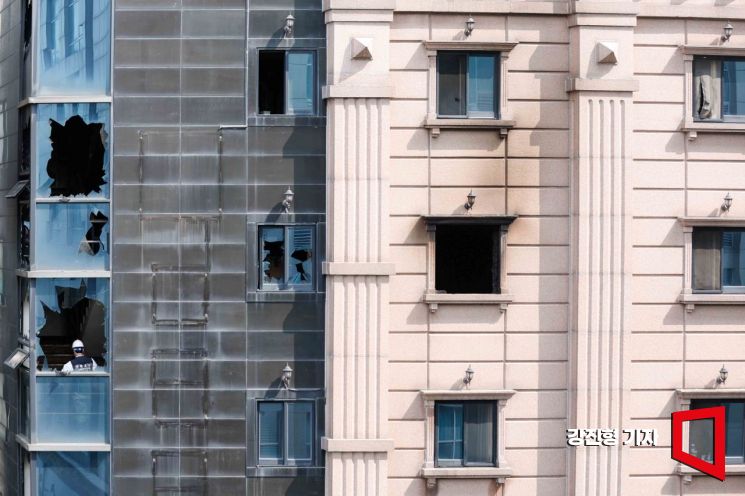 On the 23rd, the forensic investigation team is conducting an on-site inspection at the hotel fire scene in Bucheon, Gyeonggi Province. The fire started around 7:40 PM yesterday evening, resulting in 7 deaths, including guests, and 12 injuries. Photo by Jinhyung Kang aymsdream@
Fires caused by electrical factors have been recurring recently. The villa fire in Dongjak-gu, Seoul on the 27th of last month and the karaoke room fire in Buk-gu, Busan on the 29th were also suspected to have electrical causes. According to the National Fire Agency, out of 3,625 fires that occurred in the past month, 1,202 were due to electrical factors, accounting for the largest share at 36%. Specifically, unidentified short circuits, insulation deterioration, tracking, overload, and overcurrent constitute a high proportion of ignition causes.
The reason these fire damages continue is largely due to electrical leakage in home appliances caused by this summer's 'record-breaking heatwave.' When cooling devices such as air conditioners and fans operate for extended periods, poor contact with outlets or wires sticking together can cause short circuits and excessive current flow, leading to fires.
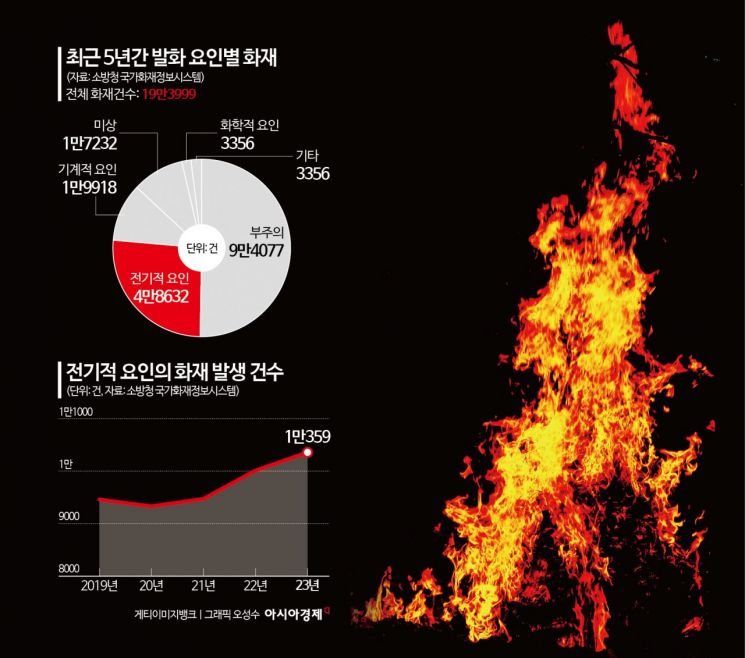
According to the National Fire Information System of the National Fire Agency, fires caused by electrical factors have exceeded 10,000 cases since 2022. Except for 2020, the trend has generally been increasing. Over the past five years, a total of 40,837 fires have occurred, resulting in 1,641 casualties. This accounts for 23% of all fires, making it the second most common cause after 'carelessness.'
As annual electricity demand increases, the risk of fires due to electrical factors has naturally risen. Professor Lee Young-joo of the Department of Fire and Disaster Prevention at Kyungil University explained, "Electronic devices are used at all times and places, and with the recent surge in electricity demand, fires are occurring more frequently. Especially, as more electronic devices use high-capacity energy compared to the past, the risk factors have increased."
Besides mobile devices and heating/cooling appliances, many high-capacity energy users such as electric kickboards and electric vehicles have become common. On the 13th of last month, a fire broke out while charging an electric kickboard at a restaurant in Wonju, Gangwon Province. This incident was also caused by electrical factors such as overload.
Experts emphasize the need to regularly inspect unseen parts in daily life, such as outlets and circuit breakers, to prevent fires caused by electrical factors. They particularly stress the importance of personally verifying safety when purchasing products.
Professor Lee Seung-joo of the Department of Fire and Disaster Prevention at Open Cyber University analyzed, "People tend to replace appliances or home environments with better ones when inconvenient, but they often hesitate to spend money on replacing unseen facilities. Since leakage and overcurrent circuit breakers have lifespans, it is necessary to inspect and replace them over time."
Professor Lee Young-joo also said, "By avoiding exposure to water or strong impacts while using various electronic devices daily, fires caused by internal faults or abnormalities can be easily prevented. Also, users who frequently charge high-capacity energy devices will be much safer if they use outlets equipped with safety circuit breakers."
© The Asia Business Daily(www.asiae.co.kr). All rights reserved.
![Clutching a Stolen Dior Bag, Saying "I Hate Being Poor but Real"... The Grotesque Con of a "Human Knockoff" [Slate]](https://cwcontent.asiae.co.kr/asiaresize/183/2026021902243444107_1771435474.jpg)
















